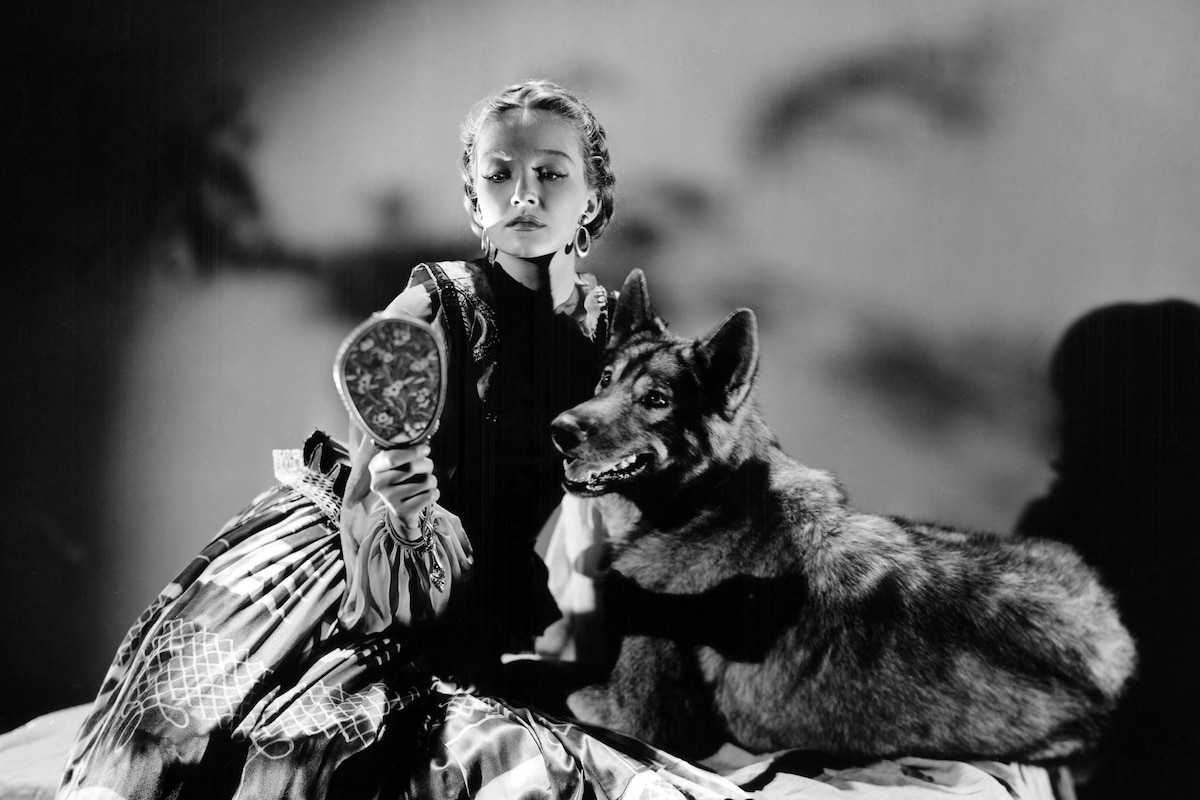
With Universal still cashing in on the success of its seminal spookshows Dracula (1931), Frankenstein (1931), The Mummy (1932), The Invisible Man (1933) and The Wolf Man (1941) via a parade of sequels and crossovers that continued into the mid-Forties, Columbia Pictures made a belated bid to siphon off some of that box office with a clutch of Universal-like horror product. The success of The Return of the Vampire (1944), which starred Bela Lugosi as a 18th Century bloodsucker revived in London during the Blitzkrieg, prompted a like-minded follow-up. Produced modestly and without Lugosi's arguable star wattage, Cry of the Werewolf (1944) was intended as a vehicle for Columbia starlet Nina Foch, who had played the ingénue in The Return of the Vampire but was given this time a role of slightly more depth - that of a young woman burdened with a gypsy curse that condemns her to the waking nightmare of life as a lycanthrope.
Cry of the Werewolf had been intended as a direct sequel to The Return of the Vampire and bore the preproduction title Bride of the Vampire. By the time cameras rolled on May 8, 1944, the script by Griffin Jay (who had written a couple of Universal's Mummy sequels) and Charles O'Neal (fresh from penning the Val Lewton-produced The Seventh Victim [1943] at RKO) had swapped out the vampirism angle in favor of werewolfery and a trick or two cadged from Jacques Tourneur's Cat People (1942) and John Brahm's The Undying Monster (1942). Production wrapped up a day shy of three weeks with former dialogue director Henry Levin at the helm and Scarface (1932) cinematographer L. William O'Connell cloaking the proceedings in an appropriate scrim of menacing shadow. Appearing in supporting roles were Stephen Crane, then-husband of Lana Turner, and stage actress Blanche Yurka, who had played Gertrude to John Barrymore's Hamlet on Broadway in 1923.
Cry of the Werewolf had its premiere in New York in early August 1944 before being sent into theaters on its own. A critical pincushion and not nearly the money-maker that The Return of the Vampire had been, the film was swiftly withdrawn from circulation and repackaged by Columbia with Will Jason's The Soul of a Monster (1944) as the "Supernatural Double Horror Show." The bargain basement two-fer promised moviegoers that they would experience "Two Queens of Horror Explode a Double Dose of TNTerror in Your Heart." Although Cry of the Werewolf had been nobody's idea of a cash cow, Universal tendered the similar She-Wolf of London (1946) only two years later; that film's failure to generate even modest box office helped to kill the almost twenty year horror craze for good.
Born in Holland in 1924, the daughter of composer Dirk Fock and showgirl Consuelo Flowerton, Foch had pointed herself initially to careers as a painter and concert pianist. Finishing her high school equivalency at an early age and too young to proceed to college, Foch studied instead at New York's American Academy of Dramatic Arts before signing with Warner Brothers and heading to Hollywood. She made her film debut in the Warners two-reeler Wagon Wheels West (1943) before shifting allegiance to Columbia. Cry of the Werewolf did little for Foch's career, which enjoyed an uptake after her success on Broadway in 1947 in Joshua Logan's production of John Loves Mary. Back in Hollywood, she enjoyed quality roles in such films as An American in Paris (1951), Executive Suite (1954), The Ten Commandments (1956) and Spartacus (1960) and a career as a character actress and acting teacher that extended right up to her death from a blood disorder in December 2008.
Producer: Wallace MacDonald
Director: Henry Levin
Screenplay: Griffin Jay (story and screenplay); Charles O'Neal (screenplay)
Cinematography: L.W. O'Connell
Art Direction: Lionel Banks, George Brooks
Film Editing: Reg Browne
Cast: Nina Foch (Marie Latour), Stephen Crane (Robert 'Bob' Morris), Osa Massen (Elsa Chauvet), Blanche Yurka (Bianca), Barton MacLane (Lt. Barry Lane), Ivan Triesault (Jan Spavero), John Abbott (Peter Althius), Fred Graff (Pinkie), John Tyrrell (Mac), Robert Williams (Homer).
BW-63m.
by Richard Harland Smith
Sources:
Nina Foch interview by Danny Savello, Scarlet Street No. 33, 1999
Nina Foch interview by Jim Bawden, 1988
American Gothic: Sixty Years of Horror Cinema by Jonathan Rigby (Reynolds & Hearn, Ltd., 2007)
Cry of The Werewolf
by Richard Harland Smith | August 11, 2011
SIGN UP FOR OUR NEWSLETTERS

CONNECT WITH TCM