At long last, Park Row (1952) is available on DVD. This fantastic Sam Fuller production was
worthy of a Criterion release with many bells and whistles, or at least a mainstream studio pressing,
but movie lovers will have to be content with the new burn-on-demand release from MGM Limited
Edition. And they will be, for the movie itself looks sharp and clean -- and in the end, the movie
itself is what really counts.
It's easy to see why this was one of Fuller's favorites of his own films and is also a favorite of
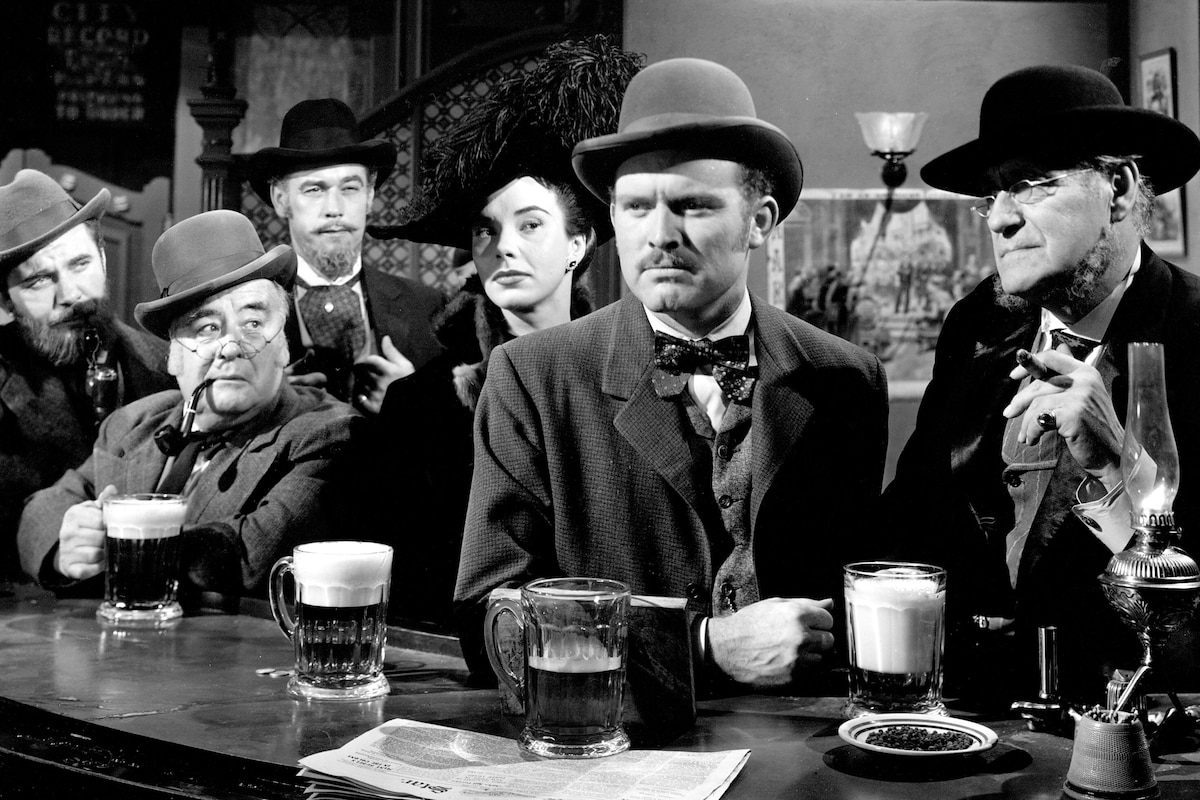
many of his fans. Certainly it's Fuller's most personal work. It's a period newspaper noir, set in
1886 and chronicling the formation of a new (fictional) paper on lower Manhattan's famed Park Row,
and the warfare that develops between it and a rival paper. Along the way, various current events of
the day are cleverly worked into the plot, including Steve Brodie's jump from the Brooklyn Bridge,
the invention of the linotype machine, and references to the new Statue of Liberty, which has been
received from France in pieces but has yet to be assembled on Bedloe's Island (as it was then known).
Most of all, Fuller's own personal passion for newspapers and freedom of the press and fair play
imbues almost every frame of Park Row. Since Fuller was a former newspaperman himself, Park
Row represents a perfect match of subject and artist.
Fuller, of course, was also famously a combat veteran of WWII, and his forceful, blunt approach with
the camera made virtually all of his movies "war movies" -- whether or not they were set in actual
combat. Park Row is no exception. Words and ideas replace guns and ammunition. Gene Evans
tears through the film like a focused soldier determined to fulfill his mission, and Fuller finds
visual ways to get his audience to feel this energy. This ranges from breathtaking, long tracking
shots through New York streets as we follow along Evans, to simple dialogue scenes in a room, which
Fuller makes forceful and dynamic through staging that has Evans lurch into the extreme foreground of
the frame as he makes a verbal point. Fuller was a master of making the most of limited circumstances
and also of translating into visual terms the powerful emotions of his yarns.
In the film, Evans plays Phineas Mitchell, a newly unemployed newspaperman who dreams of starting his
own paper and running it with integrity -- "without the support of any political machine." An
investor with a steam press likes Mitchell and gives him seed money to start just such a paper, which
Mitchell christens The Globe. In short order Mitchell assembles a small staff, gets some
butcher paper for his first issues, arranges for a horse-drawn wagon to deliver the paper, and
manufactures his first headline-grabbing story by giving up the bridge-jumping Steve Brodie to the
police and starting a drive -- in print -- to have him freed. This gets him attention not only from
readers but from Charity Hackett, editor of The Star, and she doesn't take kindly to her
circulation being affected by young upstarts. A war breaks out between the two papers even as the two
editors find a mutual attraction developing between them personally. In true Fuller style, however,
there's no question that the cigar-chomping Mitchell will choose his paper over romance any day of
the week.
Eventually Mitchell starts a fund drive to raise money for the creation of a pedestal for the Statue
of Liberty, which has been sent over from France but is resting in pieces on display around the city.
(This is in fact exactly what happened in the 1880s after France sent the statue over.) Mitchell
decrees that every donor of any amount of money, no matter how small, will get his or her name
published in the Globe. This, too, is drawn from fact, though in reality it was Joseph
Pulitzer who spearheaded the pedestal drive, getting micro-donations from readers of his New York
World (most less than a dollar), and publishing the names of all donors. Names like Joseph
Pulitzer and Horace Greeley, by the way, are uttered in Park Row with awe and reverence.
Fuller absolutely cherished these crusading, patriotic newspapermen of the time.
Fuller later wrote in his memoir that when Darryl Zanuck expressed interest in making Park Row
as a 'Scope Technicolor musical, Fuller decided to finance the film with $200,00 of his own money and
make it "a personal gift to American journalism."
Standouts among the rest of the cast include Mary Welch as Charity Hackett. This was stage actress
Welch's first and only feature film; she died during childbirth a few years later, at age 36.
Longtime silent and talkie actor Herbert Heyes wonderfully plays Josiah Davenport, the elderly, wise
reporter who ends up writing his own obituary, which Mitchell reads in a memorable scene that
contains some of Fuller's most heartfelt, poignant writing. And Bela Kovacs plays Ottmar
Mergenthaler, the inventor of the linotype machine, something Fuller recreates in this picture.
Mergenthaler really was living in the U.S. in 1886 when he invented the device.
Park Row was more than Fuller's gift to American journalism. It remains an extraordinary gift
to all moviegoers and is highly recommended.
To order Park Row, go to
TCM Shopping.
by Jeremy Arnold
Park Row - Sam Fuller's PARK ROW on DVD
by Jeremy Arnold | June 27, 2011
SIGN UP FOR OUR NEWSLETTERS

CONNECT WITH TCM