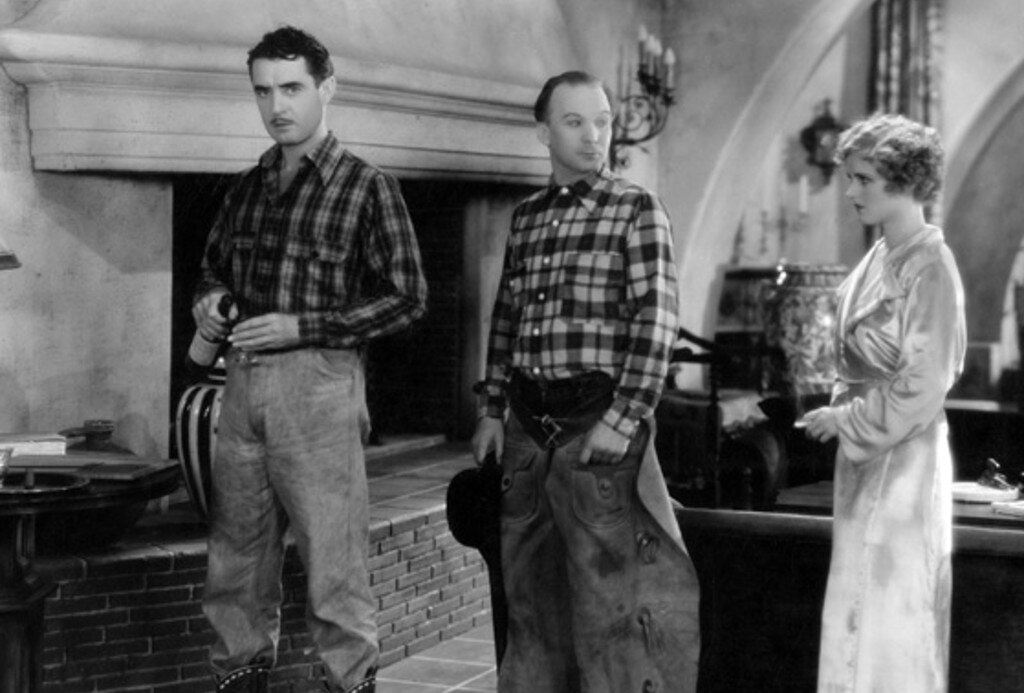
West of Broadway (1931) is a movie caught between two worlds: In 1931, talking pictures were just a few years old, and the morality restrictions instituted by the Motion Picture Code -- more commonly called the Hays Code -- wouldn't be strictly enforced until 1934. And so in West of Broadway we have John Gilbert, an actor whose career would be killed by talkies, starring as a thoroughly unlikeable but ultimately redeemed alcoholic, who spontaneously marries gold-digger Lois Moran one drunken evening, only to try to buy himself out of the marriage the next day. West of Broadway, directed by Harry Beaumont, is the product of a transitional time in Hollywood, an era when both technology and the studios' attitudes toward what audiences should and shouldn't be allowed to see were rapidly changing.
When we first meet Gilbert's Jerry Seevers, he's springing himself from a military hospital, with the help of his right-hand man, Swede (El Brendel). He's anxious to get back to his fiancée in New York, not realizing she's jilted him for another guy. To get back at her, he proposes to Dot (Moran), a low-class but extraordinarily principled tootsie. Dot thinks he's joking, but fueled by alcohol, he insists on going through with the marriage that night. The next day he tries to dispose of her, but she's already fallen in love with him and realizes he needs her help to straighten out. He tries to escape to his Arizona ranch, but she follows him, and there she's befriended by the polite, stalwart ranch foreman, Mac (Ralph Bellamy), who ultimately plays a role in changing Jerry's mind about his straight-talking, not-so-blushing bride.
West of Broadway brings together three actors whose careers would, in just a few years, veer in radically different directions. This was Bellamy's third film, and perhaps represented a tryout of sorts to see if he had what it took to be a leading man. Though this tall, sturdy, agreeable actor never became A-list leading-man material, he did become the go-to actor for certain types of supporting roles, most notably the suitor who doesn't quite get the girl. (He received an Academy Award nomination for playing just such a role in Leo McCarey's 1937 The Awful Truth.) Moran had appeared, to great acclaim, as Laurel Dallas in the 1925 Stella Dallas, though her real claim to fame may have been as the inspiration for Rosemary Hoyt in F. Scott Fitzgerald's Tender Is the Night. West of Broadway was her last full-length film; in 1935 she would marry Clarence M. Young, the Assistant Secretary of Commerce, leaving Hollywood movies behind for good.
But it was Gilbert, perhaps, who had the most to lose at the time West of Broadway was made. As Bellamy wrote in his 1979 autobiography When the Smoke Hit the Fan, Gilbert -- who, in 1928, had been one of the highest-paid stars in Hollywood -- had just signed a costly two-year contract with MGM. But his voice, as it was recorded for early talkies, was too thin and reedy to be appealing. "They tried to get him to terminate the contract, but he wouldn't," Bellamy writes. "They put him in mediocre pictures, hoping he'd refuse to appear and thus break the contract, but he didn't." Gilbert was determined to make the successful transition into talkies, or at least to keep the money rolling in. During the shooting of West of Broadway, he told Bellamy, "I'll work out the contract cleaning spittoons, if they make me, for that kind of money."
As film historian Kevin Brownlow (who himself received an honorary Oscar® last year) points out in his study of the last years of silent film The Parade's Gone By..., there was nothing at all wrong with Gilbert's voice. Early sound recording made voices sound an octave or two higher than they really were; that meant baritones were particularly well-suited to early talking pictures, simply because of the technology's limitations at the time. According to Brownlow, Gilbert's "normal speaking voice was a pleasant tenor, which was eventually recorded properly, too late to save his foundering career, in Queen Christina (1933)."
Aside from the fact that Gilbert doesn't sound unusually squeaky in West of Broadway, he brings details and shading to his performance that suggests his career could have lasted much longer than it did. The day after his hasty marriage to Dot, Jerry appears before her to cajole her into agreeing to a divorce, and his hands, his head, his whole body are quivering visibly -- the character is clearly suffering from the DTs, and in this brief period of pre-Code tolerance, Gilbert was free to portray that. The character he plays here is bitter and disagreeable, particularly in comparison to Dot's soft, yielding, generosity. But in this particular scene, Jerry's shakiness betrays his vulnerability. It's the sort of unspoken detail that great actors of the silent era, like Gilbert, excelled at. Gilbert died in 1936, at age 38, and in The Parade's Gone By..., Brownlow echoes Bellamy's contention that the actor was undone by studio politics. He noted that Gilbert's contemporary, Louise Brooks, considered the failure of the actor's career to be "a deliberate act of sabotage" on the part of MGM. West of Broadway couldn't revive Gilbert's career. But it's proof, at least, that he didn't go down without a fight.
Director: Harry Beaumont
Screenplay: Ralph Graves, Bess Meredyth, Gene Markey
Cinematography: Merritt B. Gerstad
Editing: George Hively
Art Direction: Cedric Gibbons
Cast: John Gilbert (Jerry Seevers), El Brendel (Axel 'Swede' Axelson), Lois Moran (Dot), Madge Evans (Anne), Ralph Bellamy (Mac), Frank Conroy (Judge Barham), Hedda Hopper (Mrs. Edith Trent).
BW-67m.
by Stephanie Zacharek
(Stephanie is the chief movie critic for Movieline - www.movieline.com)
Sources:
Ralph Bellamy, When the Smoke Hit the Fan, Doubleday, 1979
Kevin Brownlow, The Parade's Gone By, University of California Press, 1968
IMDb
West of Broadway
by Stephanie Zacharek | June 16, 2011
SIGN UP FOR OUR NEWSLETTERS

CONNECT WITH TCM