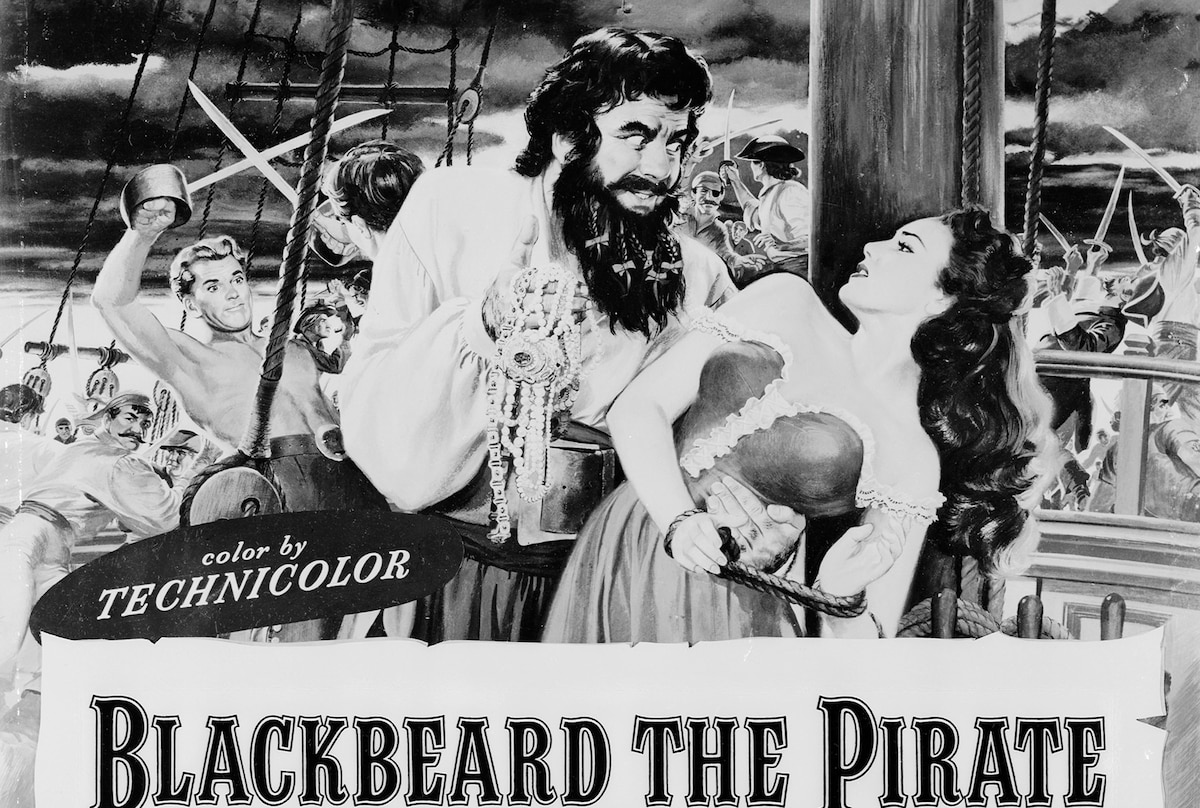
Like many other genres, swashbuckling adventures popularized by the likes of Errol Flynn were largely put on hold in Hollywood with the eruption of World War II, resulting in only odd hybrids like the 1948 MGM musical, The Pirate. However, 1950 saw a sudden resurgence with no less than seven pirate movies unleashed on moviegoers, most prominently with Disney's Treasure Island. Soon the '50s transformed into the busiest decade ever for screen buccaneers, and no film better represents the apex of this trend than 1952's Blackbeard the Pirate.
Lensed in vivid Technicolor and written by Alan Le May (a western writer who also penned the source novel for The Searchers, 1956), the film stars Linda Darnell as Edwina Mansfield, a well-bred society lady with a particularly shady past abducted by the crass Blackbeard (Robert Newton). Her possible salvation lies with Robert Maynard (Keith Andes), an innocent civilian along for the ride posing as a surgeon to prove that a powerful Jamaican magistrate also has a history of piracy.
Best known as a contract actress with 20th Century Fox from 1939 to 1952, the raven-haired Linda Darnell rose to fame during her first year with the studio in Star Dust and appeared opposite Tyrone Power in Brigham Young (1940), The Mark of Zorro (1940), and Blood and Sand (1941); she was also cast opposite him in Captain from Castile (1947) but was replaced by Jean Peters. Her tumultuous career at Fox was often unsatisfying for both the actress and her directors, but she did star in a quartet of bona fide classics: Hangover Square (1945) for John Brahm, Forever Amber (1947) for Otto Preminger (with whom she also worked on the solid film noir, Fallen Angel in 1945), Unfaithfully Yours (1948) for Preston Sturges, and A Letter to Three Wives (1949) for Joseph L. Mankiewicz. However, the 1950s proved less kind as, after appearing in No Way Out (1950) for Mankiewicz and The 13th Letter (1951) for Preminger, she was released from her contract and, not lured by the arrival of television, sought work in overseas productions. RKO hired her for Blackbeard the Pirate before she was to leave for a pair of productions in Italy, though the production ran so far over schedule she nearly lost those subsequent roles. A string of personal and romantic difficulties plagued her for many years, and she died tragically at the age of 41 on April 10, 1965, due to injuries sustained during a house fire.
Darnell's main male co-star in the film had already proven his swashbuckling mettle; in fact, English actor Robert Newton had stolen Walt Disney's 1950 version of Treasure Island in perhaps the screen's most indelible pirate role as Long John Silver, a role he reprised in a 1954 Australian film and a single-season 1955 television series. Character roles and volatile villains were his specialty, including memorable turns as Bill Sikes in David Lean's film of Oliver Twist (1948) and Inspector Javert in Les Misérables (1952), as well as a stellar sinister turn in the underrated 1949 Edward Dmytryk thriller, Obsession. His final film was Around the World in Eighty Days (1956) as Inspector Fix, and like Darnell, he died far too young at 51 in 1956.
By comparison, the other male lead in Blackbeard the Pirate had little scenery left to chew. A relative newcomer, Keith Andes had his first significant role in Fritz Lang's acclaimed noir film Clash by Night (1952). His subsequent career consisted primarily of character roles, most notably in John Farrow's Back from Eternity (1956) in which he co-starred with Lucille Ball, with whom he would subsequently appear on television several times.
The boisterous music for Blackbeard the Pirate was composed by Hollywood veteran Victor Young (who posthumously won his only Academy Award for his reunion of sorts with Newton, Around the World in Eighty Days). A wildly prolific composer, he had been working since the mid-1930s with credits including The Glass Key (1942), For Whom the Bell Tolls (1943), The Uninvited (1944) (which spawned the popular song "Stella by Starlight"), and Shane (1953). The same year as Blackbeard the Pirate, he composed the scores for seven other films including Scaramouche and The Quiet Man.
Also notably prolific was the film's director, Raoul Walsh, who began his career with silent shorts in 1913 and remained in the director's chair until 1964. An occasional actor as well, he is best remember in front of the camera in an uncredited but memorable turn as John Wilkes Booth in The Birth of a Nation (1915) for D.W. Griffith, for whom he also worked as an assistant. He had also had experience with high seas adventure one year before Blackbeard the Pirate with Captain Horatio Hornblower, and he was best known for his tough, masculine adventures and thrillers like They Drive by Night (1940), High Sierra (1941), They Died with Their Boots On (1941), and White Heat (1949). He is also remembered both for introducing moviegoers to John Wayne in the ambitious early widescreen film The Big Trail (1930) and for losing his right eye in 1928 during the making of In Old Arizona when a rabbit struck the windshield of his car. Interestingly, his pirate anti-hero in this film does not come equipped with an eye patch.
Producer: Edmund Grainger
Director: Raoul Walsh
Screenplay: Alan LeMay; DeVallon Scott (story)
Cinematography: William E. Snyder
Art Direction: Albert S. D'Agostino, Jack Okey
Music: Victor Young
Film Editing: Ralph Dawson
Cast: Robert Newton (Edward Teach/Blackbeard), Linda Darnell (Edwina Mansfield), William Bendix (Ben Worley), Keith Andes (Robert Maynard), Torin Thatcher (Sir Henry Morgan), Irene Ryan (Alvina, a lady in waiting), Alan Mowbray (Noll), Richard Egan (Briggs), Skelton Knaggs (Gilly), Dick Wessel (Dutchman).
C-99m.
by Nathaniel Thompson
Blackbeard the Pirate
by Nathaniel Thompson | May 16, 2011
SIGN UP FOR OUR NEWSLETTERS

CONNECT WITH TCM