It's been a unspoken tenet of world cinema auteur worship that the film directors who persist with a single style or
voice or theme are preferable - admirable, obsessively cool, pure-hearted and cult-worthy - than filmmakers who wildly
vary their approach and/or subjects. Louis Malle, for example, never enjoyed the unalloyed ardor of cinephiles the way
fellow French New Wavers Jean-Luc Godard, Jacques Rivette and Eric Rohmer did. While they relentlessly, and often
abstrusely, followed their singular visions, Malle tried virtually everything under the son - scandalous rom-com,
gritty '60s art film, anthropological documentary, Chekhov stagecraft, experimental American indie, quirky Tati-like
Parisian farce, autobiographical WWII dramas, you name it. From the beginning, Malle was up for anything, exuding more
of the air of a moviehead bon vivant than a serious artiste, and equally famous for his array of marriages and
liaisons. This kind of approach to moviemaking is not uncommon, and allows in any lengthy career elbow-room for a few
masterpieces - as are, for Malle, Au Revoir Les Enfants (1987) and, arguably, 1974's Lacombe, Lucien.
Black Moon (1975) has never been on that list, even for Malle fans who stump for the controversial achievements
of Murmur of the Heart (1971) and My Dinner with Andre (1981). A long-unseen product of the lingering
Art Film epoch, now brought to DVD by Criterion, Black Moon is a freak in the Malle filmography - the man's
only pan-European, proto-Surrealist-Freudian dream-film, with dollops of tangy dystopian sci-fi satire and Bergmanic
identity crisis dropped in like sour cream. As a film of its day, however, it's lovably archetypal, sharing crazy
style impulses and narrative impishness with the contemporaneous films of Luis Bunuel, Alejandro Jodorowsky, Harry
Kumel, Pier Paolo Pasolini and Roman Polanski, not to mention Jaromil Jires's Valerie and Her Week of Wonders
(1970) and Jean-Luc Godard's Weekend (1967). Perhaps this is a large reason why in 1975 the film was so
abjectly dismissed; Pauline Kael (always the go-to blabbermouthed voice of doom in those days, and the one most easily
consulted today) condemned it as "witless" and "deadly." Her biggest point is sound - Malle tries with Black
Moon to make a hallucinatory genius's film, a vision ostensibly bursting spontaneously from a unique, and even
drug-addled, consciousness. But Malle is a sensible man, with earthly, easily grasped priorities, and the two tastes
simply do not go well together.
Nearly half a century later, however, we're free of a weekly reviewer's narrow, short-term, zeitgeist-framed
perspective, and in today's light Black Moon is a bizarre artifact of a freer, seemingly utopian cinematic age,
when filmmakers trusted viewers to appreciate an experiment's zest and desire, and not worry too much about its
results. Set in a fantasy-future Europe where the landscape has been ravaged by armed combat between the sexes,
Malle's movie seems at first to be squaring off as a feminist (Malle was always interested in sexual exploitation as a
social problem, but he also often seemed just as interested in undressing his actresses). The rebel guerrilla forces
we see are all gorgeous women, captured and executed by an army of men, but this dynamic falls by the wayside, to some
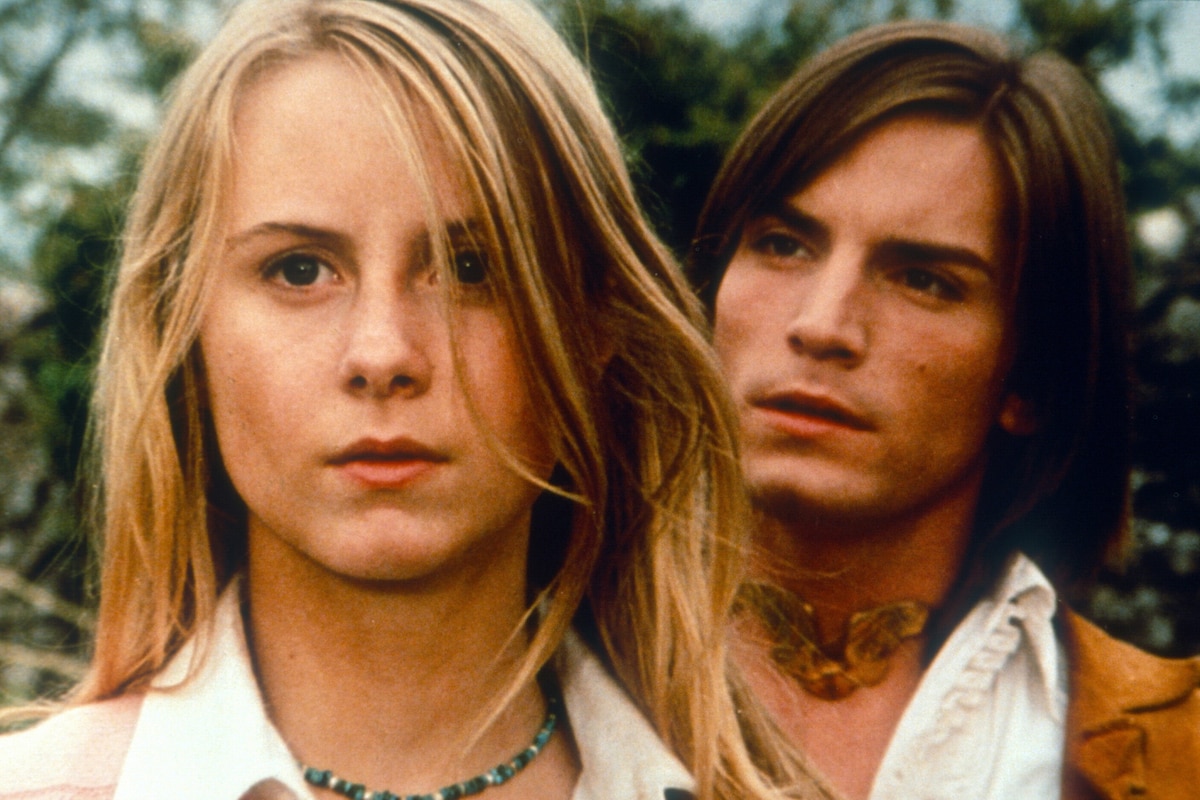
degree, as we follow escapee Lily (Cathryn Harrison) through the rural chaos, and to a seedy estate overheated with
its own familial madnesses. The world of the film is, significantly or not, overrun with wildlife, from the first
road-busy badger (quickly smushed) to legions of millipedes, sheep, roaches, turkeys, and even a Shetland unicorn that
eventually speaks. A tribe of naked children are relentlessly chasing down a huge sow through the undergrowth. And so
on.
Irrationality is the watchword. In the house a brother-sister pair of exchangeable, androgynous identical twins (Malle
squeeze Alexandra Stewart and Warhol bad-boy Joe Dallesandro), who catatonically live out an ambiguous meta-sexual,
semi-parental relationship with each other and with "the old lady" (Therese Giehse), a bedridden octogenarian who, at
one point, is breast-fed by Stewart's ghostly dominatrix. A can-do Alice not so much lost in this particular,
symbol-ridden Wonderland as willfully exploring it for curiosity's sake, Lily takes it all in stride, looking for
answers but engaging in the absurdities as a child engages in a let's-pretend play scenario. As should we - the film
is rich in metaphoric possibilities, but its position toward the abstractly suggested sexual awakening of its heroine
is exultant and frivolous, not analytical, and in this sense Black Moon seems to comprise a sister-film of
Jires's Valerie, together a misty diptych of pubertal dizziness and zonked hormonal dreams.
Nobody makes films like this anymore, this whimsically risky. Malle certainly never did again, wherever his
peregrinations took him. All of 15, Harrison, Rex's granddaughter, doesn't act very much and isn't given much of a
chance, but she's pure moviestuff - blonde, willowy and placid in the way that makes responsible men grow half-lidded
and slackjawed. (Endearingly, her pimples come and go, scene to scene.) She's just one of the film's sensual affects;
Malle is interested only in textures and disjunctures, images and vibes, and the film is rather beautiful in its silly
inventiveness. Photographed by the legendary Sven Nykvist, shot entirely on Malle's estate in southern France, and
released in dubbed English, Black Moon comes to video with only a few Criterion-grade supplements, including an
alternate French soundtrack, an oddly dry essay by Ginette Vincendeau, and an old TV interview with Malle, in which he
enjoys trying to attach lofty meaning to the film's nonsequiturs.
For more information about Black Moon, visit The Criterion Collection. To order Black Moon, go to
TCM
Shopping.
by Michael Atkinson
Black Moon - Unlike Any Louis Malle Film You've Ever Seen Before!
by Michael Atkinson | April 23, 2011
SIGN UP FOR OUR NEWSLETTERS

CONNECT WITH TCM