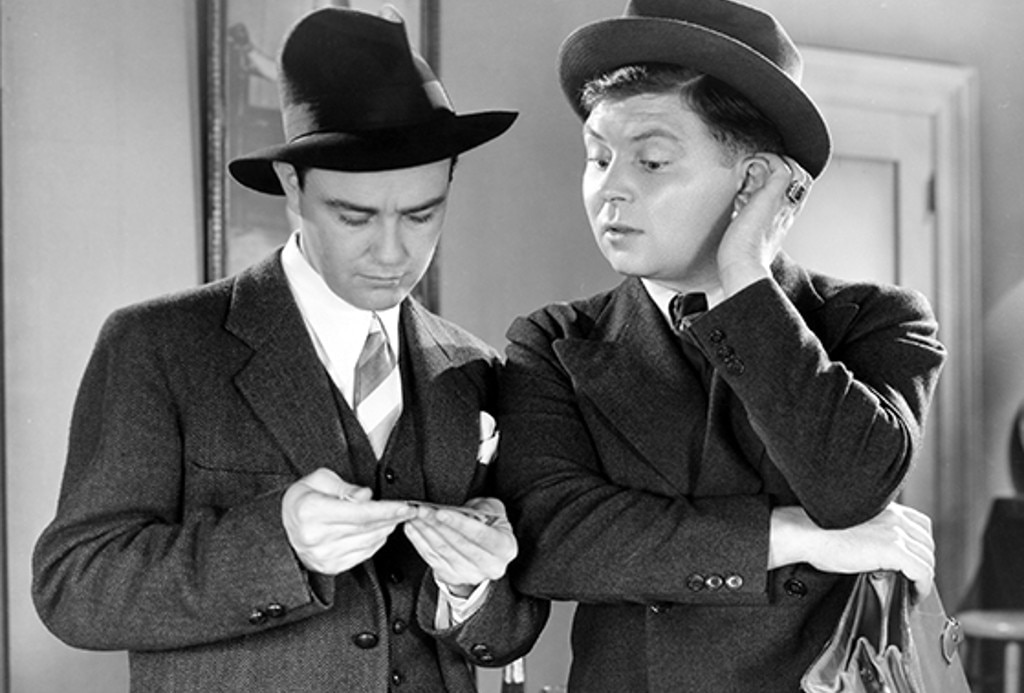
In Panic on the Air (1936), a radio sports reporter (Lew Ayres) stumbles into a murder mystery while trying to find out why a Detroit pitcher didn't take the mound against the Giants, allowing the Giants to win the world series. The film was a Columbia "programmer," a shorter, cheaper movie that fell somewhere between the studio's "A" pictures and low-budget "B"s, but in spite of its humble pedigree Panic on the Air is a lively film that boasts some intriguing credits.
Star Lew Ayres had begun his film career impressively, playing opposite Greta Garbo in MGM's The Kiss in 1929, and following that with his unforgettable performance in Universal's Academy Award-winning anti-war drama, All Quiet on the Western Front (1930). But Universal did not capitalize on the acclaim he received for his portrayal of a young soldier, and cast him in inconsequential films. After his Universal contract ended in 1934, Ayres made several mostly lackluster films at Fox and Paramount. The same year he appeared in Panic on the Air at Columbia, he also agreed to act in two films at the Poverty Row studio Republic (The Leathernecks Have Landed [1936] and King of the Newsboys [1938]), so he could direct one film - the Civil War naval drama, Hearts in Bondage (1936). 1938 proved to be a turning point for Ayres's career. He had one of his best roles in years, as Katharine Hepburn's alcoholic brother in Holiday, and he was signed by MGM and cast in the leading role of Young Doctor Kildare, the first of what became a popular film series.
The leading lady of Panic on the Air, Florence Rice, knew something about sports reporters--her father was Grantland Rice, the dean of American sportswriters of the 1920s and 30s. Florence Rice started her career on the New York stage in the early 1930s, and went to Hollywood in 1934. After working at Columbia for a couple of years, Rice, like Ayres, ended up at MGM, and while she had some good roles, she never broke out of the pack and made her last film in 1943.
Panic on the Air director D. Ross Lederman was an enormously prolific director of B-movies who broke into the film industry as an extra and stuntman for Mack Sennett's Keystone Kops series. He also worked as an assistant director for D.W. Griffith on Intolerance (1916) and worked his way up through the ranks to director, including directing several Rin Tin Tin films in the late 1920s. Panic on the Air was an adaptation of a story by Ted Tinsley published in the pulp magazine, Black Mask, and it was in the various pulp film genres--crime, westerns, adventure--that Lederman was increasingly making his mark in the 1930s. He earned a reputation for working quickly and efficiently, bringing his films in on schedule and under budget. At Warner Bros. in the 1940s, Lederman made a series of fast-paced, violent noir films such as Strange Alibi (1941) and Escape from Crime (1942) that have become cult favorites.
Lederman moved to television in the 1950s, working on action series for the Columbia TV subsidiary, Screen Gems, which was headed by his Panic on the Air producer, Ralph Cohn. The nephew of Columbia chief Harry Cohn, Cohn got into the family business as a teenager. Panic on the Air was his first producer credit, at the age of 21. For the next dozen years, Cohn cranked out b-movie serials such as the Boston Blackie and Lone Wolf mysteries. In 1949 he made Columbia the first major studio to get into television when he started Screen Gems to sell the studio's old films to TV, and eventually turned to television production.
When Panic on the Air opened in 1936, all these achievements still lay ahead for the cast, director, and producer. The film was just a modest little programmer with modest expectations. So New York Times critic John T. McManus's mild praise must have been a pleasant surprise: "Panic on the Air is the sort of vehicle that suits Lew Ayres, and, with Benny Baker's plaintiveness and Florence Rice looking nice and natural, the film is somewhat entertaining."
Director: D. Ross Lederman
Producer: Ralph Cohn
Screenplay: Harold Shumate, based on the story, "Five Spot" by Theodore S. Tinsley
Cinematography: Benjamin H. Kline
Editor: James Sweeney
Cast: Lew Ayres (Jerry Franklin), Florence Rice (Mary Connor), Benny Baker (Andy), Edwin Maxwell (Gordon), Charles C. Wilson (Fitzgerald), Murray Alper (Danker), Wyrley Birch (Major Bliss), Gene Morgan (Lefty Dugan).
BW-56m.
by Margarita Landazuri
Panic On the Air
by Margarita Landazuri | April 09, 2011
SIGN UP FOR OUR NEWSLETTERS

CONNECT WITH TCM