Trailing one of the 20th century's greatest filmmaking careers behind him - the films have been coming for almost 60 years, from shorts in the early '50s to the latest film in 2009 - Polish master Andrzej Wajda is not, in toto, an easy artist to pigeonhole. His 40+ films have varied stylistically, tangled with varying degrees of rage with Poland's postwar political messes, and aimed at ambivalent themes - hardly a recipe for auteurist neatness. Ironically, he's most famous still for the WWII "trilogy" of A Generation (1955), Kanal (1957) and Ashes and Diamonds (1958), his freshman launch overshadowing decades of work just as the first films of so many other directors, from Welles to Rossellini to Coppola. But Wajda has enjoyed a slippery, restless evolution since, and isn't that a notable achievement in and of itself? Film culture loves to sanctify the laser-focused, unwavering vision, and neglect the artist who changes and modulates and experiments over his or her career just as a person does as they mature in real life.
In any case, Wajda is in no danger of being sidelined by critical fashion; the leading figure of the Polish "new wave" - commonly called "the Polish Film School" - that came between, chronologically and aesthetically, the Italian neo-realists and the French New Wave, Wajda has always made films like a battlefield doctor takes pulses, and his films have always been startlingly of their moment, whether taking on the vagaries of life in a Communist state (1978's Without Anesthesia, etc.), the ambiguities of the Solidarnosc era (Man of Iron, from 1981), the new-millennium history-making stretching back to the war (2007's Katyn), and so on. Never, however, did Wajda make simple, preachy political films; his characters are always gray, never black or white, and the films' points of view are never simple or easily dissected. It's a surprise, then, that he has been so widely embraced internationally or that he won an honorary Oscar in 2000 (who'd have thought Academy members ever bothered to watch Polish films?), but Wajda also packed the jaunty energy and compositional eye of a born entertainer, and his films can be stunningly addictive, with an almost Hitchcockian eye for interesting locations and setups. If you're channel-prowling and happen on a Wajda film, you'll stop.
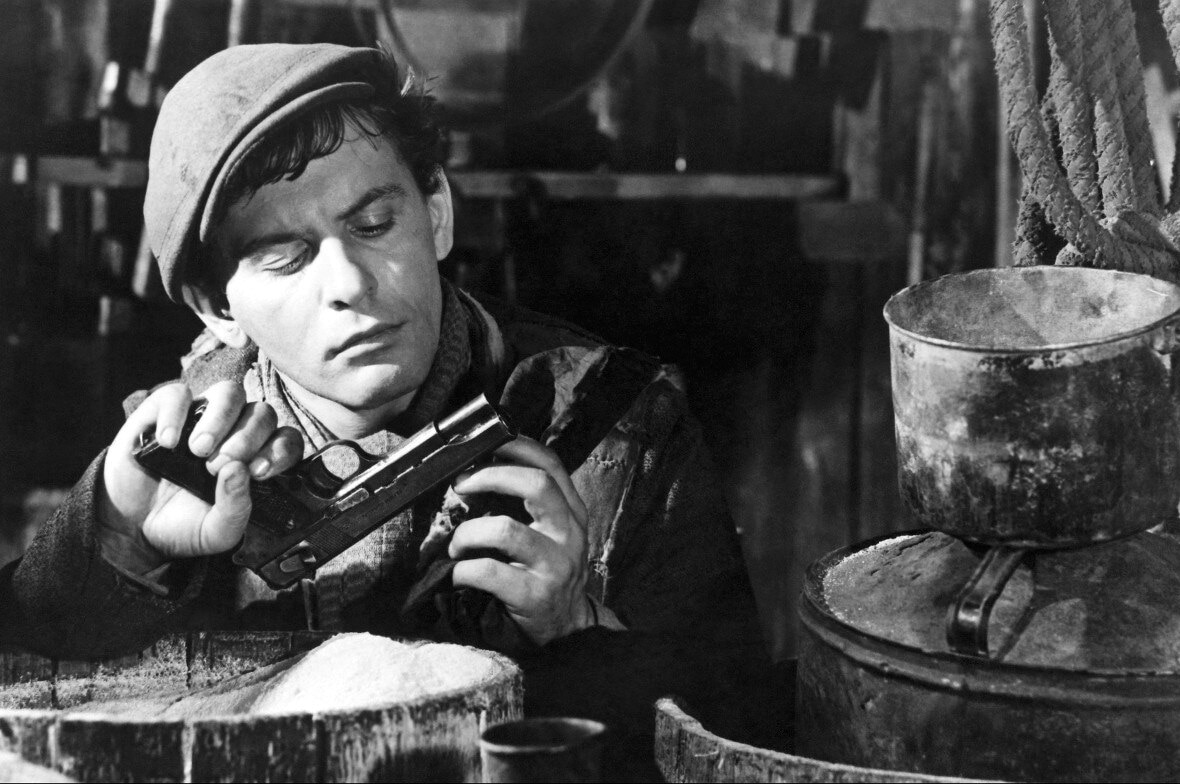
Had Wajda vanished in 1959, we'd still be talking about him - the WWII trilogy remains essential viewing, and I'd bet it always will be. If Ashes and Diamonds, a despairing portrait of earnest Resistance soldiers hunting down traitors and collaborators after WWII has officially ended, is about the gravitational grip of the past, and Kanal, a brutally evocative saga of Polish freedom fighters fleeing from the Nazis and getting lost in the excremental hell of the Warsaw sewers, is about a never-ending nightmare present, A Generation, Wajda's first film, is an elegy for a lost future. Orthodox in its story and staging relative to the other films, it's still a fluid, powerful and prickly film, set during the Nazi occupation but trained in on high-school-age punk Stach (Tadeusz Lomnicki), who quickly defects from his delinquency stage after a friend is shot by Germans while stealing coal from a moving train. Apolitical and snotty, Stach apprentices in a woodshop, only to find the place seething with black marketeering and Resistance skullduggery, all of which is of little interest to him until he's confronted with sky-eyed, apple-cheeked Dorota (Urszula Modrzynska), a beaming proselytizer for Communism and a lieutenant in the insurrectionary underground.
The absurd equation both characters are making here, linking the injustice of capitalism with the Nazi occupation itself, is as subtly gestured as a student's revolted squirm under the "kindly" grasp of a sermonizing priest. There's a good deal more - Wajda's narrative is thick with reverb and busy-ness, filled with animals and underground passages and disarming compositions (plus Roman Polanski in a prominent role as an upstart Resistance fighter), and dense with fascinating faces and subplots. Germans are not ubiquitous but doom is in the air. The fate of Stach's workshop colleague, who wants little to do with fighting and yet keeps stumbling into melees and mowing down Germans, seems proscribed particularly once he nervously endures a late-night visit of an old acquaintance running from the Warsaw Ghetto uprising, and it becomes quickly clear they had been lovers - a radical bump to install into a first film made in a Communist country in 1954. But A Generation is a very focused film, bristling with the new generational discontent its title implies.
Before the war, uppity and nihilistic youths in films were merely products of poverty and objects of rescue (think, in Hollywood, Dead End, 1937, and Boys Town, 1938), but after, in the U.S. as well as elsewhere, embittered teenagers like Stach became a touchstone for an entire rising section of humanity, hardened by their parents' war-making, emotionally mangled by the bloodshed and devastation, and hungry for freedom from conformity. These characters were suddenly everywhere, from James Dean's moody hipster to the rangy, self-knowing outlaws of Godard's 1960s movies, and they meant something. In Poland, Wajda had this number down before anyone - after Stach, he gave the Polish 16-to-25 set their own tragic-romantic modern hero, in the form of Zbigniew Cybulski, dashing his way fatalistically through Ashes and Diamonds, and then through the nation's cinema at large for most of the '60s until, like Dean, he died young, falling under a train in 1967.
There's one image among many where Wajda's purposes crystallize in A Generation - Stach and Dorota are introduced to each other in front of a church by a Communist friend, and in order to blend in, they hook arms as a couple and watch as a bridal procession passes inches in front of them - watching, in effect, the happy, normal life they'll never enjoy walk right by and disappear. Their fiery naïveté seems blunted in that moment, and though it's clear they don't quite understand what they're witnessing and what they're sacrificing, we do, just as Europeans in the mid-'50s certainly did. This is a kind of anti-war film we never get to make in America - not about the trials of soldiers sent into battle, but the fated carnage done to the young when the war happens in their own streets and schoolyards.
Director: Andrzej Wajda
Screenplay: Bohdan Czeszko (screenplay and novel)
Cinematography: Jerzy Lipman
Music: Andrzej Markowski
Film Editing: Czeslaw Raniszewski
Cast: Tadeusz Lomnicki (Stach Mazur), Urszula Modrzynska (Dorota), Tadeusz Janczar (Jasio Krone), Janusz Paluszkiewicz (Sekula), Ryszard Kotas (Jacek), Roman Polanski (Mundek), Ludwik Benoit (Grzesio), Zofia Czerwinska (Lola), Zbigniew Cybulski (Kostek), Tadeusz Fijewski (German Guard)
BW-90m.
by Michael Atkinson
A Generation (1955)
by Michael Atkinson | March 21, 2011
SIGN UP FOR OUR NEWSLETTERS

CONNECT WITH TCM