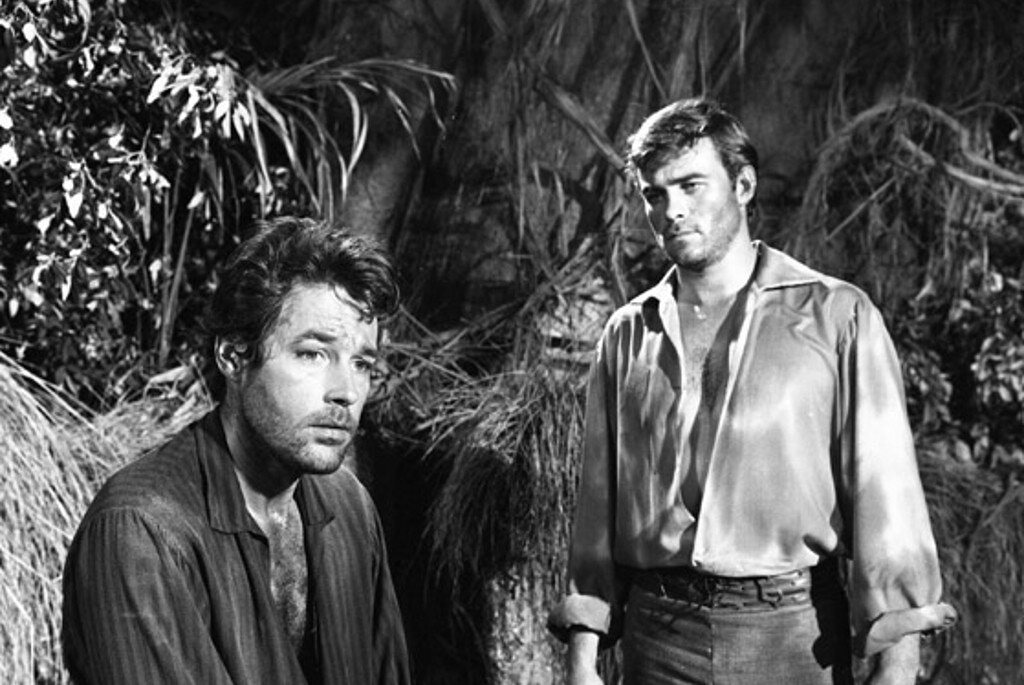
Hammer Films of England remains best known for their slate of color Gothic horror movies, but even at the height of those releases the studio gamely turned out pictures in a variety of genres. One of their earliest attempts at a family-friendly adventure film, The Pirates of Blood River (1962) was shot in July and August of 1961 but not released until July 1962, during school holiday when attendance was expected to be high for such fare. Although the studio gathered a swarthy bunch of actors, including Peter Arne, Oliver Reed, Michael Ripper, and, most prominently, Christopher Lee in an eye patch, to play the most cutthroat pirate crew of the early 1960s, Hammer fans more fondly recall The Pirates of Blood River as "the pirate movie with no boat."
In the early 1960s Hammer head Michael Carreras took note that the Disney Studios had done enormous box-office business with adventure stories such as Kidnapped and Swiss Family Robinson (both 1960), which attracted the whole family - a market that Disney seemed to have all to themselves. He saw room for Hammer to enter that arena and asked Jimmy Sangster - the prolific Hammer scripter of The Curse of Frankenstein (1957), The Horror of Dracula (1958), The Mummy (1959), and many others - to fashion a pirate story. Carreras told Sangster that there was just one major stipulation - due to Hammer's usual budget restrictions, they could not afford a pirate ship. "So there I was," Sangster later said, "faced with the challenge of writing a pirate picture without a boat."
The opening credits of The Pirates of Blood River play over stock footage of a ship at sail, but other than a lone matte painting featuring a ship docked off an island, there is no other such nautical scene in the film. Following the credits, the viewer is shown a late seventeenth-century island settlement of Huguenots and young Jonathon Standing (played by American swashbuckling actor Kerwin Mathews, Sinbad himself from The 7th Voyage of Sinbad [1957]). Standing is in the middle of a romantic clinch with Maggie (Marie Devareaux), but is interrupted by several men from the council of religious elders, including Jonathon's father, Jason (Andrew Kier). Maggie bolts and tries to cross the river of the title, but is attacked and killed by a swarm of piranha. For cavorting with the wife of Godfrey Mason (Jack Stewart), one of the elders, Jonathon is condemned to fifteen years hard labor in the colony's prison. At the mercy of sadistic guards, Jonathon escapes through the swamps and pretends to die by gunshot. He is picked up by a band of pirates, who take Jonathon to see their captain, LaRoche (Christopher Lee). LaRoche promises to take Jonathon the fifty miles inland to the settlement and gives his word to "bring just rule" to the colony. In exchange, LaRoche and his men only desire a safe haven in which to replenish themselves between voyages. Of course, LaRoche is an untrustworthy pirate, and he and his men actually seek fortune from the settlers and begin taking hostages as soon as they arrive.
The swordplay on view in The Pirates of Blood River may not be up to the standards of such swashbucklers of golden age Hollywood as Captain Blood (1935) or The Sea Hawk (1940), but although they are less polished, the fight scenes are still rough-and-tumble and exciting. Bob Simmons is credited in the film as "master of arms" and he choreographed the fights. Simmons would go on to stage the action sequences in all of the James Bond films starring Sean Connery (and he served as stunt double for Connery as well, and played the "silhouette" Bond in the famous opening gun barrel sequence). Of the many choreographed fights in the film, the standout begins as a challenge from one pirate to another. In the large settlement meeting hall, LaRoche arranges for two of his men to cross swords to finish an argument over a woman - but first they are blindfolded. Mack (Hammer regular Michael Ripper in a meaty role), puts blindfolds on the men and spins them around. The onlookers are in almost as much danger as the participants as Hench (Peter Arne) and Brocaire (the always-watchable Oliver Reed) flail and stab with wild abandon.
In the commentary for the DVD release of The Pirates of Blood River, art director Don Mingaye described the challenges of creating sets on a shoestring and of "trying to make big movies in a cubby hole." Mingaye said that Hammer's oft-celebrated production designer Bernard Robinson would study the scripts and the upcoming films in the production pipeline and plan ahead for as many as four movies so that there would be "a lot more re-painting rather than re-building." The designers at Hammer would also "cheat our spaces" in order to make small sets photograph as large ones; for example, walls would have holes in them that cameras could shoot through to catch wider views of opposite sides of a set. For the Huguenot village and fortress, the standing outdoor set at Bray Studio was redressed. The stockade appeared natural on film, as if built from timber, but it was actually made from cast plaster! Similarly, the felled trees that are used as weapons against the pirate crew toward the end of the picture were not real trees, but polystyrene ones. Mingaye also revealed that director John Gilling "...could be extremely volatile when approached, so you did that with caution. Not always did he react badly, but most of the time he did."
There was a famous visitor to the set of The Pirates of Blood River who saw the economy of filmmaking first hand and put down his observations in print. In 1961 Sammy Davis Jr. was at the height of his powers as a Las Vegas showman and a member of the infamous Rat Pack. He was also a huge fan of the Hammer horror films, so he was given a tour of Bray while the pirate swashbuckler was being filmed. In his 1980 book Hollywood in a Suitcase, he wrote, "When the cast stepped outside the Hammer building, I just didn't believe it. I thought that it was the reception area. ...I'd found that Hammer had done all of these films on one and a half stages - they could have fit the entire operation into the parking lot of the commissary at MGM. ...The whole thing was quite incredible - Hammer was making millions, but at the studio you would've thought that they were making low-budget educational films for youth clubs."
At the time, European producers with an eye toward the American box-office would often cast an American actor as the lead in their pictures. The authors of Hammer Films: An Exhaustive Filmography quote actor Kerwin Mathews, who said, "I was under contract to Columbia, and they had just OK'd my living in London. I had just settled in when Hammer called. I always enjoyed working in England. The studios were first class and all the people involved were a bit more gentle than their American counterparts. [John] Gilling had his hands full making a difficult film come in on schedule in English weather, but he was super-efficient and good for me. The film was physical and rough - it couldn't have been otherwise. One morning I had to do a scene in a swamp that had turned to quicksand. I had some of the frights of my life!" The shoot proved to be dangerous for many in the cast. Wading waist-high through a particularly filthy patch of river water, Christopher Lee developed a stomach ailment that lasted for months, and Oliver Reed, who was totally submerged during a staged fight, came out with a nasty eye infection.
The British film industry at the time employed a ratings system similar to the one that was instituted by the American industry in the late 1960s. The British designations included the ratings "U" for Universal (all-ages) material, "A" for adults and accompanied juveniles, and "X" - no children allowed. Since Hammer ultimately intended The Pirates of Blood River for release to a family audience, they submitted the film several times before receiving the "U" rating. In his book What the Censor Saw (Joseph, 1973), John Trevelyan noted that it was one of the only films labeled with all three designations: "In the early part of the film a young girl, escaping from a villain, plunged into a river and set out to swim to the other bank. In the X version a shoal of piranha fish rushed through the water and attacked the girl who struggled and was apparently dragged under the water which then became tinged with blood; in the A version the piranha fish rushed through the water but the scene stopped as they reached the girl; in the U version the piranha fish never appeared at all."
The "all ages" version of The Pirates of Blood River went out on a double bill as the second feature to the Columbia film Mysterious Island (1962). The fantasy science-fiction film was an adaptation of the Jules Verne novel and was produced by Charles Schneer and featured special effects by co-producer and stop-motion animation master Ray Harryhausen. Columbia Pictures went all out on the promotion of the family-oriented pictures, and the double feature did big business at the box-office.
(Note that TCM will be airing the uncut version of The Pirates of Blood River).
Producer: Anthony Nelson Keys
Director: John Gilling
Screenplay: John Hunter, John Gilling (screenplay); Jimmy Sangster (story); Anthony Nelson Keys (uncredited)
Cinematography: Arthur Grant
Production Design: Bernard Robinson
Art Direction: Don Mingaye
Music: Gary Hughes
Film Editing: Eric Boyd-Perkins
Cast: Kerwin Mathews (Jonathon Standing), Glenn Corbett (Henry), Christopher Lee (Captain LaRoche), Peter Arne (Hench, a pirate), Marla Landi (Bess Standing), Oliver Reed (Brocaire, a pirate), Andrew Keir (Jason Standing), Michael Ripper (Mack, a pirate), David Lodge (Smith),Dennis Waterman (Timothy Blackthorne)
C-87m.
By John M. Miller
SOURCES:
Hammer Films: An Exhaustive Filmography by Tom Johnson and Deborah DelVecchio (McFarland Publishing, 1996)
A History of Horrors: The Rise and Fall of the House of Hammer by Denis Meikle and Christopher T. Koetting (The Scarecrow Press, Inc., Revised Ed. 2009)
Audio Commentary track for The Pirates of Blood River DVD by Jimmy Sangster, Don Mingaye, and Marcus Hearn.
The Pirates of Blood River
by John M. Miller | March 15, 2011
SIGN UP FOR OUR NEWSLETTERS

CONNECT WITH TCM