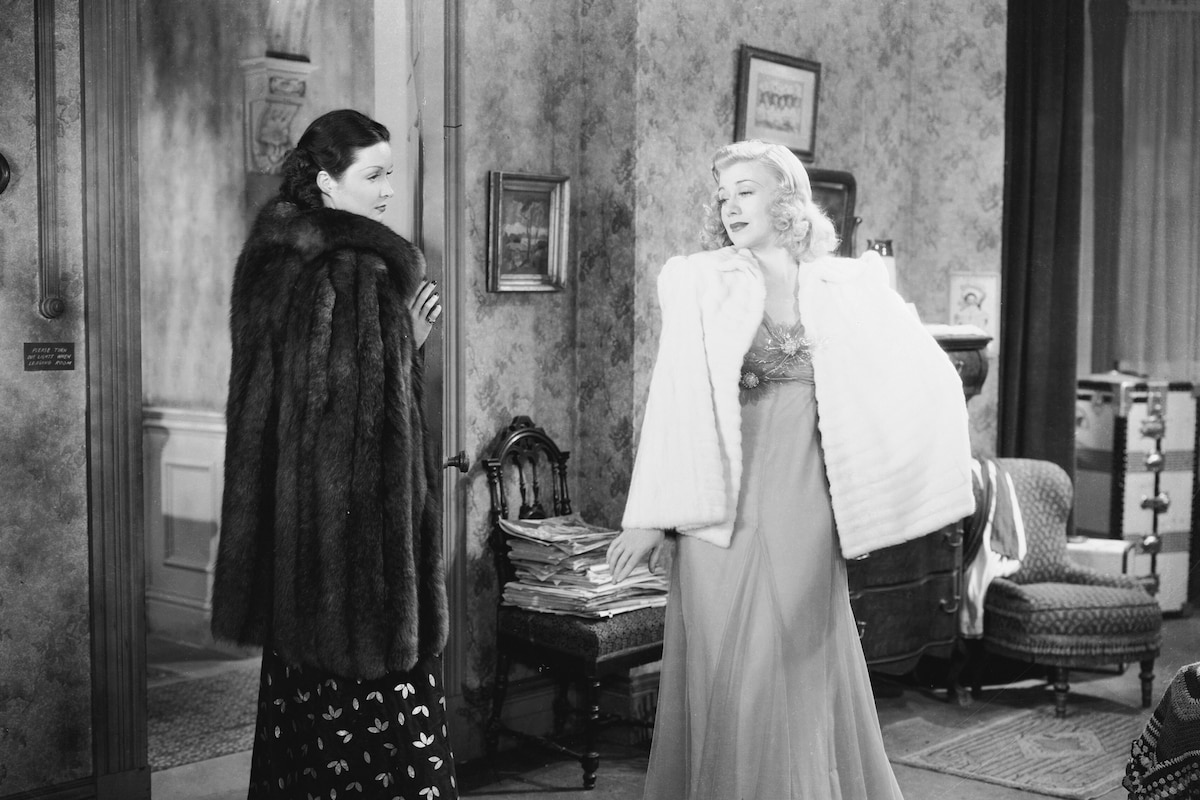
The inside buzz about Stage Door was high, even while the picture was still in production. Hollywood correspondents visiting the set noted the film would be "the talk of the movie universe," and praised Gregory La Cava for presenting a new Katharine Hepburn whose inspired work would erase the memories of the "flat, mechanical performances" she had turned in of late. Predictions were also favorable for Ginger Rogers's career outside of Fred Astaire's spotlight. Observers also noted that La Cava was creating a new star in Andrea Leeds and revealing a new young comedienne in Lucille Ball.
Reportedly, the cast of Stage Door was delighted with the finished product, for the most part. Hepburn said later she cried with laughter when she saw the movie. According to one Lucille Ball biography, however, the young comedienne was glum and silent, unimpressed by her own performance.
Stage Door premiered at Radio City Music Hall on October 7, 1937. It was financially successful (some reports said a gross of $2 million; others claimed a mere $81,000 in profits), but certainly not the box office goldmine the studio expected, especially in light of its cost (nearly a million). Industry analysts put the blame for the low profits on Hepburn, whose career at RKO was steadily declining thanks to a string of unsuccessful pictures before this one.
According to Katharine Hepburn biographer Barbara Leaming, the actress lost the chance to play the lead in Stage Door on Broadway because her agent and reputed companion Leland Hayward was jealous of her relationship with director John Ford and did not push her for the role. It went to Margaret Sullavan, who married Hayward a month after the show opened, already pregnant with their first child Brooke.
According to Katharine Hepburn, she was initially billed second to Rogers, but preview cards were so enthusiastic about her performance, the studio gave her top billing. In the film's credits and posters on its initial release, Hepburn gets first billing, albeit side-by-side with Ginger Rogers. In the 1953 re-release poster Hepburn's name is on top but in trailers for the re-issue, Rogers name comes first. In 1937, Lucille Ball was billed eighth, but in 1953 she was already nearly two years into the run of her landmark television sitcom I Love Lucy, so she was given fourth billing, just below Adolphe Menjou.
In some prints of the movie (particularly those shown on TV), the shot of Kay's grave is missing from the montage about Terry's meteoric rise to success.
"They should have called it 'Screen Door.'" - George S. Kaufman, co-author of the play the film was based on, noting how the new script removed all of the play's diatribes against Hollywood.
Largely forgotten and under-rated today, Gregory La Cava was a hard-drinking, rebellious craftsman (and close friend of W.C. Fields) who got on well with and earned the trust and respect of actors, turning out some interesting 1930s comedies with an eye to thorny social conditions and quirky personal relationships. Although known for throwing out the script and improvising (and giving his casts new pages right before rolling the cameras), he worked well with writer Morrie Ryskind. The screenwriter, who penned La Cava's best comedy, My Man Godfrey (1936), loosely adapted the latter into another Ginger Rogers vehicle a few years later, Fifth Avenue Girl (1939). La Cava also directed Rogers in a somewhat class-conscious romance, Primrose Path (1940). La Cava started as a cartoonist in the earliest days of cinema around World War I, moved to feature directing in the 1920s, and remained fairly prolific through the Depression years. In the 1940s, whether through excessive drinking or being at loggerheads with studio execs, his output dropped to only four films in eight years, with nothing at all between 1942 and his last picture, the minor Gene Kelly musical Living in a Big Way (1947). He died of a heart attack in 1952, just short of his 60th birthday.
Katharine Hepburn really needed a big hit when she made Stage Door. After bursting on the movie scene in A Bill of Divorcement (1932) and winning her first Academy Award as a stage-struck young actress in her third film, Morning Glory (1933), her films at RKO began to slide in popularity and quality. Little Women (1933), with her friend and favorite director, George Cukor, was a critical and commercial success, and today Alice Adams (1935) is considered a high-point in her career (and the second of twelve Oscar® nominations), but a subsequent series of costume pictures found no favor with public or critics. Stage Door was hailed for bringing back the fresh, pleasingly different Hepburn audiences had once responded so well to, but when it failed to garner as much box office as expected, she took much of the blame. Her next two pictures are now classics: the supreme screwball comedy Bringing Up Baby (1938) and the eccentric romantic comedy Holiday (1938), both with Cary Grant, but they were not box office hits, and by 1939 she was considered washed up in Hollywood. She left RKO and went back to the New York stage where she had a huge success in The Philadelphia Story, a play written specifically for her. When MGM wanted the screen rights to the Broadway hit, they found Hepburn had a substantial stake in them, so they had to cast her in what would become one of the most remarkable comebacks of all time. Released in 1940, The Philadelphia Story restored Hepburn to her place as one of the top stars and most respected actors of her time.
Ginger Rogers' persistence in bugging the RKO front office for pictures outside her dance partnership with Fred Astaire paid off handsomely with her role in Stage Door. Her three movies previous to this had all been musicals with Astaire. After the success of Stage Door, she went into two more well-received comedies, Vivacious Lady (1938), opposite James Stewart, and Having Wonderful Time (1938), a highly bowdlerized adaptation of another hit Broadway play. It co-starred Douglas Fairbanks, Jr. and reunited Ginger with Stage Door players Lucille Ball, Eve Arden, Grady Sutton, and Ann Miller. Only then did she return to her dance partner for Carefree (1938) and their final RKO film together The Story of Vernon and Irene Castle (1939). Although she occasionally danced briefly in subsequent films, she didn't make another musical until Lady in the Dark (1944), preferring to concentrate on comedies and dramas such as Kitty Foyle (1940), for which she won an Academy Award. Rogers was reunited with Fred Astaire (as a replacement for Judy Garland) at MGM in The Barkleys of Broadway (1949), her last feature film musical. In that, she played a Broadway musical comedy star who longs to be taken seriously as a dramatic actress.
Stage Door also boosted the career of Lucille Ball. In films since her bit role debut in the Wallace Beery drama The Bowery (1933), she languished for several years in uncredited bits and smaller roles, often in B pictures. After Stage Door, she renegotiated her contract with RKO and got more money ($125 a week), better parts, and higher billing. Despite good notices in Dance, Girl, Dance (1940) and The Big Street (1942) opposite Henry Fonda, her film career never catapulted her to A status. It took television to assure her place as one of the greatest stars with her landmark 1950s sitcom I Love Lucy.
Ball later noted about her co-star Eve Arden, "Eve and I competed for years, but it all started with Stage Door, where we both flounced around tossing out acid remarks. Later on, we'd be cast as a lady executive or the proverbial 'other woman.' They were the same roles, actually. You'd walk through a room, drop a smart remark and exit. They called us 'the drop-gag girls.' I didn't dig it at all, for in such parts you lose your femininity."
Ann Miller was only 14 years old when she made this movie, working under a falsified birth record, but could play older because of her height (5' 8"). She later admitted, "Lucille Ball and Ginger Rogers stuck by me and upheld my fake age and fake birth certificate so the studio would keep me under contract." She had been given a contract at RKO largely on the recommendation of Lucille Ball, who had seen her dancing in a nightclub while in San Francisco to promote Don't Tell the Wife (1937), Ball's movie just prior to Stage Door.
Andrea Leeds was a promising young actress in movies since 1933. Her supporting actress nomination for Stage Door was a good career boost, and she was considered for the part of Melanie in Gone with the Wind (1939), which went to Olivia de Havilland. She ended up making only seven more pictures in the three years following Stage Door and retired from the screen after marrying a wealthy horse breeder.
The two biggest female stars at RKO almost worked together previous to this. When Katharine Hepburn was getting set to play the title role in Mary of Scotland (1936), Ginger Rogers lobbied heavily to make a cameo appearance as Mary Queen of Scots's nemesis, Elizabeth I of England. She even tested for the role in heavy disguise. One story says Hepburn wasn't immediately aware she was testing with Rogers and became furious when she found out. There are stills in existence showing Rogers in costume, and supposedly silent test footage that catches Hepburn kicking her rival in the shins. At any rate, Rogers didn't get the part.
Frances Reid, who played the matriarch of the Horton clan on the long-running soap opera Days of Our Lives from 1965 to 2009, has a bit role in Stage Door.
Ginger Rogers and Adolphe Menjou appeared together again in Roxie Hart (1942), a comedy from the same source material as the Academy Award-winner Chicago (2002). Rogers played the title role and Menjou her slick lawyer Billy Flynn. They also worked together in Heartbeat (1946). Both were staunch right-wing Republicans and vocal supporters of the Hollywood blacklist.
Memorable Quotes from STAGE DOOR
JUDY (Lucille Ball): Do you want a date?
JEAN (Ginger Rogers): To some other lumberman?
JUDY: Am I supposed to apologize for being born in Seattle?
JEAN: Well, the last couple we went stepping with were made of lumber. Especially their feet.
JUDY: All right, all right, you can stay here and gorge yourself on lamb stew again.
JEAN: What's the matter, is the show closing?
SUSAN (Peggy O'Donnell): Like a tired clam.
TERRY (Katharine Hepburn): How many doors are there to this place?
JEAN: Well, there's the trap door, the humidor, and the cuspidor. How many doors would you like?
TERRY: Evidently you're a very amusing person.
TERRY: I see that, in addition to your other charms, you have that insolence generated by an inferior upbringing.
JEAN: Hmm! Fancy clothes, fancy language and everything!
TERRY: Unfortunately, I learned to speak English correctly.
JEAN: That won't be of much use to you here. We all talk pig Latin.
MARY LOU (Margaret Early): Certainly you must have heard of Hamlet!
EVE (Eve Arden): Well, I meet so many people.
TERRY: It'd be a terrific innovation if you could get your minds stretched a little further than the next wisecrack.
EVE: A pleasant little foursome. I predict a hatchet murder before the night's over.
JEAN: We got off on the wrong foot. Let's stay that way.
ANTHONY POWELL (Adolphe Menjou): You girls rehearsing for a musical?
JEAN: No, we're just getting over the DTs.
JEAN: Wish I'd been born lucky, instead of beautiful and hungry.
JEAN: Hey, you're not gonna catch the opening night tonight, huh?
EVE: No, I'm going tomorrow and catch the closing.
TERRY: The calla lilies are in bloom again. Such a strange flower, suitable to any occasion. I carried them on my wedding day, and now I place them here in memory of something that has died.
TERRY: The person you should be applauding died a few hours ago, a young and brilliant actress who could no longer find a spot in the theater. And it was for her more than anyone else that I was able to go on. And I hope that wherever she is, she knows and understands and forgives.
Compiled by Rob Nixon
Trivia - Stage Door - Trivia & Fun Facts About STAGE DOOR
by Rob Nixon | February 22, 2011
SIGN UP FOR OUR NEWSLETTERS

CONNECT WITH TCM