Director Gregory La Cava gave producer Pandro Berman fits. For one thing, La Cava was a notorious alcoholic constantly in danger of blowing his entire career over his drinking problem. By many reports, he was drunk throughout the entire production of Stage Door, and during the filming of one scene he fell off the stage of the Biltmore Theater in downtown Los Angeles. According to Ginger Rogers, he always had a cup of tea liberally laced with gin. Also, he was generally cavalier about scripts, considering them mere blueprints to be reworked and improvised during principal photography. Berman recalled him saying, "Forget about the dialogue. I can always spit that out at the last minute." In an article in Life magazine about the production, it was noted that La Cava would frequently stop shooting for rewrites with Morrie Ryskind, burning up a lot of time and money but adding to "the spontaneity of the action and the crackle of the dialog."
Despite his alcoholism and "wing-it" methods, the cast members had high praise for La Cava, as did most of the actors he worked with through the years. Andrea Leeds once noted, "He would talk to each of us like a life-long friend. That gave us a feeling of intimacy." Rogers wrote in her autobiography: "La Cava liked me and knew how to get the best from me and the rest of the actors. I liked him immensely, too, and felt great confidence in him....His alcoholism didn't affect his competence. As a person, he was kind and loving; as a director, he was masterful."
For much of the shoot, Hepburn was moody and feeling excluded, aware that the picture was mainly intended to showcase not her but the as-yet untapped dramatic talents of the studio's other major female star, Ginger Rogers. Hepburn had gone from stardom to being just another actress in an ensemble, and by her own admission she was terrified by the extent of improvisation on the set. She sat by and watched the other actresses, even those in minor roles, steal every scene while she had little idea of who her character was. La Cava's heavy drinking frightened her at first (although later she said she warmed to him when she realized it was simply part of what made him "a very talented, artistic man"), so she went to producer Pandro S. Berman and asked, "What am I supposed to do? I don't know what my part is or anything about it." Berman told her she would be lucky to play even a sixth-billed part in a successful picture at that point and to just do what she was told. She finally approached La Cava and told him she had no clue who this Terry Randall was. La Cava told her, "She's the human question mark." Hepburn nodded and walked away, but came back a short time later to ask him what that meant. "Damned if I know," he replied.
La Cava was able to use Hepburn's feelings of isolation to the advantage of her performance as a woman who is shunned and teased by all the other women in the boarding house. He also had the "brilliant idea" (Hepburn's words) to mirror her own stage disaster of 1933 in The Lake to show Terry's struggles to bring some full human emotion into her acting. Over the course of the production, Hepburn's part was enlarged to give her more to do.
By most accounts, studio rivals Rogers and Hepburn did not get along well during filming, although the tension between them helped the on-screen antagonism between their characters. "Kate always wanted her way and usually got it," Rogers wrote in her autobiography. "I steered clear of her, not trusting what she might do if I in any way crossed her. I recognized she had little empathy for me." According to Rogers, she sent Hepburn a platinum suit pin for her birthday but never got any reply from her. Years later, she visited Hepburn backstage during the run of a Broadway play and asked whatever became of the gift. Rogers said Hepburn's reply was, "Oh I don't remember. I must have given it to someone."
Despite the on-screen camaraderie of the female cast, Ann Miller recalled, "It was like dog eat dog on that picture--even though everyone was very friendly. They were writing the script on the set and I remember there was quite a lot of tension between Ginger Rogers and Katharine Hepburn. Lucy helped relieve a lot of the strain because she would always laugh and joke and kid. Eve Arden was the same way, and thank God for them."
Rogers was reluctant to be paired with Ann Miller in their dance act in the story because the younger woman was 5' 8" tall, compared to Rogers's 5' 4". Miller begged her and swore she would wear flats while Rogers could use high heels and a top hat: "Anything, but I want to dance with you!"
According to Rogers, Eve Arden became friendly with a cat that hung around the set and discovered the animal liked to be draped around her neck. La Cava apparently worked that into the story.
Stage Door was shot by Robert De Grasse, who had been the cinematographer on three previous Hepburn movies. Perhaps this is why Rogers later noted that although she considered him an "expert," she didn't feel he did his best work on her behalf for Stage Door. De Grasse would receive an Oscar® nomination for his next film, Vivacious Lady (1938), starring Rogers and for which she said he finally "understood the kind of lighting that produced a better quality close-up for me."
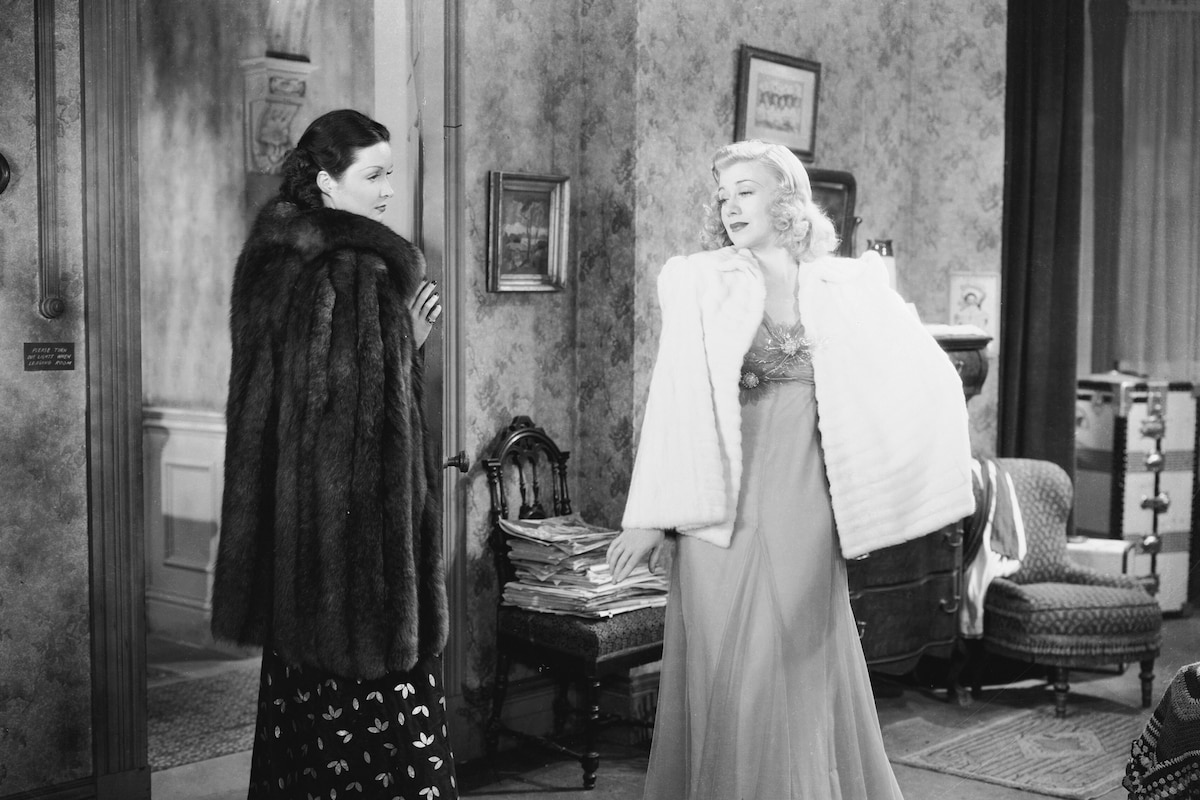
The RKO art department, justly famous for the gleaming art deco look of the Astaire-Rogers pictures and other films of the 1930s, eschewed the studio's typical glamour to create a suitably dumpy, shabby look for the interior of the Footlights Club, where most of the action takes place. The famed RKO Manhattan style is only evident in one scene set in the apartment of wealthy producer Anthony Powell.
La Cava insisted his cast wear their own everyday street clothes and not something unduly glamorous from the costume department. Studio files show Lucille Ball billed the front office for use of her personal wardrobe, causing a number of arguments among executives and certain crew members. Finally, the studio agreed to pay Ball $50 but then reneged on it, saying in a memo, "I think the girl has a terrific nerve to expect us to indulge in any such irregularity."
The final cost of the Stage Door production was about $900,000. Life magazine broke the budget down as: $100,000 for La Cava, $75,000 each for Hepburn and Rogers, $150,000 for the remainder of the cast, $50,000 for the writers, and the $125,000 for the screen rights.
by Rob Nixon
Behind the Camera - Stage Door
by Rob Nixon | February 22, 2011
SIGN UP FOR OUR NEWSLETTERS

CONNECT WITH TCM