It would have been enough had Volker Schlondorff merely avoided falling on his face when he filmed The Tin Drum (1979). It wouldn't have been the first time a film had failed to come close to capturing a classic novel, and Gunter Grass's novel is on the very short list of the 20th Century's greatest novelistic achievements, right up there with Gabriel Garcia Marquez's One Hundred Years of Solitude and Hermann Broch's The Sleepwalkers in its ability to chronicle an entire population's arc through epochal history. But Schlondorff did more than avoid disaster. He found a way into the novel in which Germany's mad collective plunge into the Nazi era is personified by one of Western culture's biggest little unforgettable dropouts.
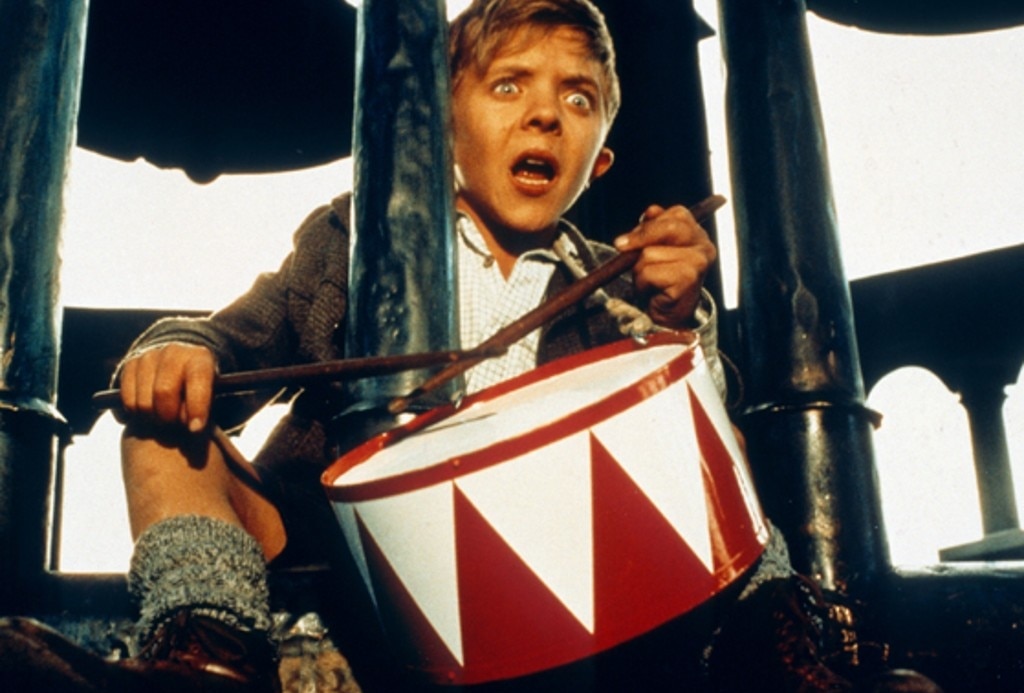
His name is Oskar Matzerath and he wills himself to stop growing at the age of three as a reaction to the lunacy and duplicity of the adult world as he experiences it in Danzig in the run-up to WW II and the war years. After carefully staging a fall down a flight of basement steps to account for his growth stoppage, he bangs out his anger on a series of tin drums bought from a Jewish toyshop proprietor. To this percussive trademark, he adds a vocal gift - the ability to shatter glass with his voice. His rage and confusion begin when he notices his mother and her cousin playing footsie under the family dinner table. Later, when he sees them meet at a cheap hotel, he shouts out half the windowpanes in the city. And yet as he ages, he becomes a creature of Rabelaisian appetites. That his real father is his mother's Polish cousin, and not her stolid German grocer husband, doesn't turn him away from sex. He's happy to partake of it however he can, and as the story progresses, several women are pleased to accommodate him.
He's barely able to contain the metaphorical faceting Grass gives him -- arrested development on the outside, steely moral compass on the inside, seething with anger and, later, hormones as he negotiates the nightmare boiling up from underneath the placid surface of his petty bourgeois world. It's a story that cries out to be filmed in black and white, in German Expressionist style. Today, The Tin Drum would be viewed as fertile graphic novel material. Schlondorff filmed it in color, though, inevitably softening it. But he did two things that make the film work. Faced with the choice of hiring a midget or a boy to play Oskar, he went the latter route, and struck a chunk of casting gold when he chose then 11-year-old David Bennent to play Oskar. With his pale blue eyes soaking up the world around him and deflecting it at the same time, he's shielded by a sort of immunity conferred upon him by being developmentally disabled. Part of the adult world's seeming obliviousness to the boy stems from their sense that he's "different.'' They endure his idiosyncrasies because they think he's mentally impaired.
We, of course, know he's not, partly because he narrates part of the time, allowing us entry into his thoughts and perceptions, of which the adults in his world are not aware. Their collective passivity, of course, is fertile soil for the rise of Nazism. Close to home, they also have a lot on their minds. The other reason The Tin Drum doesn't bend and break under the weight of its allegorical dimension is that it's delivered to us as a string of domestic embroilments, the tone of which is set in a lusty prologue depicting the genesis of Oskar's mother when a fleeing fugitive is hidden under the skirts of a generous peasant woman in a potato field. Thus is born the family proclivity for sexual waywardness. And yet the family and extended family in whose midst Oskar lives treats him lovingly and even indulgently. Their neighborhood is presented as a village within the larger city. Grass, a native of Danzig whose father ran a grocery shop there, and who happens to have been born in 1927, the year Oskar's growth came to a halt, obviously helped contribute a certain authenticity of place as one of the credited screenwriters, while also fine-tuning the dialogue. Far from trivializing the events on the larger stage, the soap opera anchors them, especially after they begin spinning picaresquely in larger and larger orbits as the lethal Nazi madness escalates.
The undeclared ménage a trois involving Oskar's mother (a voluptuous Angela Winkler), her stolid husband (Mario Adorf) and her rashly romantic lover (Daniel Olbrychski) is sustained by the grocer's complaisance, whether from generosity, indifference, or stupidity, we're never quite sure. (A longer director's cut, restoring some 20 minutes of excised material, includes a scene in which the grocer's enthusiasm for Nazism begins to cool when he's visited by two Party officials and rejects the suggestion that Oskar be euthanized.) After Oskar unravels a staged demonstration for a Nazi bigwig by beating his drum under the bleachers and throwing the orchestra off, derailing it into Strauss's Blue Danube waltz, he hits the road, swept up by a troupe of dwarfs and midgets assigned to entertain German troops throughout Europe. At one point, they picnic on the concrete roof a Normandy pillbox. And then death starts closing in alongside the Nazi downfall.
The Tin Drum is filled with flavorful and often surprisingly touching performances by characters taken beyond caricature or political cartoon. Fritz Hakl is potent as the sad, worldly midget impresario, whose circus bandstand décor included gold Stars of David on maroon velvet; Mariella Oliveri, as his wife, is full of heart, too. Charles Aznavour makes his presence felt in every scene as the wistful toyshop owner with a crush on Oskar's mother that is doomed to go unrequited. And what must Heinz Bennent, as the neighborhood greengrocer whose fondness for boys is given freer play under the Nazis than it ever had under his cover as a Boy Scout leader, have thought and felt at the sight of his own young actor/son witnessing his character's death at the end? (Obviously young Daniel Bennent was unscarred - he went on to a long and prestigious career on the German stage.)
One of the ways in which the film is able to seem unintimidated by the reputation of its source (Grass won a Nobel Prize in Literature; the film got a Best Foreign-Language Oscar®) stems from Schlondorff's decision to pitch it closer to Rabelais than Goethe as it visits the strife that rained down on Danzig (currently Gdansk, Poland), unluckily situated between Germany and Poland. The lustiness extends to Oskar sleeping with the provincial girl hired to help out after Oskar's mother dies. When the new girl later succumbs to the new widower Matzerath, and they marry, Oskar is invigorated by the thought that he, and not Matzerath, is the new child's biological father. Adorf's performance as Mazerath travels an ambitious arc -he's cement-headed at the beginning, but humane for all his crudity of outlook and manner, and by the end he's improbably affecting, avoiding lapses into stereotype. But what one most strongly takes away from The Tin Drum is the unyielding ferocity of Bennent's Oskar. Indeed, it's the motor of his survival. But then the film is, in its perverse way, a celebration of survival, right down to its penultimate grace note - refugees boarding boxcars headed toward the West and, as they see it, hope - reversing the still-haunting impact of all those civilians-stuffed-into-boxcars images of the Holocaust.
Producer: Eberhard Junkersdorf
Director: Volker Schlondorff
Screenplay: Jean-Claude Carriére, Volker Schlondorff, Franz Seitz, Gunter Grass
Cinematography: Igor Luther
Art Direction: Nicos Perakis
Music: Maurice Jarre
Film Editing: Suzanne Baron
Cast: Mario Adorf (Alfred Matzerath), Angela Winkler (Agnes Matzerath), David Bennent (Oskar Matzerath), Katharina Thalbach (Maria Matzerath), Daniel Olbrychski (Jan Bronski), Tina Engel (Anna Kaojaiczek).
C-142m.
by Jay Carr
The Tin Drum
by Jay Carr | February 02, 2011
SIGN UP FOR OUR NEWSLETTERS

CONNECT WITH TCM