It seemed that everyone in Hollywood was willing to talk -- except Charlie Chaplin. After the completion of his most recent film The Circus (1928), the movie business found itself in the midst of a painful transition period into talking pictures with the advent of sound technology. At first synchronized sound seemed little more than a novelty, with unperfected technology that generated embarrassing results more often than not whenever a character spoke. However, when The Jazz Singer (1927) and The Broadway Melody (1929) became wildly popular and made enormous profits, every studio in town began to wire for sound.
Desperate to jump on the talking picture bandwagon, studios began forcing their well-established silent film stars to make talkies. Some of the stars, such as Greta Garbo, survived the transition. Others, however, did not. The careers of people who had ruled the box office during the height of the silent era, such as John Gilbert, suddenly came crashing down when audiences, for whatever reason, failed to accept their previously unheard voices on the silver screen. It was a scary and unstable time for everyone in Hollywood.
At the time Charlie Chaplin was one of the world's biggest movie stars. Since he owned his own studio and ran every aspect of it himself, he didn't have to worry about being thrown into a talking picture against his will. However, that didn't stop his fans and colleagues from wondering whether or not he would eventually take the leap like everyone else.
Chaplin made no bones about the fact that he was not impressed with the sound pictures he had seen and had no intention of making one himself. At first he kept tabs on the talkies and was convinced that the trend would just be a passing fancy. As sound technology continued to make improvements, however, Chaplin gradually began to see that sound would in all likelihood be there to stay. It was a fact that caused him great distress since, to him, pantomime was a language that could be understood and enjoyed by anyone in the world. Sound, he feared, would destroy it. "A good silent picture had universal appeal both to the intellectual and the rank and file," said Chaplin in his 1964 autobiography. "Now it was all to be lost."
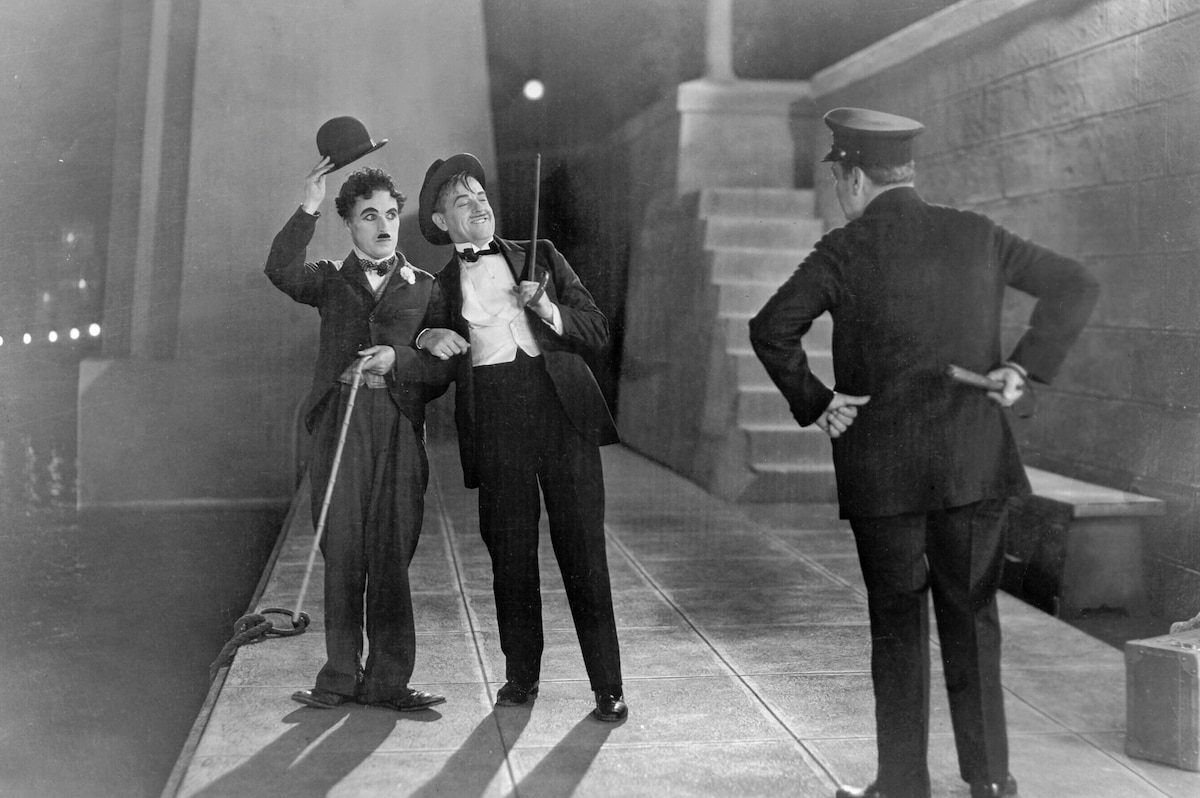
Despite pressure to make a talking picture and avoid being left behind in the silent era dust, Chaplin decided to make his next film in the same manner that he always did: his way. "I was determined to continue making silent films," said Chaplin, "for I believed there was room for all types of entertainment. Besides, I was a pantomimist, and in that medium I was unique and, without false modesty, a master. So I continued with the production of another silent picture, City Lights."
The story idea for City Lights began when Chaplin thought up a scenario about a circus clown who loses his sight in an accident. On the advice of his doctor, the clown hides his ailment from his frail daughter, fearing that the shock might be too much for her. The blind clown evolved over time into the character of the blind flower girl.
The subplot of the eccentric millionaire who befriends The Tramp, according to Chaplin's autobiography, grew out of an old story idea he had in which two rich members of a gentlemen's club conduct an experiment with a tramp. The rich men pick up the tramp when he is sleeping, lavish him with luxurious treatment, and then promptly return him to the street where they found him.
When word got out that Chaplin's next film was going to be silent, people began to have doubts. The press openly speculated about whether his career would survive such a bold rebellious move. Chaplin was well aware of the risks. "Nevertheless, City Lights was an ideal silent picture, and nothing could deter me from making it," he said."
Before he began casting City Lights, Chaplin worried that the coming of sound would ruin his film in other ways. "Since the advent of talkies, which had now been established for three years, the actors had almost forgotten how to pantomime," he said. "All their timing had gone into talk and not action. Another difficulty was to find a girl who could look blind without detracting from her beauty."
Chaplin initially had a great deal of difficulty casting the crucial role of the Blind Girl. Many actresses applied for the job, but none was suitable to the notoriously meticulous Chaplin. However, one day he saw a film company shooting a scene on a beach in Santa Monica with several attractive young bathing beauties. One of the girls, Virginia Cherrill, was a casual acquaintance, so she waved and asked if she would ever get the chance to work with him. "Her shapely form in a blue bathing suit did not inspire the thought of her playing such a spiritual part as the Blind Girl," said Chaplin. "But after making one or two tests with other actresses, in sheer desperation I called her up."
To Chaplin's surprise, Virginia Cherrill seemed to understand what he was looking for more than any of the other actresses he tried. "I instructed her to look at me but to look inwardly and not to see me, and she could do it," said Chaplin. "Miss Cherrill was beautiful and photogenic, but she had little acting experience." Chaplin, needing to move forward with the production, decided to hire her. For the other important role of the Eccentric Millionaire, Chaplin hired Australian actor Henry Clive (he would later be replaced by Harry Myers).
As cameras prepared to roll on City Lights, the stakes were high for Chaplin. While he had the utmost confidence in his talents as an entertainer, he could not be certain that audiences would still find his silent work relevant in a world taken over by talking pictures. Still, he was determined to find out.
by Andrea Passafiume
The Big Idea - City Lights
by Andrea Passafiume | January 27, 2011
SIGN UP FOR OUR NEWSLETTERS

CONNECT WITH TCM