William Powell the unflappable. That was his screen persona - established in
such hits as The Thin Man (1934). He had a voice like single malt
Scotch and a suave manner that seemed at once immensely cultured yet also
rough and rude. In the glory days of 1930s romantic comedies, he was a king.
William Powell was the 1930s equivalent of Fonzie. He was untouchably cool.
On screen, that is. No man is ever really so unmoved. And in 1938, the
off-screen William Powell was in personal and professional turmoil. The love
of his life, Jean Harlow, died tragically of renal failure at the age of 26.
Still reeling from grief at this loss, Powell found his contract at MGM, the
studio that practically made him a star, over. He was adrift, in more ways
than one-but he would be called on to put on a happy face for the cameras to
play opposite French actress Annabella in her American debut for a one-off
romantic comedy made at 20th Century Fox. Almost immediately after
completing the film, Powell would be diagnosed with cancer, and spend most of
the next two years fighting for his life. That the film in question is even
watchable, given such conditions, is a testament to Powell's professionalism.
It was an adaptation of the 1936 Viennese play Jean (a surprising
number of Hollywood's romantic comedies in that period came from Austrian and
Hungarian theatre). The play had already migrated to Broadway in 1937, where
it took the title The Lady Has a Heart and accommodated Vincent Price
in the role now destined to be Powell's. That role was Jean, the title
character. A note appended to the first screenplay treatment in the studio
files indicates that the Fox writing staff were already eyeing another title
change: "Jean is a rather Frenchy name and is interchangeably masculine and
feminine." Studio chief Darryl Zanuck decided on the new title: The
Baroness and the Butler (1938).
The play had obviously been selected on the basis of its thematic similarity
to Powell's Oscar®-nominated blockbuster hit My Man Godfrey
(1936). Again, Powell is cast as a butler in a situation that turns on the
Depression-era gap between the Haves and the Have Nots, although this time
the action was relocated to a fantasy vision of Hungary, full of
faux-European opulence.
Mixing class-warfare and progressive rabble-rousing with romantic comedies
sounds like a dangerous concoction, and one cannot easily imagine the studio
moguls in the late 1930s taking such stuff lightly. But the more audiences
responded positively to these socially-minded farces, the more Hollywood
would keep making them-and William Powell's brilliance in Godfrey, one
of the most prominent of the sub-genre, made him an obvious go-to choice for
anyone seeking to replicate that formula. He was even in contention to play
the male lead in Ernst Lubitsch's Ninotchka (1939), a role that went
to Melvyn Douglas when Powell's cancer-related troubles sidelined him for a
few years.
Director Walter Lang had worked his way up the ranks during the silent era.
By 1926 he was directing movies-and then he decided to give it up. Lang took
a brief hiatus from that career to try his hand at being an expatriate
painter in Paris. He soon slunk back to Hollywood with his tail between his
legs to resume making comedies, such as the superlative Carole Lombard
vehicle Hands Across the Table (1935). By the 1940s and 50s he
settled into making lavish Technicolor musicals, of which his last was the
mildly unfortunate 1961 swan song Snow White and the Three Stooges
(not an unbearably bad movie, but likely not how the director of The King
and I (1956) and Desk Set (1957) would like to be remembered).
The production supervisor on the film was another old hand at comedy,
Raymond Griffith. In the 1920s, Griffith was a screen clown whose comedies
confidently bore comparison to those of Buster Keaton and Charley Chase.
However, his acting career had effectively ended by 1927. Any thoughts he
may have harbored about trying for a comeback ended as sound rolled in, his
weak raspy voice being unfit for talking pictures. He started anew, as a
production supervisor, and served in that administrative capacity for many
happy years.
As directed by Walter Lang, The Baroness and the Butler opens by
introducing not its characters but its settings-three places, each as
significant to the plot as any of the humans who live there. The first is
the Hungarian Parliament in Budapest, where the rulers rule. Second is the
town of Tura, where the ruled live in poverty. Last is Castle Sandor, where
the rulers live in prosperity. Then, and only then, is it time to introduce
William Powell as Jean, now renamed Johann, the butler to the Prime Minister,
Count Sandor (Henry Stephenson). Theirs is a warm relationship: Sandor is a
generous old man with a big heart, and his servant seems to genuinely love
him. But it is a professional relationship, demarcated by clear class
boundaries and strict rules. It may appear to be a form of friendship, but
it is a friendship in which one man is forbidden to sit in the presence of
the other, all but banned from speaking at all.
So, when it comes to pass that Johann has been elected to serve as a Senator
representing the socially progressive opposition party, this relationship is
put to the test....well, sort of.
The odd thing about this movie, the thing that keeps it from being great
while at the same time providing its main source of interest, is that the
improbable central premise is only a loony high-concept on top of which the
filmmakers stretch out an even nuttier and less plausible set of additional
circumstances.
At Parliament, Johann is a sharp-tongued activist with a take-no-prisoners
opposition to Sandor; but he retains his position as butler. The tensions
multiply in every direction: these two men admire and respect each other, yet
are political foes. And even that respect between them is a source of
tension-Sandor's gentle demeanor makes him a beloved public figure, yet he
advances regressive and selfish policies for the moneyed set. Johann needs
to destroy his master's public image to make any social change. Meanwhile,
Sandor agrees with Johann's policies, yet does nothing to help him, and
rankles that his butler's public responsibilities are distracting him from
his private duties. The Sandor family practically explode with fury at the
betrayal, and are horrified to have to think of their butler now as something
of a social equal . . . and did I mention this is a romantic comedy?
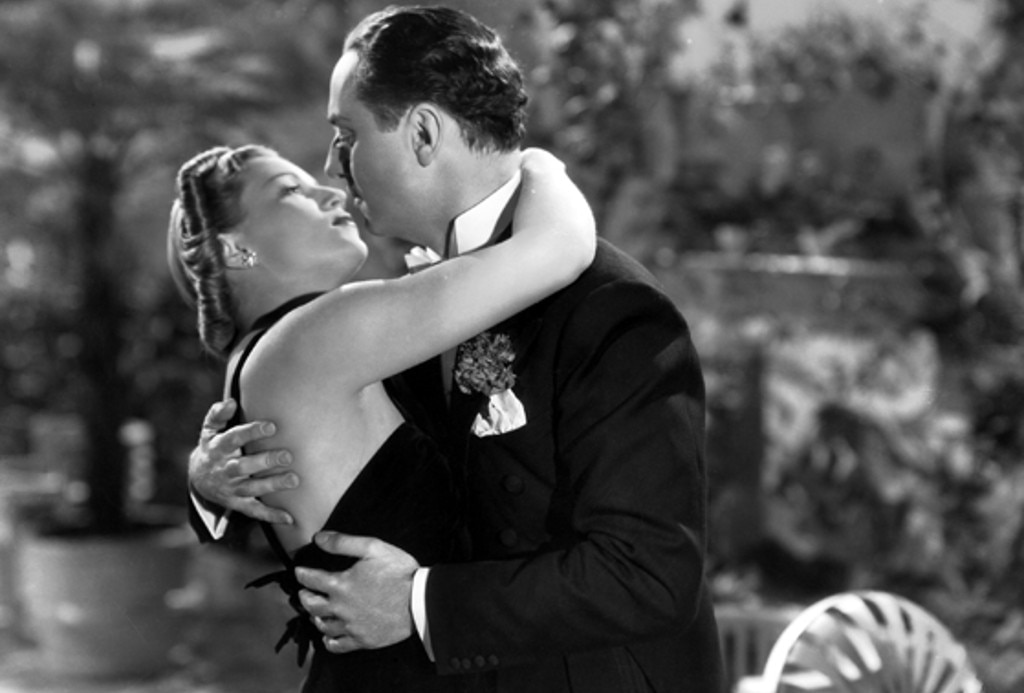
The romance angle comes from Annabella, as the PM's daughter Katrina. As
long as Johann was unambiguously her servant, she flirted with him
constantly. Now that he has all these uppity ideas above his station, she
sets out to ruin him-but this being a 1930s rom-com, her surface hostility
masks a hidden tenderness. In the age of the screwball, combat is courtship.
The Baroness and the Butler doesn't really work, not the way its
makers probably intended. It's hard to swallow a serious political message
from something so scattershot and farcical, yet it's equally hard to lose
yourself in the comic complications when everyone keeps making political
speeches. Throughout it all, Powell gives a terrific performance. Whatever
was burning away inside him, he appears to be his usual imperturbable self,
adroitly juggling the conflicting moods of the crazy plot. Annabella fares
less well-her thick French accent and haughty demeanor are appropriate for
her character but get in the way of the necessary sexual chemistry she's
supposed to be kindling with Powell. One is cool as a cucumber, one is
ice-cold, and the combination isn't entirely inviting.
The relationship between Powell and Stephenson is another matter entirely.
Here is genuine warmth and humanity, and more rare, a willingness to agree to
disagree. In an age where contemporary American political discourse has
become alarmingly ugly and vindictive, it is refreshing to spend 82 minutes
in the company of two opponents who won't let their political beliefs obscure
their friendship.
Director: Walter Lang
Screenplay: Sam Hellman, Lamar Trotti, Kathryn Scola (screenplay); Ladislaus
Bus-Fekete (play "Jean"); Melville Baker, George Marion Jr., Allen Rivkin
(contributing writer (uncredited))
Cinematography: Arthur Miller; Robert H. Planck (uncredited)
Art Direction: Bernard Herzbrun, Hans Peters
Film Editing: Barbara McLean
Cast: William Powell (Johann Porok), Annabella (Baroness Katrina Marissey),
Helen Westley (Countess Sandor), Henry Stephenson (Count Albert Sandor),
Joseph Schildkraut (Baron Georg Marissey), J. Edward Bromberg (Zorda), Nigel
Bruce (Major Andros), Lynn Bari (Klari - Maid), Maurice Cass (Radio
Announcer), Ivan Simpson (Count Dormo).
BW-75m.
by David Kalat
Sources:
Scott Eyman, Ernst Lubitsch:
Laughter in Paradise, Johns Hopkins University Press, 1993.
Roger
Bryant, William Powell: The Life and Films, McFarland & Co. 2006.
James Harvey, Romantic Comedy in Hollywood, Da Capo Press, 1998.
The Baroness and the Butler
by David Kalat | January 25, 2011
SIGN UP FOR OUR NEWSLETTERS

CONNECT WITH TCM