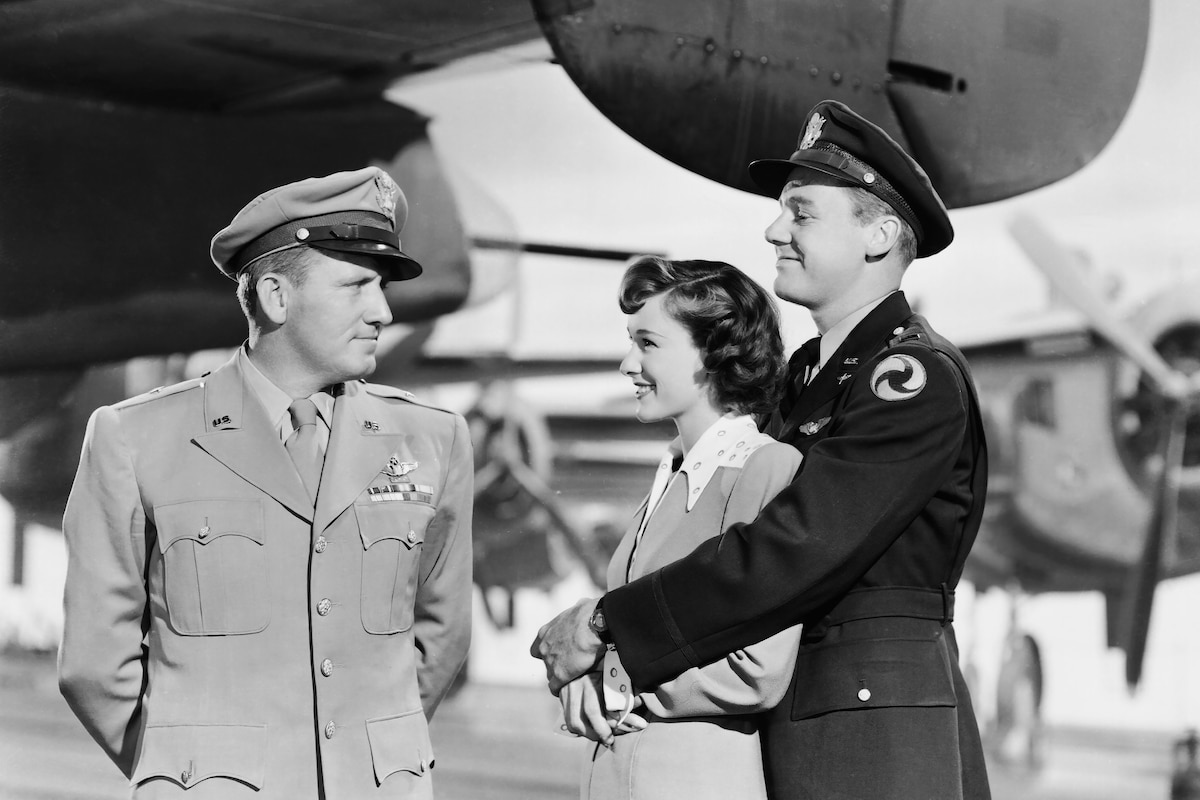
MGM filmed the training sequences in Thirty Seconds Over Tokyo at Eglin Air Force Base in Pensacola, FL, where Lieutenant Colonel James H. Doolittle had trained his men for the mission. Other scenes were shot at Mines Field in Los Angeles, Mills Field in San Francisco and the Alameda Naval Air Station near San Francisco. The Army loaned the studio 12 B-25s for the production and supplied men to fly them. Doolittle and General Hap Arnold provided technical advice throughout filming. Ted Lawson, on whose book the film was based and who was played by Van Johnson, was the film's official technical adviser.
During location shooting, many of the young actors in the cast bonded over their boredom and the tough living conditions. They also attracted the ire of many of the enlisted men, who resented their not being in the service. As drinking increased, so did clashes between the cast and the military men. At one point Robert Mitchum gave a brutal beating to a drunken sergeant who was causing problems for co-star Robert Walker.
Because the Navy could not supply an actual aircraft carrier for the shoot, most scenes of the team launching and preparing at sea were created by combining newsreel footage, rear projection, miniatures and other special effects. MGM built a mock-up of the USS Hornet's flight deck on Stage 15. The set was large enough to hold four B-25s.
The actual take-off scenes in Thirty Seconds Over Tokyo were created by building about 80 percent of the flight deck on a scale of one inch to the foot. The miniature was then set in the studio's water tank. The special effects team couldn't generate waves large enough to move a model of that size, so the carrier was attached to a hydraulic system that duplicated its movement at sea while pumps pushed water past it. Miniature planes attached to piano wire were moved in synchronized patterns to simulate the takeoffs. This was then combined with newsreel footage of the actual mission.
San Francisco and Oakland filled in for Japan for some aerial shots in Thirty Seconds Over Tokyo. When an oil refinery in East Oakland caught fire, it provided the footage the special effects department needed to recreate the bombing. The aerial approach to Tokyo was filmed by mounting cameras on the noses of several B-25s flown over the Pacific towards Los Angeles, while aerial shots of China were made near Santa Maria, CA.
Van Johnson had been in a serious car wreck while filming A Guy Named Joe (1943). Afterwards, makeup artists usually had to cover his forehead scars. For the final half of Thirty Seconds Over Tokyo, after Johnson's plane crashes in China, they simply let the real scars show rather than adding fake scars.
The set was particularly tense the day they filmed the amputation of Johnson's leg because Lawson was there watching every take.
by Frank Miller
Behind the Camera - Thirty Seconds Over Tokyo
by Frank Miller | January 22, 2011
SIGN UP FOR OUR NEWSLETTERS

CONNECT WITH TCM