Shortly before he's shot, Liberty Valance draws the "dead man's hand," aces and eights. The legend of the fatal poker deal grew from the hand Wild Bill Hickok supposedly held as he was shot dead in a saloon in Deadwood, South Dakota. Ford used the dead man's hand once before, held by Luke Plummer just before he is shot by the Ringo Kid (John Wayne) in Stagecoach (1939), making a nice symmetry between the first of his great sound Westerns and what many consider his last. Although Cheyenne Autumn (1964) and one segment of How the West Was Won (1962) came later, most film critics and analysts consider The Man Who Shot Liberty Valance Ford's last fully realized work.
It wasn't until this point in his career that John Wayne called another character on film "Pilgrim," but Wayne imitators ever since have used it as one of his most standard catchwords.
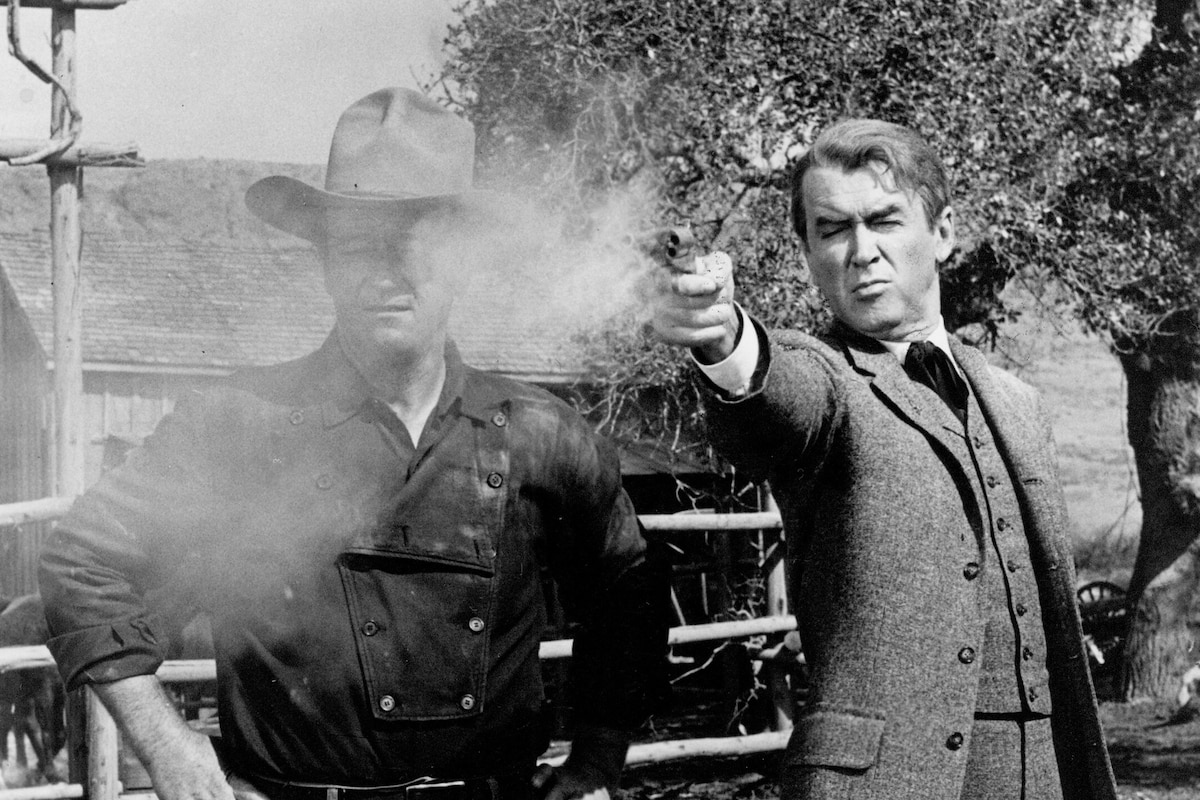
Parodies of Wayne's use of the term "Pilgrim" to refer to Stewart have turned up in various movies, including Full Metal Jacket (1987) and An American Tale: Fievel Goes West (1991).
On a 1972 episode of the British TV comedy Monty Python's Flying Circus, there is a "cheese western" spoof that mentions "The Cheese Who Shot Liberty Valance."
Although it was never used in the score for The Man Who Shot Liberty Valance, a popular pop ballad was inspired by the movie. It was written by Burt Bacharach and Hal David but not recorded until after the picture came out. It became a Top 10 hit for Gene Pitney. The tune was later recorded by Jimmie Rodgers, James Taylor, and the Royal Guardsmen.
At one point, hard-drinking newspaper editor Dutton Peabody refers to the bad guys as "Liberty Valance and his Myrmidons." The Myrmidons were figures of ancient Greek mythology, skilled warriors in Homer's Iliad commanded by Achilles. Because they were known for their fierce loyalty to their leader, the term came to be used in pre-industrial Europe almost as "robots" would be today. According to the Oxford English Dictionary, the term has since come to mean "hired ruffian" or "a loyal follower, especially one who executes orders without question, protest, or pity--unquestioning followers."
Print the Legend, a phrase taken from the movie's famous quote, is the title of a crime novel by Craig McDonald about the death of Ernest Hemingway, a study of photography in the American West, and, of course, a book about John Ford by Scott Eyman. The phrase is often invoked in any writing or discussion about a person or event whose fame has surpassed the base realties.
Sergio Leone, the director of Once Upon a Time in the West (1968), The Good, the Bad, and the Ugly (1966), and many other Westerns, was one of the directors heavily influenced by Ford. He said The Man Who Shot Liberty Valance was his favorite John Ford film because "it was the only film where he (Ford) learned about something called pessimism."
by Rob Nixon
Pop Culture 101 - The Man Who Shot Liberty Valance
by Rob Nixon | January 21, 2011
SIGN UP FOR OUR NEWSLETTERS

CONNECT WITH TCM