Born in Iowa in 1905, Dorothy M. Johnson grew up in Montana. After graduating from the state university, she moved to New York for work as a writer and editor. In 1950, she returned to Montana, edited the local paper, and joined the university faculty. Over the course of her life, she published 17 books and 52 short stories, becoming one of the most noted female writers of fiction about the American West. Her story "A Man Called Horse" was first adapted into an episode of the Wagon Train television series and later into a 1970 film. Her novel The Hanging Tree was brought to the screen by director Delmer Daves and star Gary Cooper in 1959. The Man Who Shot Liberty Valance began as a short story in Johnson's 1953 collection Indian Country.
Although he had been one of Hollywood's most respected and powerful directors for decades, John Ford was operating in a very different industry by the late 1950s. The old studio system was in its final days; most of the big companies were increasingly functioning as distributors and often only partial financers of projects initiated outside the studio. Ford had been putting together his own productions for years, but now it was becoming harder to find backing. Tastes were changing as well. Ford's work was looked on more and more as sentimental, old fashioned, and unsophisticated, and his most characteristic genre, the Western, although still popular (particularly on the rival medium of television), would not be a viable genre much longer. In this atmosphere, it was more difficult for Ford to get work and took him longer to find projects he could connect with personally. His last two productions, Sergeant Rutledge (1960) and Two Rode Together (1961), a picture that was a disappointment to him, had not been big successes. He busied himself directing his most frequent star, John Wayne, in an episode of TV's Wagon Train and doing some uncredited work on the Duke's film The Alamo (1960). So he was happy when he found Johnson's story, which had themes close to his heart and provided a good role for Wayne. Unfortunately, it would not be smooth sailing into production.
To adapt the screenplay, Ford renewed his collaboration with the writers of Sergeant Rutledge, Willis Goldbeck and James Warner Bellah. Goldbeck also signed on as co-producer.
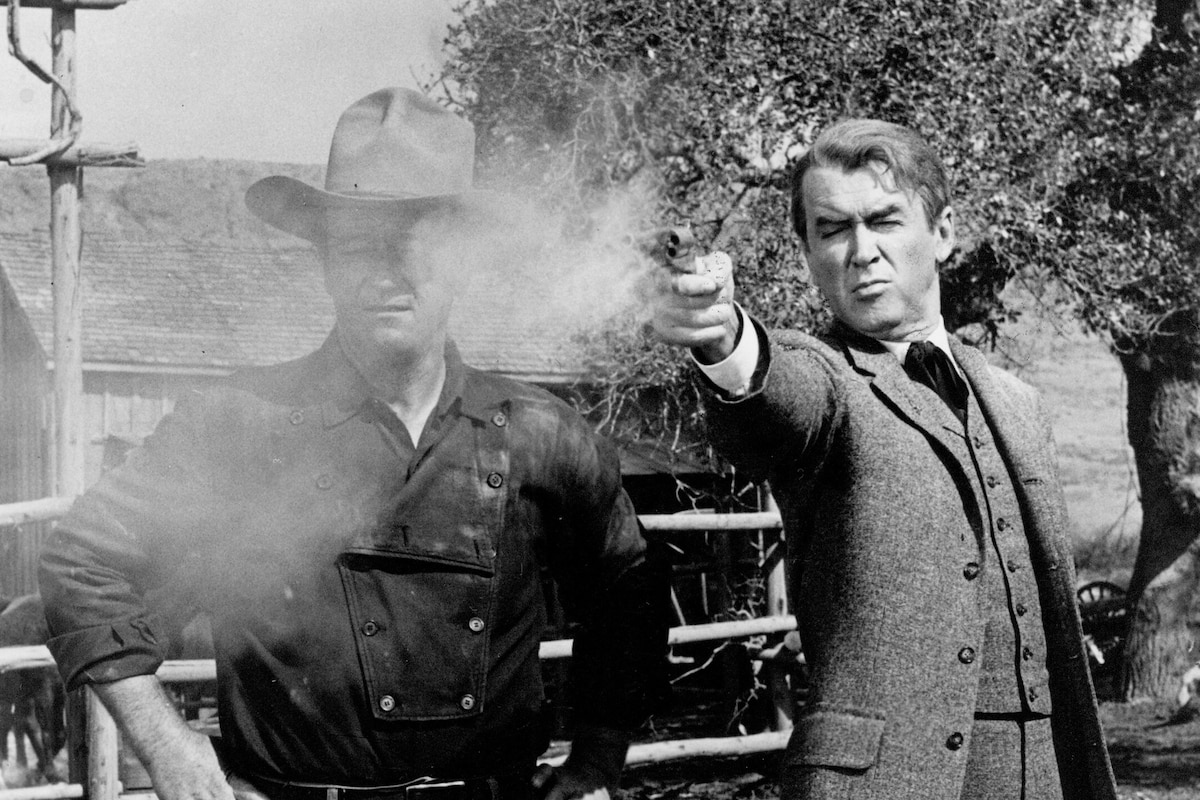
For the part of the young lawyer from the East who inadvertently becomes a town hero and successful politician, Ford chose James Stewart, whom he had worked with for the first time on Two Rode Together. Stewart genuinely liked Ford and was eager to work with him again, especially since he was less than happy about the development of his unlikable character in the earlier film, but would be playing an upstanding citizen and idealist in Liberty Valance.
Wayne convinced Ford to cast Lee Marvin, his co-star in The Comancheros (1961), as villain Liberty Valance.
John Wayne was one of Hollywood's biggest stars and had just signed a ten-picture deal with Paramount at $600,000 per film, so Ford took Liberty Valance there. But even with the director's reputation plus his agreement to come up with half the $3.2 million budget and two major stars on board, the studio was not sold on the project and took nearly half a year to greenlight it. The studio had several concerns about the project: It was downbeat in nature; Wayne's character was dead at the outset; and Stewart, who was approaching his mid-50s, would have to play a character fresh out of law school for the extensive flashback structure and a man in his 60s or older for the framing story. The company was also still smarting from the loss they incurred on Marlon Brando's One-Eyed Jacks (1961) and was not eager to make another risky Western.
Ultimately, it was Wayne's clout and his solid deal with Paramount that got the go-ahead on the project. It also probably rankled Ford to have the actor whose career he virtually created be the one he was now dependent on to get his production going.
Wayne was still on location for The Comancheros in early summer 1961 when he began getting memos about their upcoming project from Ford, who was eager to have his star back by summer's end to begin shooting Liberty Valance. "For a change, no locations," Ford wrote on July 7. "All to be shot on the lot. ... Seriously we have a great script in my humble opinion."
The script followed Johnson's story and viewpoint fairly closely with one notable exception. On the page, Tom Doniphon (Wayne's character) was more of a mentor to Ranse Stoddard (Stewart), easing him along the road from frontier lawyer to state senator. In the film, except for two notable acts that change Stoddard's life forever, Doniphon isn't quite so proactive with an eye to Stoddard's future.
In 1967, Ford was quoted as saying The Man Who Shot Liberty Valance was based on historic facts, although he never said, and evidence never revealed, what that facts might have been.
by Rob Nixon
The Big Idea - The Man Who Shot Liberty Valance
by Rob Nixon | January 21, 2011
SIGN UP FOR OUR NEWSLETTERS

CONNECT WITH TCM