SYNOPSIS
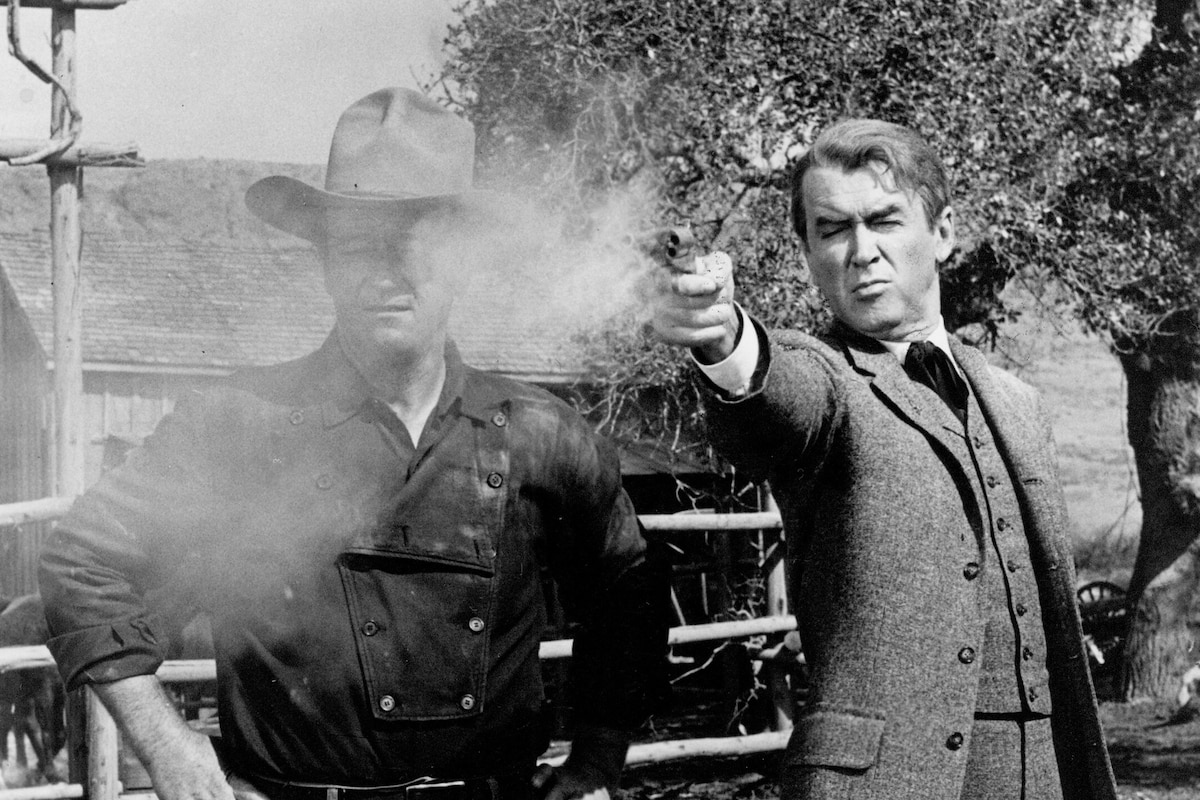
Sen. Ransom Stoddard and his wife Hallie, visitors from Washington, D.C., arrive in the Western town of Shinbone, where they met and married years before, to attend the funeral of their old friend Tom Doniphon. The couple finds the town changed from the lawless frontier they once knew. Except for a few old-timers, no one in Shinbone even remembers Tom, who was once the toughest and fastest gunman in the territory. Yet, everybody has heard about Stoddard, the man who shot Liberty Valance, a murderous outlaw who terrorized the town until his death brought law and order to the district. While Doniphon's simple coffin is readied for a pauper's burial, reporters gather around Stoddard with questions about his life and especially about his heroic act, but the senator insists on setting the record straight about the incident that made him famous.
Director: John Ford
Producer: John Ford, Willis Goldbeck
Screenplay: James Warner Bellah, Willis Goldbeck, based on the story by Dorothy M. Johnson
Cinematographer: William H. Clothier
Editor: Otho Lovering
Art Directors: Eddie Imazu, Hal Pereira
Original Music: Cyril J. Mockridge
Cast: John Wayne (Tom Doniphon), James Stewart (Ransom Stoddard), Vera Miles (Hallie Stoddard), Lee Marvin (Liberty Valance), Edmond O'Brien (Dutton Peabody), Andy Devine (Marshall Link Appleyard).
BW-124m. Letterboxed. Closed Captioning.
Why THE MAN WHO SHOT LIBERTY VALANCE is Essential
"When the legend becomes fact, print the legend." This famous line from The Man Who Shot Liberty Valance might also be the motto for John Ford's career. Although he directed in a wide range of genres, Ford is best known for his Westerns, and along with writers like Zane Grey, visual artist Frederick Remington, and perhaps a few others, no one did more to forge the legends and myths of the Old West with its heroes and villains, the codes and philosophies, the look and sound and feel of it.
Ford's was a romantic, sentimental vision of our historical past, and it frequently centered on the conflict between the wilderness and civilization, tinged with nostalgia and loss. As a younger man, with My Darling Clementine (1946), he viewed the encroachment of society into the untamed West with some sense of hope and possibility. Nearly 20 years later, The Man Who Shot Liberty Valance still depicts the inevitable demise of the "outlaw hero," the man who acts on behalf of a civilization that must always exclude his type to progress forward. But the world that replaces his is now shot through with regret, fraud, and a willful forgetting. "Aren't you proud?" Ranse Stoddard's wife asks as she looks over the "garden" that he has made from the desert. The look on his face and the final coda to the film speaks not of pride but of the realization that his entire life and career have been built on a lie, and that's a shattering truth for a man in his twilight years.
Back in 1962, many dismissed The Man Who Shot Liberty Valance as a minor, disappointing work from a master filmmaker who had seen better days. In the years following, the pendulum made a wide arc into unqualified reverence and a determination to see major significance in every tiny corner of the frame and every utterance. ("Ransom Stoddard! Get it? Ransom? And he defeats Liberty?!") A more balanced contemporary approach recognizes the film's flaws but gives it credit as the last fully realized work of one of the most important directors in American cinema history. If nothing else, as theorist Robert B. Ray has detailed, it can be taken as a perfect critical study of one of the most enduring of Hollywood tropes: the outlaw hero (Tom in Liberty Valance, Clementine's Doc Holliday, Rick in Casablanca, 1942) reluctantly drawn into cooperating with the "official" hero (Stoddard, Wyatt Earp, Victor Laszlo) to defeat a common enemy (Valance and the cattle interests, the Clantons, Nazis), usually for the mutual love of a good woman (Hallie, Clementine, Ilsa). Except the outcome in Valance is dark and painful. As some have noted about this story: The hero doesn't win; the winner isn't heroic. Destiny here is more a matter of accident and misunderstanding, and history depends entirely on who's telling it and why.
Much of the criticism leveled against The Man Who Shot Liberty Valance focused on its look, what seemed to be Ford's lack of regard for any kind of pictorial beauty. The elegant vistas of his beloved Monument Valley, the majestic sweep of the cavalry trilogy, My Darling Clementine, and The Searchers (1956), are nowhere to be seen. The film is dark and confined, shot almost entirely on a sound stage. Opposing reasons for this have been put forward: The studio, reluctant to finance a Ford Western even with stars like Wayne and Stewart, imposed the production limits; the black-and-white photography was necessary to cover the make-up that allowed 54-year-old Stewart to play both a young man just out of law school and a distinguished, elderly politician; Ford wanted to forego his usual methods in favor of concentrating on the characters and their often-suppressed emotions, motives, and truths. It has even been put forth that the casting was not as off-handed as it appears or merely arising from Ford's desire to work with actors he knew and trusted, regardless of their age inappropriateness, but rather a decision dictated by the notions of truth, legend and history inherent in the story. We don't see the characters realistically as they were years earlier but as projections of their memories, which have been distorted by legend and fateful acts from which there is no escape. Whatever the reason, the murky darkness and confined spaces of The Man Who Shot Liberty Valance perfectly reflect the gloom and pessimism of the story.
Peter Bogdanovich once pointed out that The Man Who Shot Liberty Valance was made when John Ford was 67--and he was old in terms of his health, hastened by many years of hard work and hard living. His films of the five or six years prior to this had generally not been commercial successes or critically praised, and the studio system under which he made his greatest works was changing drastically. He was now in the position of begging for financing, and the only reason he got it for this picture was because he had John Wayne, the actor he had made into a star, a film legend almost single-handedly forged by Ford himself. "I think the world he knew was collapsing," Bogdanovich said. Perhaps in this story, Ford found a telling parallel to his late-life realizations and one last comment on the West he had virtually created on screen.
by Rob Nixon
The Essentials - The Man Who Shot Liberty Valance
by Rob Nixon | January 21, 2011
SIGN UP FOR OUR NEWSLETTERS

CONNECT WITH TCM