In the early to mid 1950s, British drama and literature took a drastic turn away from the genteel, understated works that, along with the classics, had been the usual theatrical fare, typified by the playwright Terence Rattigan (The Winslow Boy, Separate Tables). A new group of writers, among them John Osborne and Kingsley Amis, rose to prominence with stories generally set among the working classes and the disaffected; these were often set in the industrial Midlands and north of England, and characterized by stark settings, themes of alienation and disillusionment with British society, and a leftist, even anarchistic, political point of view. The first significant work of this kind was Osborne's play Look Back in Anger, which caused a sensation when it premiered in 1956. This very loosely defined group became known as "Angry Young Men" (a term most rejected). As this form of social realism developed across the arts in Great Britain, critics and cultural commentators began to refer to it as Kitchen Sink Drama--frequently a negative term, even as the style grew in popularity.
One of the writers who became associated with this "school" was Alan Sillitoe, a child of the working class of Nottingham, which was then very much a factory city. Largely self-educated and suffering from tuberculosis as a young man, Sillitoe took to writing while living on a meager government pension and published his first book, Saturday Night and Sunday Morning in 1958, a novel about a philandering young factory worker that limned the lack of options and opportunities for the working class in post-war Britain. The following year, Sillitoe published a collection of short stories named for the book's most notable story, The Loneliness of the Long Distance Runner. The book was awarded the prestigious Hawthornden Prize for literature, helping greatly to establish Sillitoe and the "Angry Young Man" school in British culture. In his autobiography, Sillitoe said he did not feel "part of the 'angry young man' movement, if such there was, and I can't think of any writers who did, for the label was used by journalists and others who wanted to classify those who wrote in ways they didn't understand or care for--to define so as to defuse."
Corresponding to these changes in theater and literature, British film began to undergo a transformation after the war. The film It Always Rains on Sunday (1947) was an early example of a trend toward depicting the harsh realities of post-war life and the ill effects of grinding poverty. A few years later, a documentary film movement emerged, beginning with a screening of three short films at the National Film Theatre in London on February 5, 1956--Lindsay Anderson's O Dreamland (1953), about an amusement park in Margate, Kent; a documentary about a North London jazz club, Momma Don't Allow (1955), the first film for co-directors Karel Reisz and Tony Richardson, who had just begun his career as a stage and television director the year before; and a documentary-style fiction film, Together (1956) by Lorenza Mazzetti, about a pair of deaf-mutes in London's war-ravaged East End, one of the city's poorest districts. Anderson and Mazzetti drew up a manifesto for what would become known as the Free Cinema movement, touting the filmmakers' "belief in freedom, in the importance of people and the significance of everyday life."
Tony Richardson began his directing career on television with productions for the BBC in the early 50s. In 1955, he founded the English Stage Company, which led to his directing Osborne's Look Back in Anger at London's Royal Court Theatre and later on Broadway. In the next few years, he was one of England's busiest directors, overseeing productions of Shakespeare, Ionesco, and Osborne's next play, The Entertainer, starring Laurence Olivier as a failing music hall performer. In 1959, Richardson and Osborne formed Woodfall Films, largely to retain a degree of artistic control over film adaptations of Osborne's work. Despite his lack of feature film experience, Richardson was given the reins of Look Back in Anger (1959). The film was a landmark, initiating what would become known variously as the British New Wave and the Kitchen Sink film dramas.
Richardson produced another important work in the genre, Saturday Night and Sunday Morning (1960), based on Sillitoe's book and directed by Karel Reisz. The film starred Albert Finney, a rising young stage star whose only previous feature film role had been in Richardson's film version of Osborne's The Entertainer (1960).
After a bad experience in Hollywood directing the William Faulkner adaptation Sanctuary (1961) for Fox, Richardson returned to England determined to do films his way, which meant, chief among other things, choosing his own locations to achieve the greatest degree of realism possible. In his film version of Shelagh Delaney's play A Taste of Honey (1961), Richardson took location filming farther than it had ever gone in any major British production. It was also the second time he worked with cinematographer Walter Lassally (after Momma Don't Allow), one of the leading artists of the Free Cinema movement. Together they developed a look and style that would serve them well in their next production.
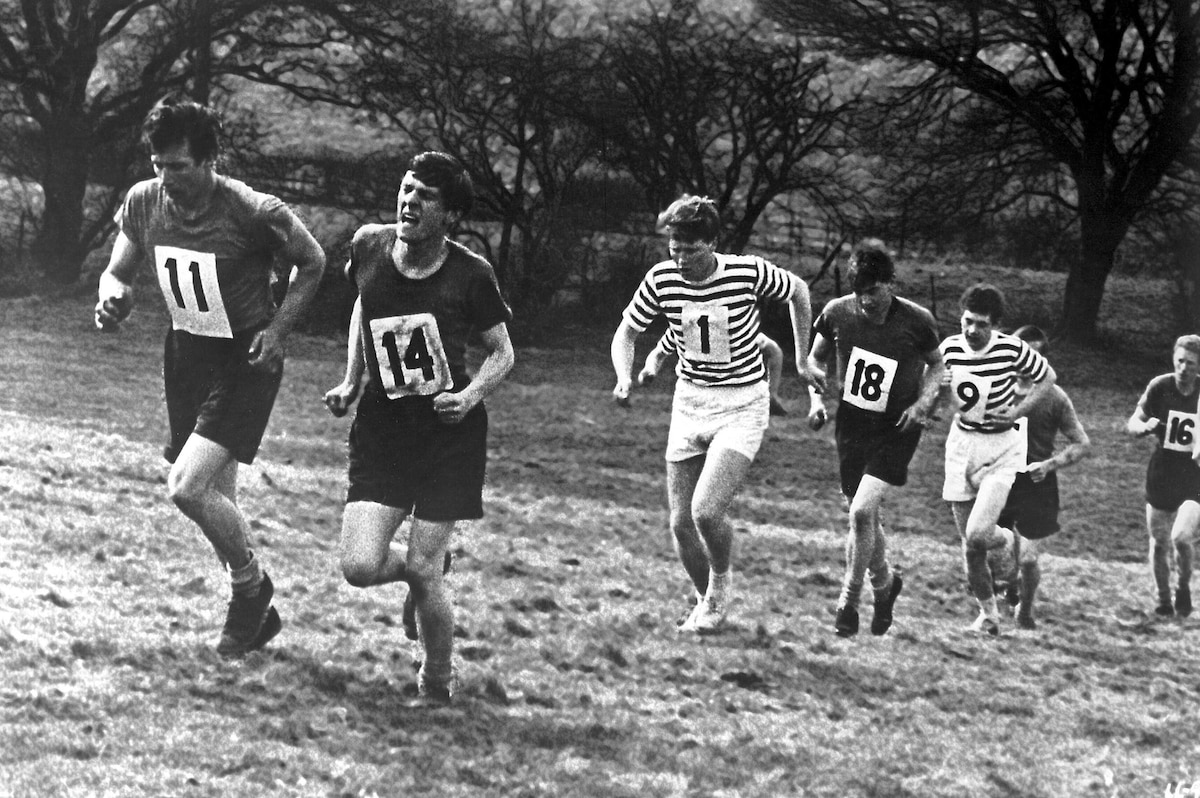
Richardson acquired the rights to Sillitoe's short story about a working class boy sent to a borstal (reform school) after committing a robbery. Sillitoe was paid 6,000 pounds for the rights and for his work on the screenplay of The Loneliness of the Long Distance Runner (1962).
In expanding the story for the screen, Sillitoe and Richardson hit on the idea of using extensive flashbacks to contrast the lyrical, poetic feel of the lead character's solitary cross-country runs with memories of the harsh, gritty life in Nottingham that led to his incarceration. The short story's lead character, known only as "Smith" in the book, became the more fully fleshed out Colin Smith of the movie, a somewhat more romanticized and heroically sympathetic figure than his colder and more brutal counterpart in the book.
Richardson snagged Lassally and many of the crew from A Taste of Honey to work on the new picture.
After being forced by co-financiers Warner Brothers to use top names such as Richard Burton, Edith Evans, and Claire Bloom in the film of Look Back in Anger, Richardson preferred to find new young talent like Saturday Night and Sunday Morning's Albert Finney and A Taste of Honey's Rita Tushingham, actors less known by the public and more capable of bringing greater realism to their roles. For Loneliness, he found his star in Tom Courtenay, a young stage actor who had drawn good notices for his work in Shakespeare productions and for taking over (from Albert Finney) the lead in Billy Liar, a play that more or less fit into the kitchen sink category, although it was far more comic than others of that type.
In his less than reliable autobiography, Richardson claims to have cast Courtenay after meeting him at a party, but other sources claim the director made his decision after seeing the actor in a British television play. Courtenay said he was recommended to Richardson by John Osborne and critic Penelope Gilliatt, who had seen him in Chekhov's The Seagull on stage. "I had a ten-minute interview, and 18 months later we made the film." Richardson's book also erroneously claims Courtenay's only previous role had been in The Seagull.
For the part of the borstal governor, Richardson cast Michael Redgrave, a long-respected member of the old school acting establishment who made a nice contrast with the relatively unknown Courtenay as the anti-establishment figure.
by Rob Nixon
The Big Idea - The Loneliness of the Long Distance Runner
by Rob Nixon | January 21, 2011
SIGN UP FOR OUR NEWSLETTERS

CONNECT WITH TCM