SYNOPSIS
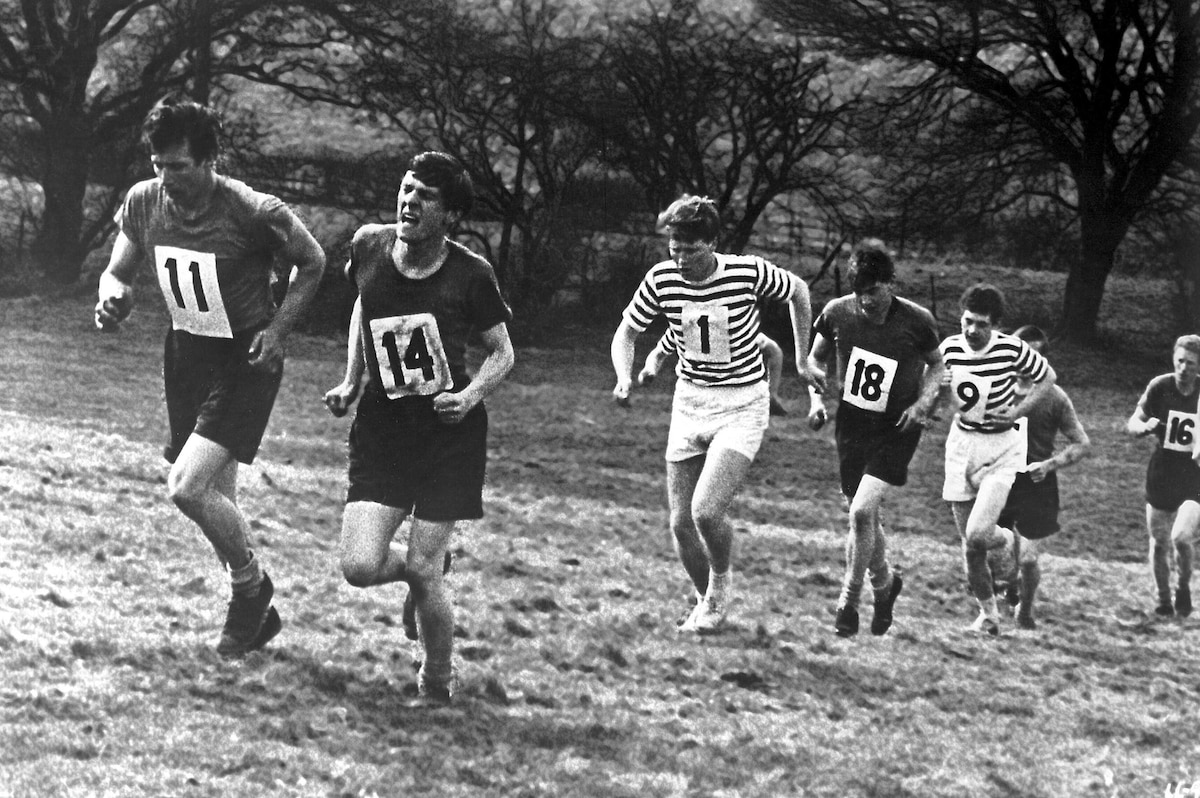
Colin Smith, an aimless working class youth, is sent to borstal (British reform school) after his impulsive robbery of a local bakery. While incarcerated, the rebellious and surly young man discovers a talent for long distance running, and in his long cross-country runs, he thinks back to his life in the poor districts of industrial Nottingham and the circumstances that brought him to a reformatory. The school's governor, seeing an opportunity to best a respectable boys school in a track competition, encourages Colin to train and perfect his abilities, suggesting the boy might find a new life and way out of his miserable circumstances by competing all the way to the Olympics. But will Colin's pride in his skills outweigh his strong views about cooperating with an established authority he despises?
Director: Tony Richardson
Producers: Tony Richardson, Michael Holden
Screenplay: Alan Sillitoe, based on his short story
Cinematography: Walter Lassally
Editing: Antony Gibbs
Art Direction: Ted Marshall
Production Design: Ralph Brinton
Original Music: John Addison
Cast: Michael Redgrave (Governor), Tom Courtenay (Colin Smith), Avis Bunnage (Mrs. Smith), Alec McCowen (Brown), James Bolam (Mike), Topsy Jane (Audrey).
BW-104m.
Why THE LONELINESS OF THE LONG DISTANCE RUNNER is Essential
The late 1950s and early 60s saw some major changes in the established film industries of several countries. As the old studio system started to collapse and more independent productions made their way into mainstream movie houses, Hollywood began to take on more controversial subjects and slowly relax its restrictions on sex and violence. In France, critics coined the term "Nouvelle Vague" (New Wave) for the work of young filmmakers inspired by classical Hollywood genres and experimenting with radical narrative devices that rejected both the conservative political establishment and the French cinema's "tradition of quality."
Great Britain had its own New Wave, led by such filmmakers as Karel Reisz, Lindsay Anderson, and Tony Richardson. British cinema had long ignored or marginalized the country's working classes, the very people who made up the bulk of its audience, in favor of more genteel tales set in the middle and upper classes. The change came first with darker, grittier noir films of the post-war period, and then with the emergence of these new artists, who took the techniques and subject matter of the Free Cinema documentary movement they started in the mid 50s and applied them to the work of so-called "angry young man" writers like John Osborne and Alan Sillitoe.
The Loneliness of the Long Distance Runner was one of the key films of the new era. In it we see all the hallmarks of the British New Wave: a preference for location work over studio shooting, casting relative unknowns from the stage, the use of hand-held cameras and minimal lighting, and a story of working-class life taken from an award-winning collection by Sillitoe, one of the key creators of what had become known as "kitchen sink realism."
Not everyone liked where this film took the new realist style, certainly not the cultural establishment. Some critics saw in the tale of a defiant reform school inmate a leftist-anarchist view of the damaging effects of Britain's class system and dismissed it as communist propaganda. Others rejected it on purely cinematic grounds, saying its use of jump cuts, overlapping sound, and speeded-up footage was too derivative of such French New Wave directors such as Truffaut and Godard. On the other hand, many praised its combination of compassion and agitation and the use of flashbacks to contrast gritty realist settings with moments of lyrical grace. They regarded the film's almost casual anti-style as an effective exploration of emotions that avoided sentimentality.
Even the most hostile reviews had to admit admiration for Tom Courtenay, a promising young stage performer making his film debut. His unmannered style and ordinary looks made him one of the most exciting and sought-after actors of this new generation. Courtenay's performance, aided by the greater dimensionality Sillitoe added to the nihilist character he created in his short story, brought an authenticity and honesty to the picture that some found lacking in others of its type. In fact, The Loneliness of the Long Distance Runner may be seen as a shift away from the angry brutality of the 50s "angry young man" films toward the more aware and considered rebellion of the 1960s. The earlier films were often slammed for, as one critic put it, "presenting us less with the unique quality of individual life than with the broad general outlines of sociological types." Here, Richardson and Courtenay strove to more fully illuminate the character in both rough and tender moments and give rise to a deeper understanding, if not outright sympathy. They also leavened the grimmer realities with welcome humor, as in a ludicrous, self-important television speech by a Tory politician that is no less biting for all the comedy mined from it.
The Loneliness of the Long Distance Runner, regardless of one's emotional response to its characters and story or appreciation of its technique, is important as a historical document and a lasting reflection of its time. Removed from the stiff upper-lip English society that weathered World War II (brilliantly but subtly alluded to in scenes of the borstal inmates dismantling old gas masks) but not yet reflective of the Swinging London to come a few years later, the film is a prime example of a brief cinematic "movement." It also marks the end of an era, at least for the artists who gave birth to the New Wave.
Tony Richardson's next project was an iconoclastic but lavish period comedy adapted from an 18th century novel, Tom Jones (1963). He never truly returned to the "kitchen sink" style of film he was so instrumental in creating. Woodfall, the company he founded with John Osborne, continued to produce films into the 1980s, but Richardson and Osborne soon parted ways, and the remaining films considered part of the British New Wave would be handled by new directors such as John Schlesinger, Ken Loach, and Richard Lester. As for "angry young man" Alan Sillitoe (a description he firmly rejected), although prolific until late in life, he was connected to only two more feature films besides Loneliness and Saturday Night and Sunday Morning (1960); one was a war melodrama, Counterpoint (1967), based on his novel The General, and the other was The Ragman's Daughter (1972), from his original screenplay. The latter was more like a homage to the type of film that had such an impact in its time but died off in the late 1960s.
by Rob Nixon
The Essentials - The Loneliness of the Long Distance Runner
by Rob Nixon | January 21, 2011
SIGN UP FOR OUR NEWSLETTERS

CONNECT WITH TCM