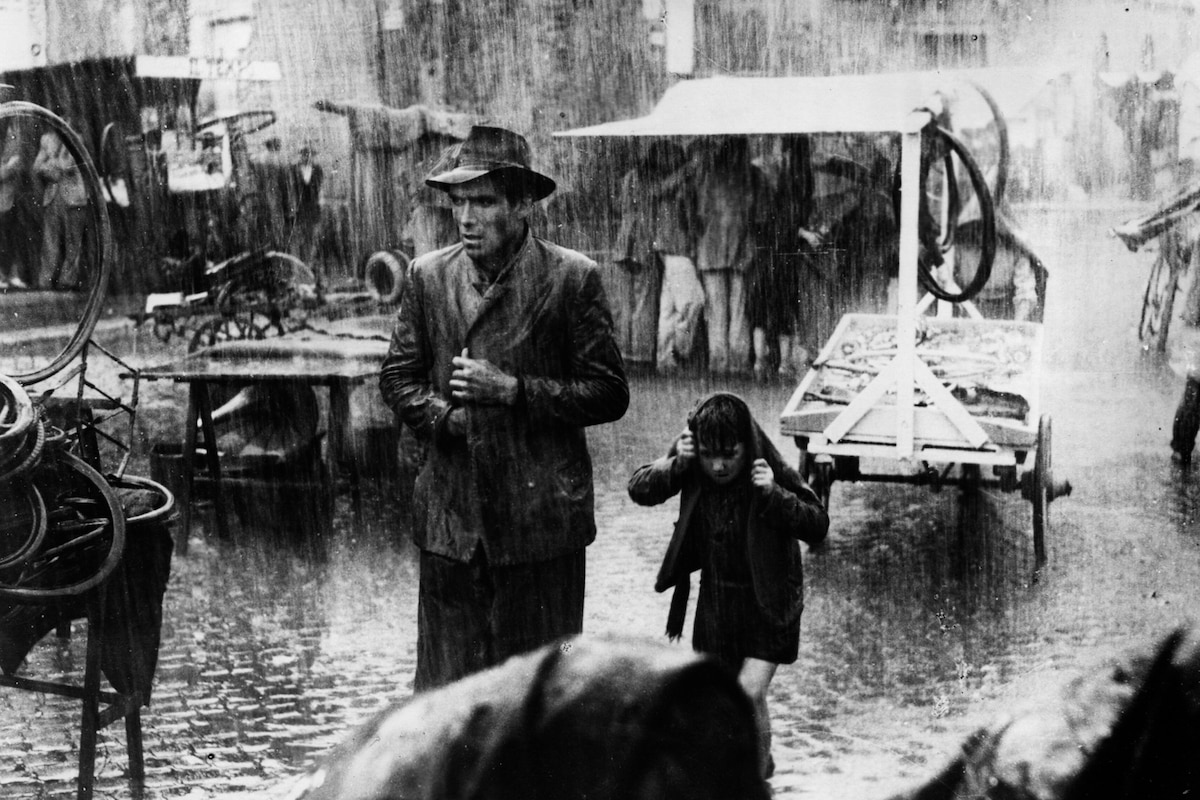
The film's proper title would be Bicycle Thieves, but it was turned to the singular for its U.S. release. The original not only links Antonio, who attempts to steal a bicycle at the film's climax, with the thief who had stolen his vehicle, but suggests that in a world riddled with poverty we are all thieves. Each person's success robs another of his livelihood.
The Bicycle Thief's U.S. distributors, Arthur Mayer and Joseph Burstyn, applied for a Production Code Seal of Approval so the film could play the major second run chains after its art house run. PCA head Joseph Breen said he would approve the film with two cuts, a brief moment in which Antonio's son, Bruno, tries to relieve himself against a wall and the scene in which Antonio chases the thief into a brothel. De Sica refused to allow the cuts, so Mayer and Burstyn appealed Breen's decision, only to have representatives of the major studios side with the PCA. When word of the disagreement got out, the press pilloried Breen and the Code, claiming that he only demanded the cuts to protect Hollywood films from competition. It didn't help that he had allowed a joke about urination in 20th Century-Fox's Cheaper by the Dozen and a brothel scene in Universal's Buccaneer Gold (both 1950). The charge of protectionism makes little sense. Even with The Bicycle Thief's art house success, it was not likely to pose a serious threat to the escapist entertainments of Hollywood.
While the film's PCA status was under appeal, Mayer and Burstyn did little to ingratiate themselves to Breen by placing an ad in New York papers picturing a caricature of Bruno, seen from the rear and saying "Please come and see me before they cut me out of Bicycle Thief!"
The PCA's parent organization, the Motion Picture Producers Association (MPPA) had recently amended its rules to exempt distributors from the fine for presenting films that did not bear the Code's Seal of Approval. When it became clear that The Bicycle Thief would not pass the Code, the Skouras Circuit became the first major independent theatre chain to book a film without the Seal. Two other independent chains picked it up almost immediately.
The poster Antonio is putting up before his bicycle is stolen is for the 1946 Rita Hayworth classic Gilda.
The brand name on Antonio's bicycle is Fides, the Italian for "faith," symbolically relating its loss to the loss of faith in traditional institutions.
After The Bicycle Thief was completed, Lamberto Maggiorani lost his job as a steelworker, experiencing his character's poverty first hand.
SOURCES:
Censored Hollywood: Sex, Sin & Violence on Screen by Frank Miller
Memorable Quotes from THE BICYCLE THIEF
"You live and you suffer." -- Lamberto Maggiorani, as Antonio Ricci.
"Why should I kill myself working when I'll end up just as dead?" -- Maggiorani, as Antonio.
"There's a cure for everything except death." -- Maggiorani, as Antonio.
"I've been cursed since the day I was born." -- Maggiorani.
"Your mother and her prayers can't help us." -- Maggiorani.
"I mind my own business, I bother nobody, and what do I get? Trouble." -- Giulio Chiari, as The Beggar.
"Either you will find it immediately or you will never find it." -- Ida
Bracci Dorati, as La Santona.
Compiled by Frank Miller
Trivia - The Bicycle Thief - Trivia & Fun Facts About THE BICYCLE THIEF
by Frank Miller | January 21, 2011
SIGN UP FOR OUR NEWSLETTERS

CONNECT WITH TCM