Awards & Honors
Zavattini's screenplay for The Bicycle Thief was nominated for an Academy Award®, but lost to Joseph L. Mankiewicz's A Letter to Three Wives (1949).
The Bicycle Thief won the Grand Prize at the Brussels Film Festival, the BAFTA (British Academy of Film and Television Arts) Award for Best Film from any Source, the Golden Globe for Best Foreign Film, the National Board of Review Awards for Best Film and Best Director and the New York Film Critics Award for Best Foreign Language Film. It also received a special Academy Award® as the year's outstanding foreign-language film (the competitive category had not yet been created).
In Sight & Sound magazine's first poll to name the best films of all time, conducted in 1952, a group of critics voted The Bicycle Thief the top spot. It fell to seventh in 1962 and then lost its place on the list. In the magazine's 2002 poll of film directors, however, it captured sixth place.
The Bicycle Thief made it to the top ten (listed alphabetically) in the British Film Institute's poll of filmmakers, teachers and critics to name "The 50 Films You Should See by the Age of 14."
Critic Reviews: THE BICYCLE THIEF
"Made with a cast of principals who were picked up in Rome's streets and had never before faced a camera, and with a story [from a novel by Luigi Bartolini] incredible in its simplicity as a basis for a 90-minute film, the picture is a pure exercise in directorial virtuosity. The beauty of it, however, is that that is never apparent. There are no obvious tricks and no obvious striving."
- Variety.
"Again the Italians have sent us a brilliant and devastating film in Vittorio De Sica's rueful drama of modern city life, The Bicycle Thief. Widely and fervently heralded by those who had seen it abroad (where it already has won several prizes at various film festivals), this heart-tearing picture of frustration, which came to [the World Theater] yesterday, bids fair to fulfill all the forecasts of its absolute triumph over here. For once more the talented De Sica, who gave us the shattering Shoeshine (1946), that desperately tragic demonstration of juvenile corruption in post-war Rome, has laid hold upon and sharply imaged in simple and realistic terms a major -- indeed, a fundamental and universal -- dramatic theme. It is the isolation and loneliness of the little man in this complex social world that is ironically blessed with institutions to comfort and protect mankind."
- Bosley Crowther, The New York Times
"This story of a poor man's search for his stolen bicycle is deceptively simple. At first, there is ironic tenderness: humanity observed with compassion but without illusion. Then the search becomes an odyssey of poverty, encompassing much more than the realistic method leads you to expect. And the richness and the enigmas sneak up on you. What is the meaning of the seeress's words? How is it that the hero who is searching for the bicycle thief becomes the bicycle thief?"
- Pauline Kael, 5,0001 Nights at the Movies
"This is the most important film of the immediate postwar period; its extension of the traditional concepts of plot and dramatic structure exerted considerable influence on the development of the cinema...The film's main theme is unemployment in a country where unemployment seemed a chronic disease. Beyond this, however, it is concerned with the loneliness of man in a dehumanized society."
- Georges Sadoul, Dictionary of Films
"The tight structure and the quietly effective social criticism are enriched by the gently romantic vein which enables De Sica to avoid the stridency of Sciuscia (Shoeshine)...Ladri di biciclette powerfully criticizes the forces - the Church among them - which reduce people to disillusion and despair; it remains both sharp and relevant, despite its apparently dated conventions."
- The Oxford Companion to Film
"De Sica'a direct and unadorned approach to cinema is at its best here. The film is compassionate where it could be cynical; severe where it could be complaisant; somber where it could be picturesque."
- Peter Cowie, 80 Years of Cinema
"The Bicycle Thief is so well-entrenched as an official masterpiece that it is a little startling to visit it again after many years and realize that it is still alive and has strength and freshness....This story is so direct it plays more like a parable than a drama. At the time it was released, it was seen as a Marxist fable (Zavattini was a member of the Italian communist party). Later, the leftist writer Joel Kanoff criticized the ending as "sublimely Chaplinesque but insufficiently socially critical"....But if the film is allowed to wait long enough--until the filmmakers are dead, until neorealism is less an inspiration than a memory--The Bicycle Thief escapes from its critics and becomes, once again, a story. It is happiest that way."
- Roger Ebert
"...the film is moving, even if the attempt on our heartstrings is so blatant and so much at odds with the thing that is really striking and beautiful: the sense of the streets of a great city where nearly everyone is having a hard time....The nature of the tale is obtrusive, whereas the atmosphere of the streets is stunning. And that was what was really new: the untidy infinity of life made to seem like the crowd, or all of Italy."
- David Thomson, Have You Seen...?
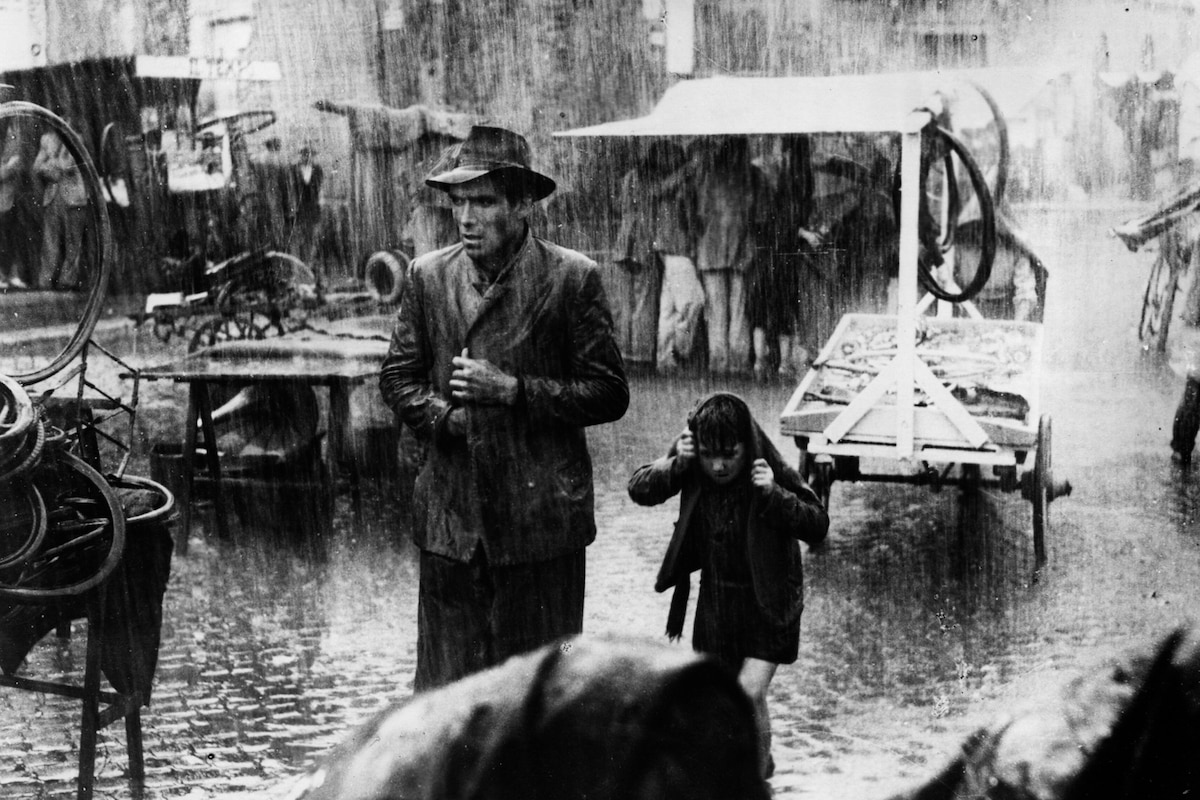
"The roles are played by non-actors, Lamberto Maggiorani as the father and Enzo Staiola as the solemn boy, who sometimes appears to be a miniature man. They bring a grave dignity to De Sica's unblinking view of post-war Italy. The wheel of life turns and grinds people down; the man who was riding high in the morning is brought low by nightfall. It is impossible to imagine this story in any other form than De Sica's. The new black-and-white print has an extraordinary range of gray tones that get darker as life closes in."
- Bob Graham, The San Francisco Chronicle
Compiled by Frank Miller
Critics' Corner - The Bicycle Thief
by Frank Miller | January 21, 2011
SIGN UP FOR OUR NEWSLETTERS

CONNECT WITH TCM