In early drafts of the screenplay, Norma Desmond hired the Joe Gillis character to co-author her memoirs. Changing the autobiography to a screenplay for her comeback role put more at stake for the character.
During filming, director Billy Wilder complimented Erich von Stroheim, saying, "Von, you were always 10 years ahead of your time." Von Stroheim replied, "Twenty."
The silent film Norma screens for Joe is Queen Kelly (1929). Swanson had hired Erich von Stroheim (Max) to direct the film, but had him fired a third of the way through production. A hastily assembled version with new scenes was released in Europe, but could not be shown in America until 1966 because of legal problems with von Stroheim and his estate. In 1985, Kino International released a restored version using stills and titles to fill in for unshot scenes and lost footage from von Stroheim's version.
One suggestion from von Stroheim that Wilder did not follow was the director's idea for a scene in which Max is shown washing and ironing Norma's underwear. The idea had come from Three Faces East, a 1930 film in which he had appeared with Constance Bennett.
Greta Garbo, who had worked with Wilder on Ninotchka (1939), agreed to let him mention her name in the film, but when she saw it she was sorry she had. She felt the mention depicted her as a star of the past, relegating her to the history books. "I thought Billy Wilder was a friend of mine," she said.
Joe Gillis's birthday, which he tells Norma early in the film is December 21, is the same as Wilder's daughter Victoria.
When crew members asked Wilder how he was going to shoot the burial of Norma's monkey, one of the film's most bizarre scenes, he just said, "You know, the usual monkey-funeral sequence."
Norma Desmond's ornate bed was once owned by dancer Gaby de Lys.
For the bridge scene, Wilder brought in former silent stars Anna Q. Nilsson, H.B. Warner and Buster Keaton. Ironically, Keaton had been addicted to bridge during his days as a star, often playing for hours in his dressing room, particularly when one of his marriages was on the rocks.
The film Cecil B. DeMille is shooting during Norma's visit is Samson and Delilah (1949), the top-grossing picture of its year.
Originally Wilder had planned to include a cameo by Hedy Lamarr, who played Delilah. DeMille was supposed to ask her to give her chair on the set to Norma. When Lamarr demanded $25,000 to appear, Wilder cut her from the scene. She then demanded $10,000 for the use of her name on the chair. Instead, Wilder simply had DeMille offer Norma his own chair.
DeMille had actually helped make Swanson a star, directing her in such early hits as Male and Female and Don't Change Your Husband (both 1919). Like the DeMille in the movie, the real life director used to address Swanson on the set as "young fellow."
The peacock feather in Norma's hat when she goes to visit DeMille is a reference to the peacock headdress she had worn in Male and Female.
Stage 18, where Norma visits DeMille, really was his favorite sound stage, often referred to as "The DeMille Stage." In later years, it was home to the Star Trek TV series.
After DeMille finished his scene, Wilder is reported to have said, "Very good, my boy. Leave your name with my secretary. I may have a small part for you in my next picture."
DeMille demanded $10,000 for his scene in Sunset Blvd. When Wilder needed to re-take a close-up, the rival director only agreed if Paramount bought him a new car and paid him another $3,300.
The idea behind the script on which Joe Gillis and Betty Schaefer are working is based on a script Wilder and Max Kolpe wrote in 1932 for the German film Das Blaue vom Himmel.
The love theme Franz Waxman composed for Joe and Betty was actually the Paramount newsreel theme slowed down.
The scene in which Swanson performs for Holden drew on more of the star's past. Although she had never been one of Mack Sennett's bathing beauties, she had starred in his films at the start of her career. She had previously imitated Charles Chaplin on screen in Manhandled (1924).
The day Swanson filmed her Chaplin imitation, she arrived on the set to find the entire crew wearing derby hats like the Little Tramp's. While filming the monkey's burial a few day's later, she discovered that the stuffed animal had one on as well.
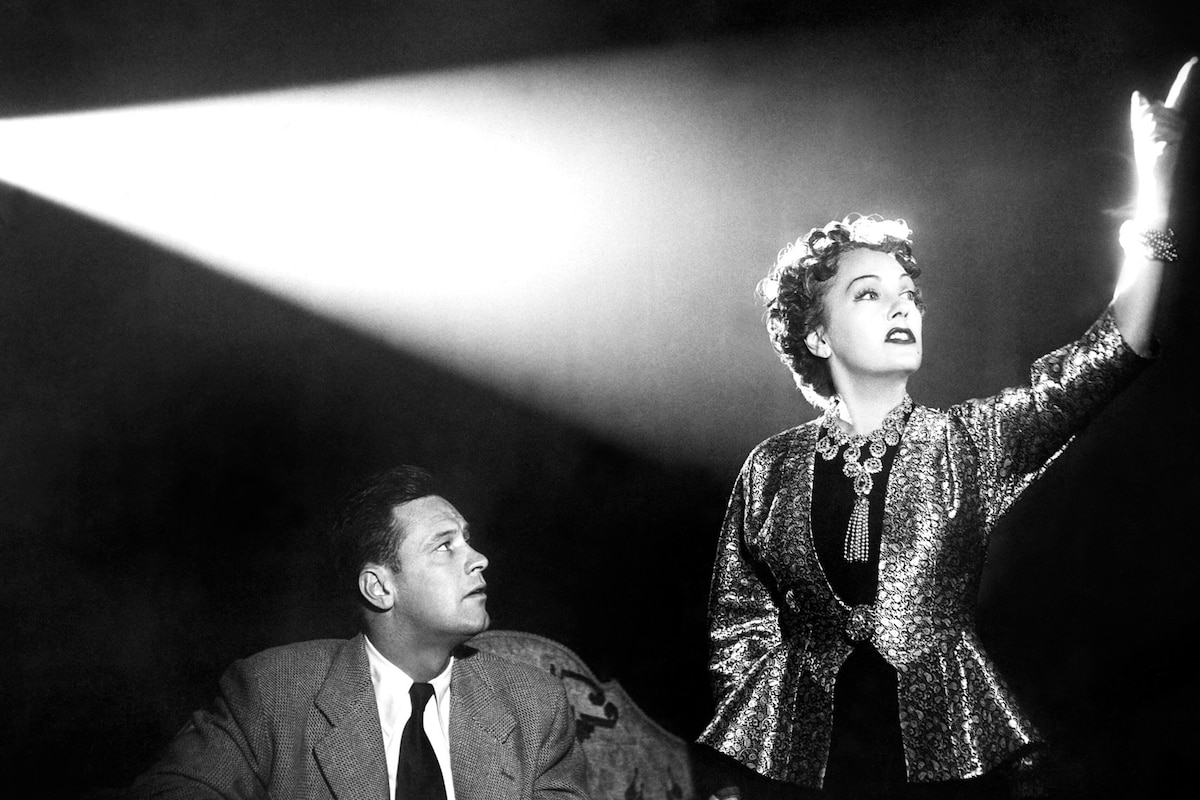
When Swanson realized she would have to walk down the narrowest side of the staircase for her final scene, she kicked off her heels and played the scene barefoot.
As in silent film days, Wilder played music on the set to keep Swanson in the right mood for her staircase descent. Appropriately, since she thought she was playing Salome, it was the "Dance of the Seven Veils" from Richard Strauss' opera Salome.
Brackett was paid $130,000 for producing Sunset Blvd but nothing for writing it. D.M. Marshman received $11,600 for his contributions to the screenplay. Wilder's writing fee came to $211,416, with another $90,000 for directing.
When he was nominated for the Oscar® for Best Supporting Actor, von Stroheim protested that he was too big a star for such an insult and threatened to sue.
The Sunset Blvd mansion was torn down in 1957 and replaced by a 22 floor business complex that houses the Getty Oil Company. Its address is 3810 Wilshire Boulevard.
Famous Quotes from SUNSET BLVD
"Poor dope. He always wanted a pool. Well, in the end, he got himself a pool -- only the price turned out to be a little high." -- William Holden, as Joe Gillis.
"I got myself ten nickels and started sending out a general S.O.S. Couldn't get hold of my agent, naturally. So then I called a pal of mine, name of Artie Green -- an awful nice guy, an assistant director. He could let me have 20, but 20 wouldn't do. Then I talked to a couple of yes men at Metro. To me they said no." -- Holden, as Joe Gillis.
"I had landed myself in the driveway of some big mansion that looked rundown and deserted ....It was a great big white elephant of a place. The kind crazy movie people built in the crazy twenties. A neglected house gets an unhappy look. This one had it in spades. It was like that old woman in Great Expectations -- that Miss Havisham in her rotting wedding dress and her torn veil, taking it out on the world because she's been given the go-by." -- Holden, as Joe, describing the house on Sunset Blvd.
"I am big. It's the pictures that got small." -- Gloria Swanson, as Norma Desmond.
"They took the idols and smashed them, the Fairbankses, the Gilberts, the Valentinos! And who've we got now? Some nobodies -- a lot of pale little frogs croaking pish-posh!" -- Swanson, as Norma Desmond.
"There once was a time in this business when we had the eyes of the whole world! But that wasn't good enough for them, oh no! They had to have the ears of the whole world too. So they opened their big mouths and out came talk. Talk! TALK!" -- Swanson, as Norma.
"Don't get sore at me. I'm not an executive. I'm just a writer."
"You are! Writing words, words! You've made a rope of words and strangled this business! But there is a microphone right there to catch the last gurgles, and Technicolor to photograph the swollen tongue." -- Holden and Swanson.
"Poor devil, still waving to a parade which has long since passed her by." -- Holden, describing Swanson.
"I didn't know you were planning a comeback."
"I hate that word. It's a return, a return to the millions of people who have never forgiven me for deserting the screen." -- Holden and Swanson, discussing her plans for Salome.
"She was the greatest of them all. You wouldn't know, you're too young. In one week she received 17,000 fan letters. Men bribed her hairdresser to get a lock of her hair. There was a maharajah who came all the way from India to beg one of her silk stockings. Later he strangled himself with it!" -- Erich von Stroheim, as Max von Mayerling.
"We didn't need dialogue. We had faces." -- Swanson, viewing herself in Queen Kelly.
"Fans, you all know Joe Gillis, the well-known screenwriter, opium smuggler, and Black Dahlia suspect." -- Jack Webb, as Artie Green, welcoming Holden to his New Year's Eve party.
"You're the only person in this stinking town who's been good to me." -- Holden, comforting Swanson after her suicide attempt.
"A dozen press agents working overtime can do terrible things to the human spirit." -- Cecil B. DeMille, as himself, explaining what happened to Norma Desmond.
"Look at this street. All cardboard, all hollow, all phony. All done with mirrors. I like it better than any street in the world. Maybe because I used to play here when I was a kid." -- Nancy Olson, as Betty Schaefer, walking through the back lot with Holden.
"You must understand, I discovered her at 16. I made her a star, and I cannot let her be destroyed." -- Von Stroheim, as Max von Mayerling, revealing his bond with Swanson.
"You'd be killing yourself for an empty house. The audience left 20 years ago." -- Holden, leaving Swanson.
"Madam is the greatest star of them all." -- Von Stroheim, as Max.
"No one ever leaves Norma Desmond." -- Swanson, responding to Holden's departure.
"The stars are ageless, aren't they?" -- Swanson, after she kills Holden.
"So they were turning again. Those cameras, which can be strangely merciful, had taken pity on Norma Desmond. The dream she had clung to so desperately had enfolded her." -- Holden, describing Swanson's appearance before the newsreel cameras.
"I can't go on with the scene. I'm too happy. Do you mind, Mr. DeMille, if I say a few words. Thank you. I just want to tell you how happy I am to be back in the studio making a picture again. You don't know how much I've missed all of you. And I promise you I'll never desert you again, because after Salome we'll make another picture, and another and another. You see, this is my life. It always will be. There's nothing else -- just you and me and those wonderful people out there in the dark...All right, Mr. DeMille, I'm ready for my close-up." -- Swanson, imagining she has returned to the movies in the film's final speech.
Compiled by Frank Miller
Trivia - Sunset Blvd. - Trivia & Fun Facts About SUNSET BLVD
by Frank Miller | January 20, 2011
SIGN UP FOR OUR NEWSLETTERS

CONNECT WITH TCM