SYNOPSIS
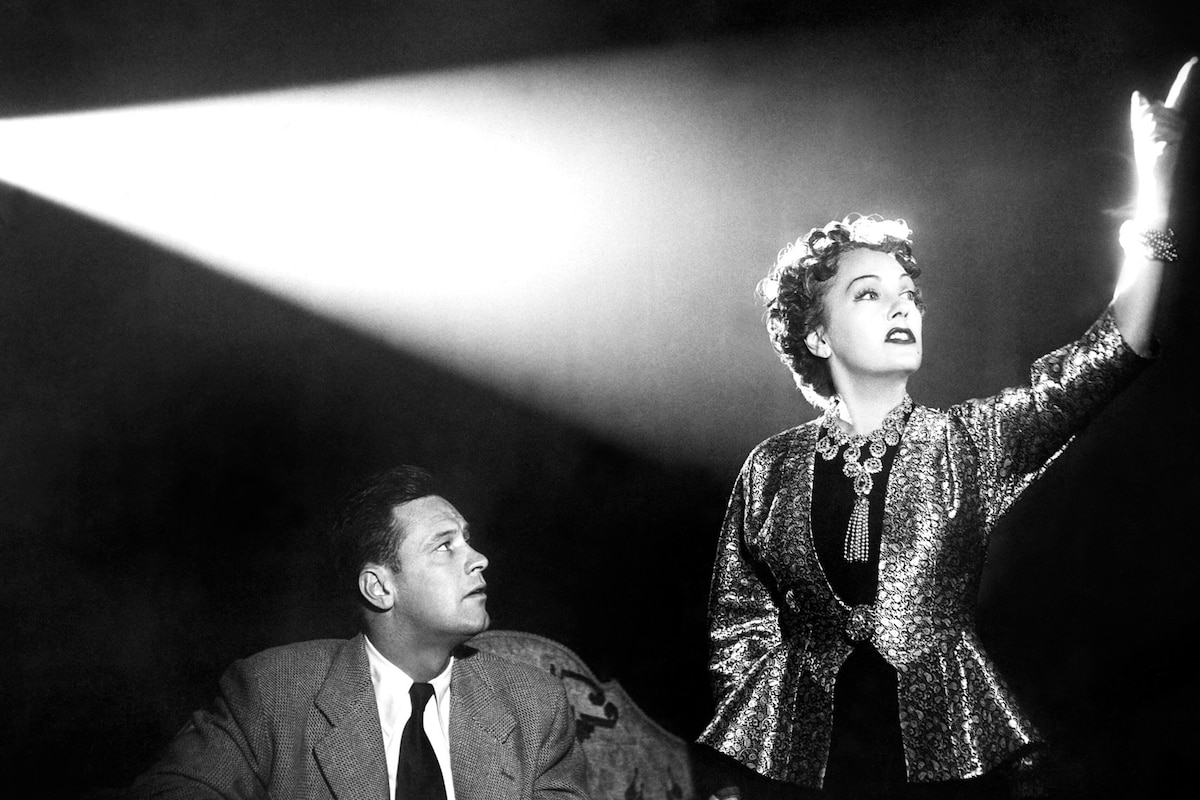
Joe Gillis is a down-and-out screenwriter who can't pay his bills. While hiding his car from a finance company, he stumbles across a decaying mansion on Sunset Boulevard and hides there, assuming it to be uninhabited. He discovers that it is the home of silent movie queen Norma Desmond, who is lost in her dreams of former glory. Her servant and former director Max von Mayerling helps preserve her fragile illusions. Desperate for money, Gillis agrees to work on the script for her supposed comeback vehicle and finds himself becoming a kept man to the possessive movie star. On the sly he meets with the idealistic young studio script reader Betty Schaefer, who likes one of his projects, and the two gradually fall in love. Norma Desmond, however, grows increasingly suspicious and jealous, setting the stage for a fateful confrontation.
Director: Billy Wilder
Producer: Charles Brackett
Screenplay: Charles Brackett, Billy Wilder and D.M. Marshman, Jr.
Based on the story "A Can of Beans" by Brackett and Wilder
Cinematography: John F. Seitz
Editing: Arthur Schmidt
Art Direction: Hans Dreier and John Meehan
Music: Franz Waxman
Cast: William Holden (Joe Gillis), Gloria Swanson (Norma Desmond), Erich von Stroheim (Max von Mayerling), Nancy Olson (Betty Schaefer), Fred Clark (Sheldrake), Lloyd Gough (Morino), Jack Webb (Artie Green), Cecil B. DeMille, Hedda Hopper, Buster Keaton, Anna Q. Nilsson, H.B. Warner, Ray Evans, Jay Livingston (Themselves)
BW-110 m.
Why SUNSET BLVD is Essential
Often hailed as the definitive insider portrait of Hollywood, Sunset Blvd was one of the first serious treatments of life in Hollywood, coming at a time when most movies about movies were irony-free comedies and musicals. The picture exposes the film capitol at its worst as a world of fleeting fame where almost everybody is on the hustle for success, money and sex. As such, it was a key influence on such films as The Bad and the Beautiful, The Star (both 1952) and The Barefoot Contessa (1954).
A major step in Hollywood realism, Sunset Blvd shocked audiences in 1950 with its portrayal of an aging, wealthy woman buying a younger man's company. That it got such subject matter past the industry's self-censor, the Production Code Administration, is a tribute to Billy Wilder's skill as a writer and director and Charles Brackett's production expertise.
Sunset Blvd was the final collaboration for writer-producer Brackett and writer-director Wilder, the longest writing collaboration in Hollywood history. Their previous films together included Double Indemnity (1944) and The Lost Weekend (1945), which Wilder also directed, and Ninotchka (1939).
This was the last major Hollywood film shot on a nitrate negative. The process was eventually abandoned because the film was highly flammable, but it produced amazingly lustrous black and white images.
The role of Joe Gillis changed William Holden's image from a conventional leading man to an actor of incredible power and range, revealing a dark, cynical side. His popularity in the film would bring him similar roles in Stalag 17 (1953) and The Bridge on the River Kwai (1957), which would make him an international superstar.
Everyone remembers Sunset Blvd for its performances and its endlessly quotable dialogue ("I am big. It's the pictures that got small."), but the film is best appreciated as a work of cinema in which all the elements are meticulously coordinated. Billy Wilder may not have the flamboyant visual style of, say, Alfred Hitchcock, but his direction is fluid and expressive, moving from shockingly direct imagery such as an underwater view of a corpse floating in a pool to more subtle effects such as using camera placement to draw the viewer's attention to a pair of doors from which the locks have been removed after we learn of Norma Desmond's history of suicide attempts. The art direction by Hans Dreier and John Meehan brilliantly evokes the decaying grandeur of a bygone era; for those lucky enough to see a good 35mm print of the film, its rich detail is unforgettable. Franz Waxman's musical score, alternating between tense orchestral tuttis and a sly, jazz-inflected piano theme--associated mainly with the character of Gillis--is among the best of his career.
by Frank Miller & James Steffen
The Essentials - Sunset Blvd.
by Frank Miller & James Steffen | January 20, 2011
SIGN UP FOR OUR NEWSLETTERS

CONNECT WITH TCM