The genesis of Splendor in the Grass goes all the way back to the hit 1957 play The Dark at the Top of the Stairs written by William Inge and directed on Broadway by Elia Kazan. The play was the first collaboration between Kazan and Inge, which generated a lasting friendship between the two. During the production of The Dark at the Top of the Stairs the idea for Splendor was generated when Kazan dropped a casual remark to Inge. Kazan said that the two should make a film together in the future and asked Inge if he had any good ideas for a screenplay. Inge, whose credits include Bus Stop, Come Back, Little Sheba and the Pulitzer Prize-winning Picnic, had never written a screenplay before, but he was intrigued by the idea. "[Inge] told me a story of a couple of high school kids in Independence, Kansas, where he'd lived, and I said let's do it," recalled Kazan in his 1988 autobiography A Life.
In the spring of 1958 William Inge handed in his first draft of Splendor in the Grass to Kazan, and the two began putting the film project together through Warner Bros. Kazan enjoyed collaborating with Inge and found that they were very productive together. "Professionally he was perfect," said Kazan of Inge. "He listened to suggestions openly, decided always from the core of his own intentions what he would do and what he would not do. When he didn't agree, he had good reasons. When he did agree he would always give you back a little more than you expected. I loved working with him; I esteemed him always."
For research, Inge took Kazan on a trip to his hometown of Independence, Kansas in 1958 so that Kazan could get a firsthand feel for the characters and locations of Splendor. "I did a lot of research on the picture," said Kazan in a 1971 interview. "I went out to Kansas and hung around high schools to watch the kids' behavior. I went to the Menniger Clinic for awhile and saw how it worked. It was very interesting to me that the first mental institution of its kind was located in mid-America -- almost an acknowledgement that mid-America was cracking up, that its values were not working."
When the time came for casting Splendor in the Grass, it was William Inge who suggested Natalie Wood for the role of Deanie. Kazan, however, was considering other young actresses for the part including Diane Varsi (Peyton Place [1957]), Lee Remick and Jane Fonda. Natalie Wood was an established star at the time who had been appearing in films since she was a child. However, Wood was under suspension to Warner Bros. studios and having trouble moving into adult roles. "When Natalie was first suggested to me," said Kazan, "I backed off. I didn't want a 'washed-up child star.' But when I saw her, I detected behind the well-mannered 'young wife' front a desperate twinkle in her eyes. I knew there was an unsatisfied hunger there. I became interested - professionally."
Landing the role of Deanie would mean everything to Natalie Wood. If Splendor in the Grass succeeded, her career would get a much-needed boost and she could transition into the more adult roles that she had been craving. Warner Bros., Wood's home studio, was eager to turn the star into a renewed asset rather than a liability and pressured Kazan to use her. When Jack Warner offered Wood at a discount price, Kazan agreed to meet with her. "I wanted to find out what human material was there, what her inner life was," said Kazan. "I saw that she was a restless 'chick' who reminded me of the 'bad' girls in high school who looked like 'good' girls. I remembered that kind and how they'd have nothing to do with me, only with the big 'letter men,' like Warren Beatty. My memory assured me she was perfect for the part."
In his 2008 memoir Pieces of My Heart Natalie Wood's husband at the time, actor Robert Wagner, remembered Wood's state of mind at the time. "Natalie was so hungry for the part that she even agreed to test for it," said Wagner. "She told Kazan that she wanted a new career, and Gadge [Kazan's nickname] recognized her power as an actress and her willpower as a person; she got the part. What was unsaid but clearly indicated by the fact of that screen test was that she was willing to put herself completely in his hands - one of those things that every director wants to hear."
It was a critical time in Wood's life not only professionally, but also personally, when the opportunity to do Splendor came along. Wood's marriage to Robert Wagner was showing signs of strain under career pressures and ambition. "Natalie's success or failure as an actress was more important to her than anything else," said Wagner. "Including me."
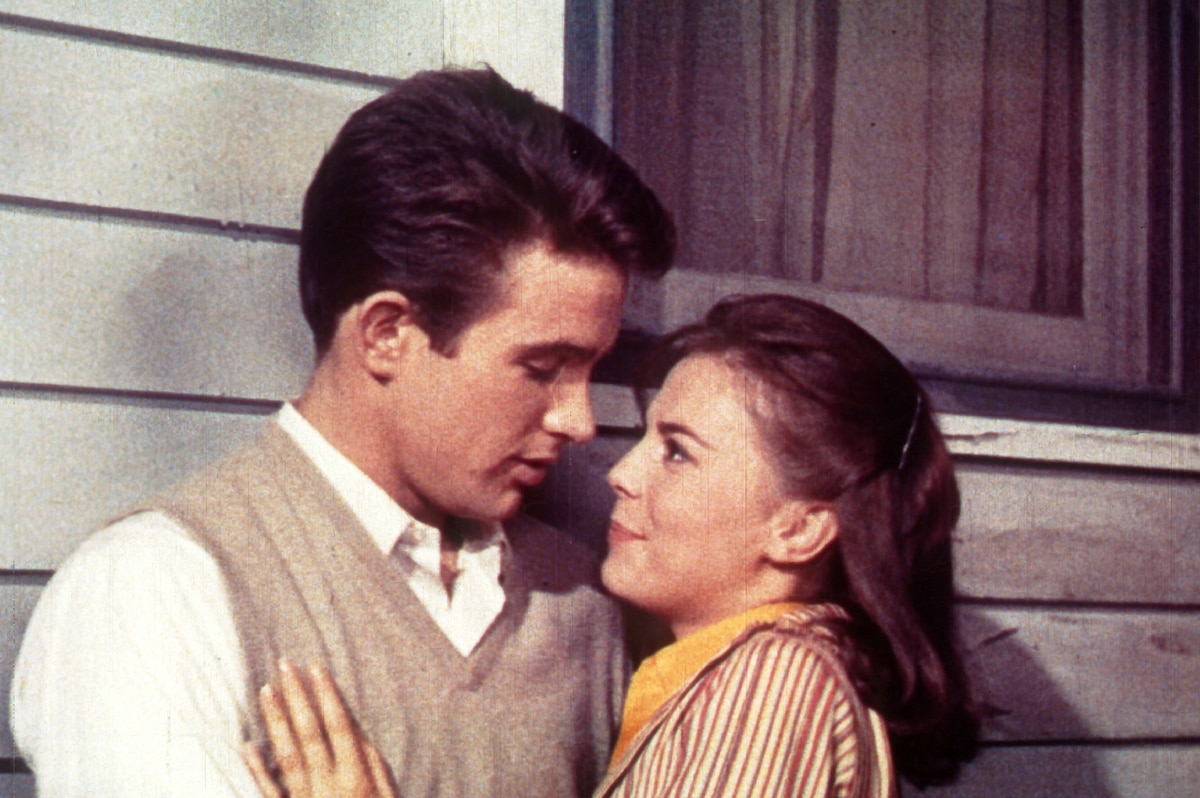
For the role of Bud, several names were tossed around in consideration including Jody McCrea (son of Joel McCrea and Frances Dee) and new Warner Bros. heartthrob Troy Donahue. It was William Inge who first thought of using newcomer Warren Beatty. Beatty was just getting started in the business, appearing mostly in small television parts. When Inge had the opportunity to catch one of Beatty's performances on an NBC serial drama, he was intrigued and ended up casting him in his 1959 Broadway play A Loss of Roses. While the play was a rare flop for Inge, he was impressed with the young Beatty and was convinced he would be perfect to play Bud.
Landing Splendor in the Grass would create a once-in-a-lifetime opportunity for Warren Beatty. It would be his chance to make his feature film debut working with both one of the industry's greatest directors and one of the world's most beautiful stars in a terrific story written by one of the world's most esteemed playwrights. His performance could make or break his career as a movie star, and he was determined to succeed.
When he finally got the news from Kazan that he had landed the role, according to Peter Biskind's 2010 book Star: How Warren Beatty Seduced America, Beatty said some years later, "I felt a chill start at my heel that went up my back to the top of my head, because I thought, unless I'm stupid, I'm not going to be poor. I have a shot. And I can do something with it."
For the key parental characters in Splendor in the Grass, Kazan hired veteran stage actors Audrey Christie as Deanie's Mother Mrs. Loomis and Pat Hingle as Bud's father, Ace Stamper. Hingle and Kazan had worked together several times before on stage, and Hingle had provided narration for Kazan's 1960 film Wild River.
The future Mrs. Elia Kazan, Barbara Loden, soon came on board to play Bud's wild sister Ginny. Kazan, who was married to someone else at the time, had begun an affair with Loden in the late 1950s and made the aspiring actress one of his protégés by casting her as Montgomery Clift's secretary in Wild River. Splendor in the Grass would mark the second big screen role for the talented actress whom Kazan described in his autobiography as "a little bitchy and occasionally a pain in the ass -as well as a pleasure."
by Andrea Passafiume
The Big Idea - Splendor in the Grass
by Andrea Passafiume | January 20, 2011
SIGN UP FOR OUR NEWSLETTERS

CONNECT WITH TCM