With a new working title of It's Only Human, production began on what would become Miracle on 34th Street in November 1946 with the cast and crew traveling to New York City to capture real shots of the Macy's Thanksgiving Day Parade.
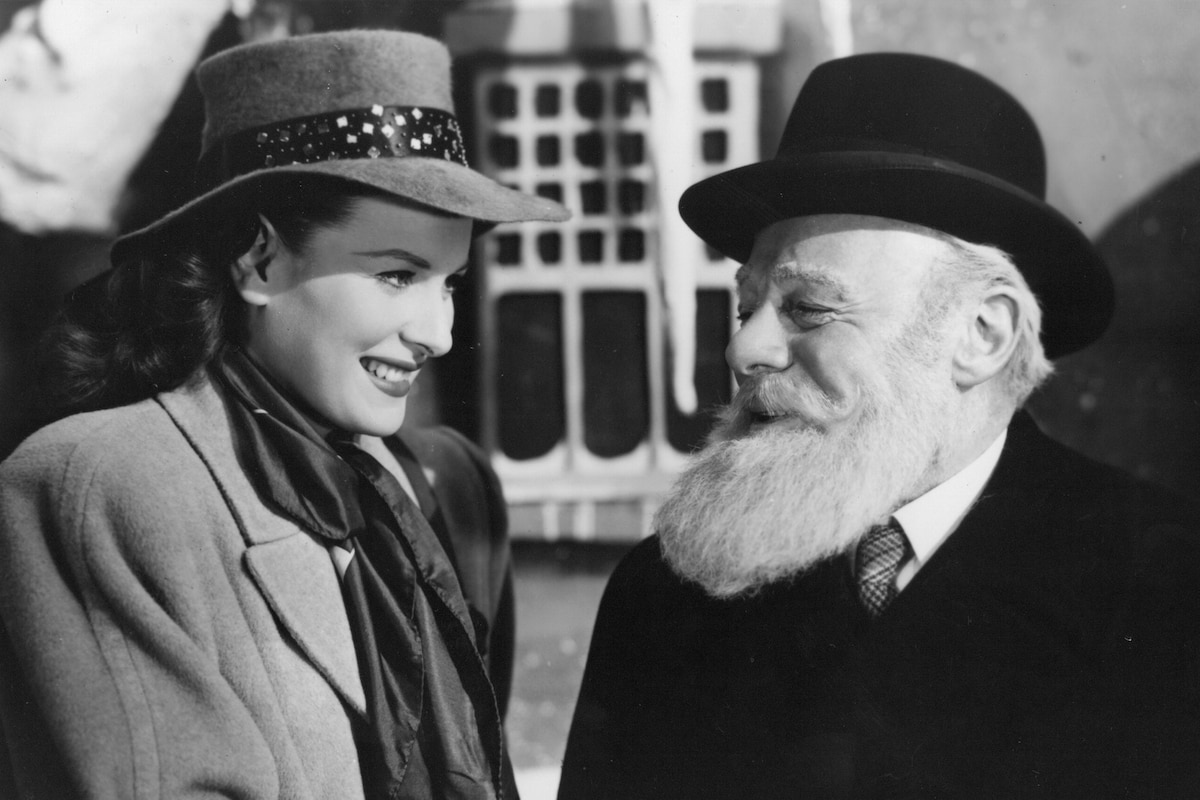
On Thanksgiving Day November 28, 1946, director George Seaton did his best to shoot as many scenes as he could by placing his actors in the midst of the parade festivities. They had to work quickly, however, since the parade was not going to be stopped on their account. "It was a mad scramble to get all the shots we needed, and we got to do each scene only once," said Maureen O'Hara in her 2004 autobiography 'Tis Herself. "It was bitterly cold that day, and Edmund and I envied Natalie and John Payne, who were watching the parade from a window."
Actor Edmund Gwenn got a thrill when he got to play Santa Claus that day. He was given the task of riding in the actual Santa Claus float during the parade and climbing to the top of the Macy's marquee. The crowds were not aware at the time that it was Gwenn waving to them. It was only the next day when the New York Times ran a small piece about it that everyone became aware that Gwenn had been the star of the show the previous day.
Following the parade, the cast and crew remained in New York to film as much as they could on location in order to capture a realistic feel of the city during the Christmas season. With the department store's permission, scenes were shot inside the real Macy's Herald Square during the month of December. "When Natalie [Wood] and I shot the scenes in Macy's," said O'Hara, "we had to do them at night because the store was full of people doing their Christmas shopping during the day. Natalie loved this because it meant she was allowed to stay up late...I really enjoyed this time with Natalie. We loved to walk through the quiet, closed store and look at all the toys and girls' dresses and shoes."
O'Hara's time with Natalie Wood was something she always treasured. "I have been the mother to almost forty children in movies, but I have always had a special place in my heart for little Natalie," said O'Hara. "She always called me Mamma Maureen and I called her Natasha, the name her parents had given her."
The entire cast enjoyed a special bond, according to O'Hara, and always got along beautifully throughout the production. "Each evening, when we were not working," recalled O'Hara, "Edmund Gwenn, John and I went for a walk up Fifth Avenue. Natalie had to go to bed, but we didn't. We stopped and window-shopped at all the stores, which were beautifully decorated for the holidays. Edmund especially loved those nights and acted more like the kid who might be getting the presents instead of the Santa who would be giving them. I got such a big kick out of seeing the expressions of window dressers when they saw Edmund peering in at them--I knew then that he was going to make a big splash as Santa Claus."
The cast and crew were unanimous in their opinion of Santa Claus himself, Edmund Gwenn: they loved him. Actor Alvin Greenman who played soft-spoken janitor Alfred called Gwenn "a dear, dear man," and Robert Hyatt, who played the judge's son Tommy, Jr., said in a 2001 interview, "He was a really nice guy, always happy, always smiling. He had this little twinkle in his eye." Added Maureen O'Hara: "...by the time we were halfway through the shoot, we all believed Edmund really was Santa Claus. I've never seen an actor more naturally suited for a role."
In January of 1947 the cast and crew returned to California to finish shooting the film on the 20th Century Fox studio lot. In March, the filming wrapped and went into post-production.
Sporting the new and final title of Miracle on 34th Street, the film was finally screened--separately--for the high ranking Macy's and Gimbels executives, who still had veto power if they didn't like what they saw. There was a risk that they wouldn't approve the final film, but the studio felt confident that Miracle on 34th Street depicted both Macy's and Gimbels in a positive light. It was the kind of publicity that money couldn't buy if the film did well at the box office. Luckily, the famous department stores gave their blessings with enthusiasm.
20th Century Fox knew that it had a terrific film on its hands and believed it had the potential to be a big hit. With that in mind, studio chief Darryl Zanuck made the decision to release the Christmas-themed film not in December, which would seem logical, but rather in June. The studio believed that more people went to the movies during summer and would therefore mean bigger box office potential.
With a summer film about Santa Claus, the challenge for 20th Century Fox was in figuring out how to market it. Darryl Zanuck and his marketing team devised a publicity campaign for Miracle on 34th Street that would entice audiences to see it without ever mentioning it was about Christmas. The holiday theme was played way down in teaser trailers, and movie poster art featured Maureen O'Hara and John Payne prominently with Edmund Gwenn barely visible in the background. As far as unsuspecting audiences knew, they were simply seeing a lighthearted romantic comedy. The marketing campaign worked. When the film was released in the summer of 1947, it was a smash hit, winning the hearts of audiences and critics alike.
by Andrea Passafiume
Behind the Camera - Miracle on 34th Street
by Andrea Passafiume | January 18, 2011
SIGN UP FOR OUR NEWSLETTERS

CONNECT WITH TCM