Shooting began on Hannah and Her Sisters in
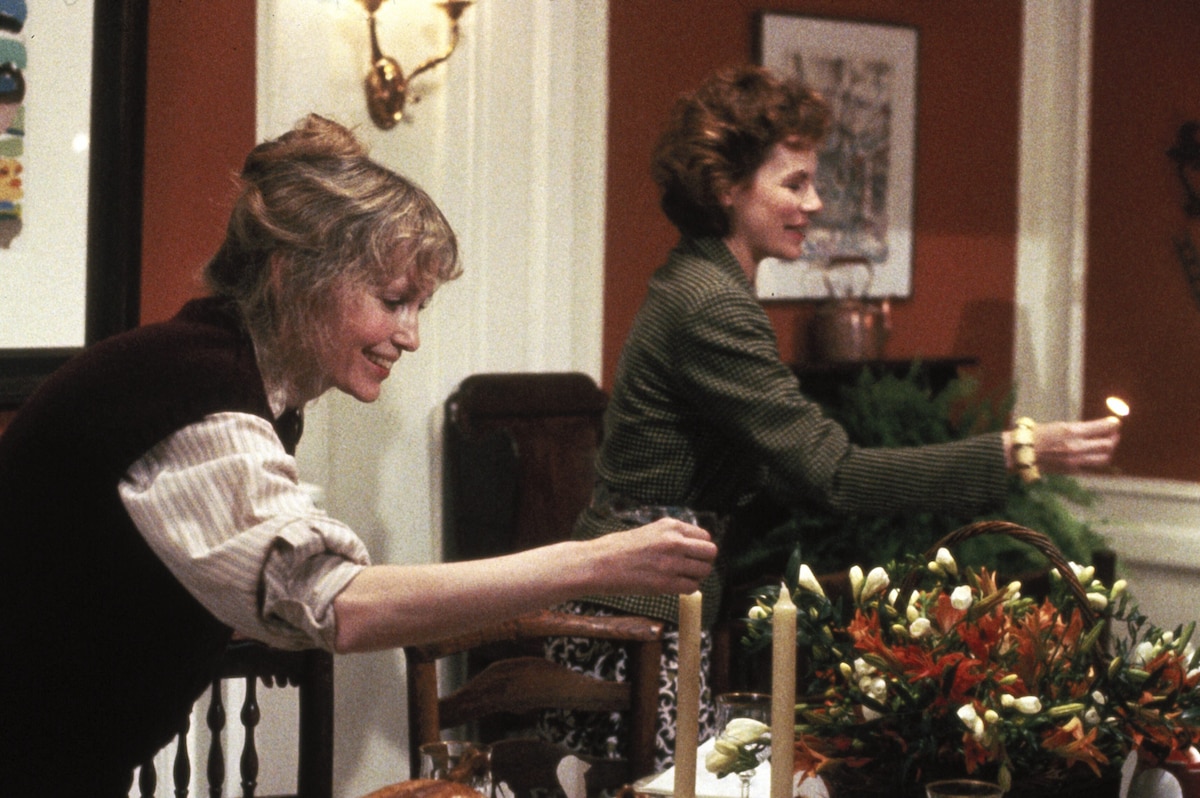
the Fall of 1984 in New York City. Woody Allen used Mia Farrow's real-life apartment on Central Park West as
Hannah's home in the film. Farrow's real-life children were also used in the big family Thanksgiving scenes that
bookend the film. With those details--along with having Farrow's real-life mother Maureen O'Sullivan playing
Hannah's mother--it made the film something of a family affair, bringing a warmth and familiarity to the
set.
Since Farrow and her extensive brood were actually living in Hannah's fictional apartment during
filming, they had to do their best to go about the usual daily routine in a way that fit into the shooting
schedule. "The place was pandemonium," said Farrow in her 1997 memoir What Falls Away. "The rooms were
clogged with equipment. Forty people arrived at dawn crowding into any available space, our personal treasures
were spirited away to who-knew-where. The kitchen was an active set for weeks...Some nights I literally couldn't
find my bed...It was strange to be shooting scenes in my own rooms - my kitchen, my pots, my own kids saying
lines, Michael Caine in my bathroom, wearing a robe, rummaging through my medicine cabinet. Or me lying in my own
bed kissing Michael, with Woody watching...The commotion, and not being able to find anything, sometimes got me a
little crazy. But the kids loved it."
At times co-star Michael Caine felt like he was in the middle of an
intimate home movie. "It got so domestic that when we were shooting the sequence [in Mia's apartment], I would
often see Mia serving up food to her numerous offspring," said Caine in his 1992 autobiography What's It All
About?. "The assistant director would come into the kitchen and say, ÔYou are wanted on set, Miss Farrow.' Mia
would stop ladling out food, take off her apron and go into the other room and start acting and at the end of the
scene she would rush back into the kitchen."
Sometimes, according to Caine, things could get surreal
under such circumstances. "When we got to the bedroom scenes, which were shot in Mia's real bedroom (although for
propriety's sake I think we had a different bed), things became even more cozy until one day I wound up doing a
love scene in bed with Mia in her own bedroom, and being directed by her lover!" said Caine. "This was
nerve-racking enough but got even worse when I looked up during the rehearsal to find her ex-husband Andre Previn
watching us from the other side of the bedroom. He had come to visit the children and found us all there. It took
all my concentration to get through that scene!"
Other than those uncomfortable moments, Michael Caine
found working on Hannah and Her Sisters to be a rewarding experience. He enjoyed being directed by Woody
Allen for the first time. "Being an actor himself," said Caine, "Woody was wonderful to work with. He understood
the problems and was very tolerant of them and he was a specialist in detail."
Caine found that making a
comedy with Allen was serious business. "When people hear that I have worked with Woody they often think it must
be a very amusing experience," said Caine, "but in fact the exact opposite was true. He was a very quiet and
sensitive man who liked to work in a very quiet atmosphere, so even the crew on his pictures - who for the most
part have worked with him many times, were the quietest crew with whom I have ever worked. The atmosphere on
Woody's set was a bit like working in church...Like all comedy writers he doesn't say funny things, but listens to
hear if you say something funny that he can use."
It was a source of great joy for Caine to work
surrounded by so many talented actresses. He found Mia Farrow great fun to be with, Barbara Hershey a "gifted
actress and lovely woman," Carrie Fisher "wildly funny" and Dianne Wiest very talented. "Dianne Wiest was another
actress in the film of whom I had never heard," said Caine, "but I soon saw how good she was and was hence very
surprised when Woody started to give her a tough time, making her do scenes over and over again. I think I figured
out what he was doing. She was playing a neurotic in the movie, but was so happy at having got the part she was
having difficulty in being miserable, so Woody fixed it."
According to Mia Farrow, Woody Allen was never
able to find an ending to Hannah and Her Sisters that satisfied him. He ended up giving the film an
uncharacteristically upbeat ending, though it was a decision that he would never stop re-thinking. "I had written
a different ending that was not as upbeat: Michael Caine's character is still hopelessly in love with Hannah's
sister, who has married another guy because he couldn't bring himself to act, and he's stuck with Hannah and it's
going to be a nothing marriage," Allen told Entertainment Weekly in 2008. "And I shot that ending. But when
I looked at it, it was like the picture dropped off the table. It was negative, a downer. So I guided the thing
instinctively to an ending where all the characters came out happy, and the picture was very successful. But I
never felt positive about it. I felt I had a very poignant idea but finally couldn't bring it home."
Audiences disagreed with Allen and embraced Hannah and Her Sisters with open arms when it was released in
1986. The movie was universally praised, making it a rare critical and commercial success for the famously
New York-centric director. People noticed a warmth and optimism present in Hannah that was missing in his
earlier works and responded in kind. Its family-centered story and broad themes seemed more accessible, and there
was a new depth and humanity present that signaled a new maturity in Allen's work that would help usher in the
next phase of his prolific career.
Hannah and Her Sisters was nominated for seven Academy Awards
including Best Picture, Best Director, Best Editing, Best Original Screenplay, Best Art Direction, Best Supporting
Actor (Michael Caine) and Best Supporting Actress (Dianne Wiest). Michael Caine and Dianne Wiest both won, as did
Woody Allen for Best Original Screenplay. It was Allen's second win in that category - the first time had been for
his 1977 Best Picture winner Annie Hall.
Hannah and Her Sisters went on to become one of
the most successful films of Woody Allen's 40+ year career and one of the most beloved. To this day Hannah
routinely tops the list whenever critics rank the best of Woody Allen's films.
by Andrea Passafiume
Behind the Camera - Hannah and Her Sisters
by Andrea Passafiume | January 18, 2011
SIGN UP FOR OUR NEWSLETTERS

CONNECT WITH TCM