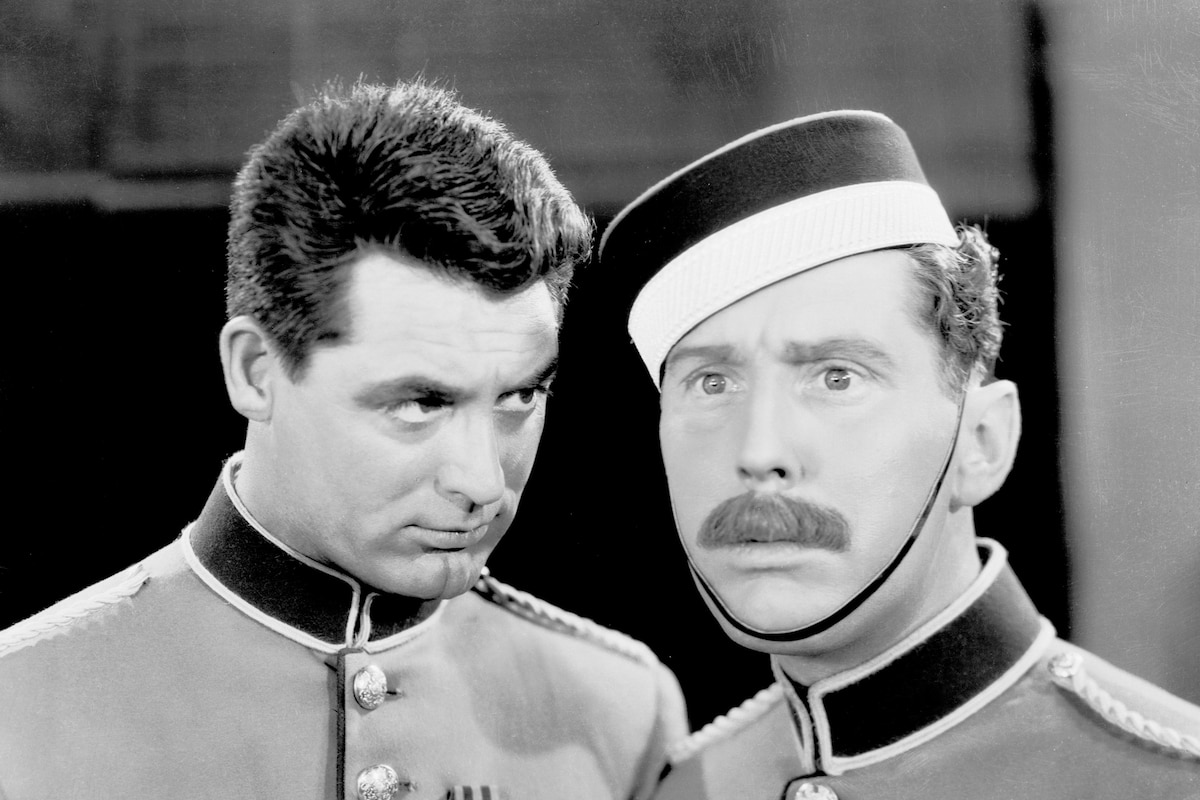
Gunga Din was one of the first movies to be given the colorization treatment in the 1980s, during the height of popularity for that controversial process. One of the participants who did not object to the results was Cary Grant. In the book Evenings with Cary Grant, the actor was quoted as saying, "...I've seen a reel of Gunga Din in color. It's absolutely marvelous. The uniforms are exactly what they should be." Grant also enjoyed the colorized version of Topper (1937), but admitted that "...some films should be left untouched."
There was never a sequel made to Gunga Din. However, in Blake Edwards' 1968 comedy The Party, Peter Sellers plays an Indian actor named Hrundi V. Bakshi. At the beginning of the film, we see that stage actor Bakshi has been brought to Hollywood to play the title role in a movie called Son of Gunga Din. The brilliantly inept Bakshi is fired when he manages to destroy the very expensive outdoor set built for the film while trying to tie his shoe on the dynamite ignite lever!
If 1939 was a banner year for Hollywood, then it stands to reason that 1939 was one of the best and most prolific years for Ben Hecht, who had quickly become one of the industry's highest paid screenwriters, on both credited projects and on "script doctoring" assignments. Hecht had a hand in nine films released in 1939, including several of the most prominent, such as Gone with the Wind, Stagecoach, Wuthering Heights, and of course, Gunga Din.
Pandro S. Berman, the long-time RKO executive and producer who served as a production manager for Gunga Din, moved to MGM in 1941 to head a production unit. In 1951 he produced Soldiers Three, which was adapted more faithfully from the Rudyard Kipling book. Directed by Tay Garnett, the film relates in flashback form the adventures in India of three British privates: Archibald Ackroyd (Stewart Granger), Dennis Malloy (Cyril Cusack), and Jock Sykes (Robert Newton). In another link with Gunga Din, actor Robert Coote, who played Sgt. Higginbotham in that film, turns up here as Major Mercer.
Almost all of the major plot elements of Gunga Din show up in the 1962 comedy Sergeants 3, directed by John Sturges. This Rat Pack film moves the action to the U.S. Indian Territory in 1870 and concerns three rowdy Cavalry sergeants: Mike (Frank Sinatra), Chip (Dean Martin), and Larry (Peter Lawford). This time it is Frank and Dean who are determined to prevent Peter from leaving the service to get married. The Gunga Din figure is camp bugler Jonah Williams (Sammy Davis, Jr.), a former slave who is anxious to one day become a trooper. A tribe of bloodthirsty American Indians stand in for the original film's cult of Kali-worshipping Indians. Director Sturges had actually served as an uncredited assistant editor on Gunga Din. The plot of the older film was casually lifted for this romp; apparently the remake rights were acquired rather late in the game to avoid any legal entanglements upon release.
Gunga Din remained the cinema's only use of the Kali-worshipping Thuggee Cult as a plot point for many years; that is, until they turned up in the second Beatles film Help! (1965), directed by Richard Lester. Here, the Thuggees were not interested in murder by strangulation as much as they were in retrieving a ring needed for their religious ceremonies for the goddess Kali. The Cult leader, played by Leo McKern, rallies his forces to recover the ring at any cost; for most of the film it resides on the finger of Ringo Starr.
Thuggees also served as the main villainous force in the second Indiana Jones movie, Indiana Jones and the Temple of Doom (1984), directed by Steven Spielberg from a story by George Lucas. This prequel to Raiders of the Lost Ark (1981) borrows many elements from Gunga Din, including scenes on a precarious rope bridge overlooking a deep gorge. The Thuggees in this film are not merely assassins; they also practice blood sacrifice to Kali. The intensity of the violent sacrifice scenes in Indiana Jones and the Temple of Doom helped lead the Motion Picture Association of America to expand the ratings system to include a PG-13 classification.
by John M. Miller
Pop Culture 101 - Gunga Din
by John M. Miller | January 18, 2011
SIGN UP FOR OUR NEWSLETTERS

CONNECT WITH TCM