Acclaimed author, poet, and journalist Rudyard Kipling (1865-1936) allowed very few of his works to be adapted to the screen during his lifetime. There was a short silent film adaptation made in 1911 of his famous poem, "Gunga Din," but it was probably unauthorized. Years later, Irving Thalberg at Metro-Goldwyn-Mayer had entertained the idea of a film called Gunga Din, and after the success of Trader Horn (1931) director W. S. Van Dyke was attached to the project. No film resulted, however, and the property never got past the treatment stage.
Kipling died in London on January 18, 1936. Kipling's widow began selling the film rights to various properties, resulting in a rush of production. In 1937, three Kipling adaptations were released. Alexander Korda's film Elephant Boy (1937) was based on the Kipling story "Toomai of the Elephants," and made a star of young Indian actor Sabu. Wee Willie Winkie (1937), directed by John Ford, came from a Kipling story about a small boy, but the gender was changed to allow for this vehicle starring Shirley Temple. Captains Courageous (1937) was a fine adaptation of Kipling's novel. It starred Spencer Tracy and Freddie Bartholomew and was directed by Victor Fleming for MGM. It was nominated for several Oscars®, including Best Picture, and Tracy won his first Best Actor Oscar® for his role.
The film rights to Kipling's poem "Gunga Din" were purchased in 1936 by independent producer Edward Small. Small paid Kipling's widow 5,000 pounds for the rights, and hired no less than William Faulkner at $750 a week to fashion a story. Faulkner spent weeks on the project, and laid out several somber variations on a theme, all of them painting Din as a drunk and a gambler! Small felt that a serious approach with a complex plot was the wrong way to go, so other writers were brought in for new treatments.
RKO Radio Pictures acquired the rights from Small and put the film on its roster, with Howard Hawks set to produce and direct. Hawks had run into budget and schedule problems with his screwball comedy Bringing Up Baby (1938), and when that film sputtered at the box office, RKO instead assigned its large-scale Kipling project to George Stevens, a rising young producer-director. Stevens had distinguished himself at the studio in recent years, moving up from helming Wheeler and Woolsey comedies to directing such properties as the Katharine Hepburn drama Alice Adams (1935) and the musical comedies Swing Time (1936) and A Damsel in Distress (1937).
During Hawks' brief tenure as director, he brought writers Ben Hecht and Charles MacArthur into the project. Hecht and MacArthur reworked the treatments that Faulkner and other writers had left from the earlier phase of the picture. The writing team kept the basic Soldiers Three (published 1895) Kipling story, but added concepts from their own hit play The Front Page, in particular the struggle by Sgt. MacChesney to keep Sgt. Ballantine in the service and away from his new fiancée. (In the play, newspaper editor Walter Burns goes to great lengths to keep reporter Hildy Johnson away from his marriage vows and on his staff). George Stevens brought in his own writers, Joel Sayre and Fred Guiol, who eventually received the screenplay credit for the film. The final major plot element to be added to the story was the conflict with the Thuggee Cult of assassins.
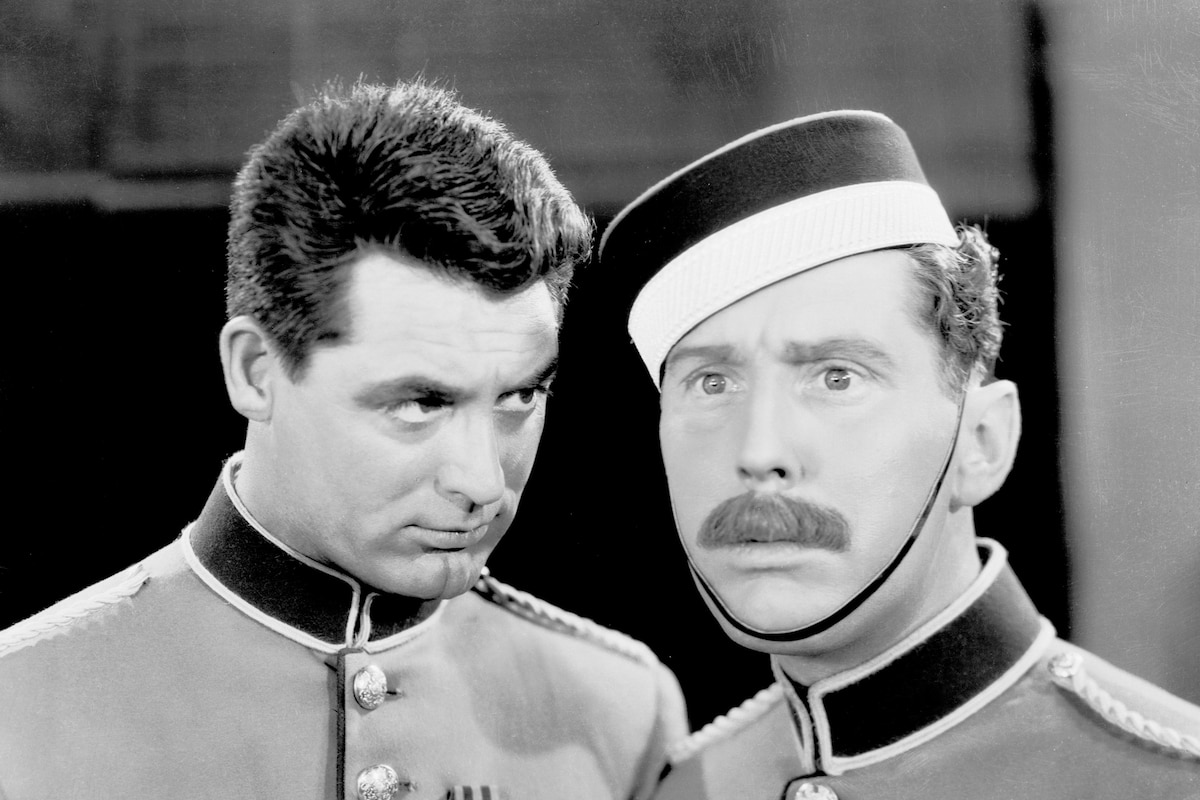
Casting for the picture was all-important, in order to retain the proper "3 Musketeers" chemistry. Veteran Victor McLaglen, an Oscar®-winner for John Ford's The Informer (1935), was cast as the brawny Sgt. MacChesney. McLaglen had already appeared in the Kipling adaptation Wee Willie Winkie, as Sgt. MacDuff. Cary Grant had a non-exclusive contract with RKO, and had recently scored big in several non-RKO films, such as Topper (1937) at Hal Roach Studios, and The Awful Truth (1937) and Holiday (1938) at Columbia Pictures. He was offered the dashing role of Sgt. Ballantine, but Grant preferred to play the smaller role of Sgt. Cutter. Grant was anxious to play a broad Cockney character with a lot of physical comedy, and he and Stevens worked up several new bits of business for Cutter. Grant also gave the character his own real first name, Archibald. With Cary Grant playing Sgt. Cutter, the role of Ballantine was open for the film's third lead. Only two weeks before the start of principal photography, Douglas Fairbanks, Jr. was cast - Grant, in fact, had suggested him for the role.
Sabu would have been a natural to play the title role, and RKO was certainly interested in acquiring him. Producer Alexander Korda held Sabu's contract, however, and Korda was unwilling to loan him out; Korda's epic The Thief of Bagdad (1940) was in preproduction and the producer wanted to keep his star nearby. The role of Gunga Din was open, and although he was 47 years old at the time, character actor Sam Jaffe auditioned for the part of the water-boy. Jaffe, whose most recent appearance was as the wizened High Lama in Frank Capra's Lost Horizon (1937), knew of the desire to have Sabu play the role, and so he simply played it as Sabu might have.
by John M. Miller
The Big Idea - Gunga Din
by John M. Miller | January 18, 2011
SIGN UP FOR OUR NEWSLETTERS

CONNECT WITH TCM