FUN FACTS AND TRIVIA on FAIL SAFE (1964)
The film uses no background music at all. Many critics praised the impressive use of silence between speeches.
To make the President's phone seem more ominous, Lumet used a larger model created for explosives companies to communicate during demolitions jobs.
The impressive zoom shot from the satellite was created by mounting a camera on a V2 rocket launched from White Sands, NM, and then running the film backwards.
Fail Safe did not do well at the box office, primarily because the earlier release of Dr. Strangelove or: How I Learned to Stop Worrying and Love the Bomb (1964) blunted its impact, making nuclear warfare seem more a subject for dark humor than serious drama.
Although completed before Dr. Strangelove, Fail Safe sat on the shelf for months so Columbia could release the other film sooner. Dr. Strangelove opened to mostly glowing reviews and strong box office in January 1964.
Fail Safe premiered at the second New York Film Festival in August 1964. Although the New York Times' Bosley Crowther, who had hated Dr. Strangelove, gave it a rave, many other critics felt the earlier film, with its comic tone, had stolen much of the Lumet picture's thunder.
Some critics also noted that by the time of the film's release, some of its technology was outdated. In particular, the U.S. had developed in-flight radio transmissions that could not be jammed, making the bombers' inability to receive the abort command impossible.
Audiences also compared the two different films, with many refusing to take Fail Safe seriously because of its comic predecessor. Henry Fonda would later say he could not have played the tense, dramatic phone conversations with the Soviet Premier had he seen Peter Sellers' performance as the president in Dr. Strangelove first.
Columbia sold Fail Safe with the tagline, "It will have you sitting on the brink of eternity!"
Famous Quotes from FAIL SAFE
"They're good men, we've seen to that. If their orders are attack, the only way you're going to stop them is to shoot them down."
"We've got no alternative! This minute the Russians are watching their boards, trying to figure out what we're up to. If we can't convince them it's an accident we're trying to correct by any means, we're going to have something on our hands nobody bargained for, and only a lunatic wants!" -- Russell Hardie, as General Stark, and Dan O'Herlihy, as General Black.
"I want to know...what you think he's feeling; it's important that we understand each other." -- Henry Fonda, as the President, instructing Larry Hagman, as Russian interpreter Buck, on how to translate the Soviet Premier's calls.
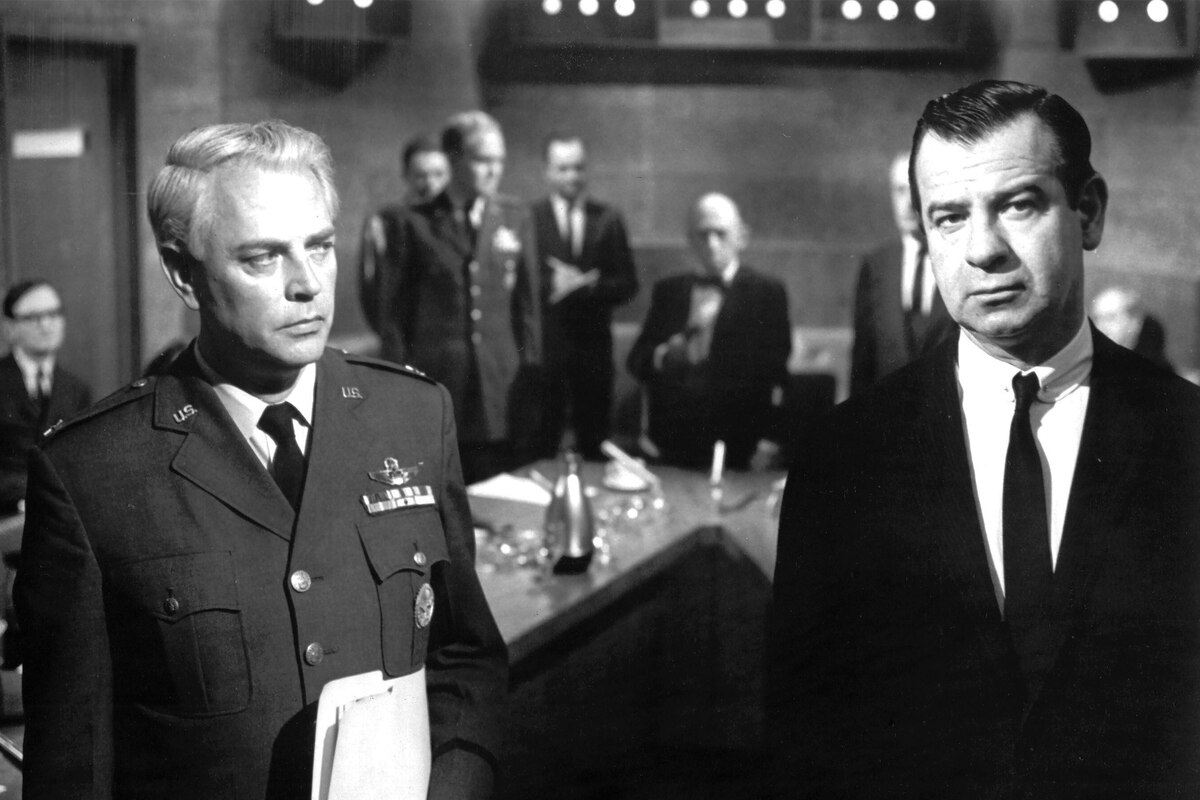
"Mr. Secretary, I am convinced that the moment the Russians know bombs will fall on Moscow, they will surrender. They know that whatever they do then, they cannot escape destruction. Don't you see, sir, this is our chance. We never would have made the first move deliberately, but Group 6 has made it for us, by accident. We must take advantage of it -- history demands it. We must advise the President not to recall those planes." -- Walter Matthau, as Prof. Groeteschele.
"We don't go in for sneak attacks. We had that done to us at Pearl Harbor."
"And the Japanese were right to do it. From their point of view, we were their mortal enemy. As long as we existed, we were a threat to them. Their only mistake was that they failed to finish us at the start, and they paid for that mistake at Hiroshima." -- Hardie, as General Stark, debating Matthau, as Prof. Groeteschele.
"Where do you draw the line once you know what the enemy is? How long would the Nazis have kept it up, General, if every Jew they came after had met them with a gun in his hand? But I learned from them, General Black. Oh, I have learned."
"You learned too well, Professor. You learned so well that now there's no difference between you and what you want to kill." -- Matthau, as Groeteschele, debating O'Herlihy, as General Black.
"This crisis of ours -- this accident as you say....In one way it's no man's fault. No human being made any mistake, and there's no point in trying to place the blame on anyone....This disappearance of human responsibility is one of the most disturbing aspects of the whole thing. It's as if human beings had evaporated, and their places were taken by computers. And all day you and I have sat here, fighting, not each other, but rather the big rebellious computerized system, struggling to keep it from blowing up the world."
"It is true, Mr. President. Today the whole world could have been burned without any man being given a chance to have a say in it." -- Fonda, as the President, to the Soviet Premier, translated by Hagman, as Buck.
"I can hear the sound of explosions from the north east. The sky is very bright. All lit up." -- Last words of U.S. Ambassador to Moscow.
"General Stark, are there any papers or documents in New York which are absolutely essential to running the United States?" -- William Hansen as Defense Secretary Swenson.
"I've been making a few rough calculations based on the effect of two twenty megaton bombs dropped on New York City in the middle of a normal workday. I estimate the immediate dead at about three million. I include in that figure those buried beneath the collapsed buildings. It would make no difference, Admiral Wilcox, whether they reached a shelter or not. They would die just the same. Add another million or two who will die within about five weeks. Now our immediate problem will be the joint one of fire control and excavation. Excavation not of the dead, the effort would be wasted there. But even though there are no irreplaceable government documents in the city, many of our largest corporations keep their records there. It will be necessary to... rescue as many of those records as we can. Our economy depends on this. [walking back to his seat] Our economy depends on this. And the Lord said, gentlemen, 'He who is without sin, let him cast the first stone.'" -- Matthau.
"How did you get to be a translator, Buck? You don't seem the academic type."
"I guess I have a talent for languages, sir. I hear a language once, I pick it right up. I don't even know how. They found out about it in the Army."
"You sound sorry they did."
"No, sir. It's a very interesting job. That is, most of the time."
"Well, you did a good job today, Buck."
"Thank you, sir. All I did was repeat what he said."
"You didn't freeze up. Another man might have.
"You're the one who didn't, sir."
"I wonder what it's like outside? Looked like rain before."
"The radio said it would clear by the afternoon." -- Fonda and Hagman.
"The Matador, the Matador...me...me." -- O'Herlihy, as Black, speaking the film's last lines.
"The producers of this film wish to stress that it is the stated position of the Department of Defense and the United States Air Force that a rigidly enforced system of safeguards and controls insure that occurrences such as those depicted in this story cannot happen." -- Final credit.
Compiled by Frank Miller
Trivia - Fail Safe - Trivia & Fun Facts About FAIL SAFE
by Frank Miller | January 18, 2011
SIGN UP FOR OUR NEWSLETTERS

CONNECT WITH TCM