Few directors have provided such a clear, detailed picture of their working methods as Sydney Lumet. His book Making
Movies (Knopf, 1995) has become something of a primer for filmmaking, and he amplified the process in interviews with Peter
Bogdanovich, printed in the book Who the Devil Made It (Knopf, 1997).
"I work from the inside out," Lumet has said. "What the movie is about will determine how it will be cast, how it will look,
how it will be edited, how it will be musically scored, how it will be mixed, how the titles will look, and, with a good studio,
how it will be released. What it's about will determine how it is to be made."
Lumet likes to have the entire production team present at the first reading of the script. He then schedules rehearsals for a
minimum of two weeks. He started acting in the Yiddish theater at the age of four and appeared on Broadway while still quite
young. His method of directing actors owes much to the stage, and with the long rehearsals, he makes it clear he expects the
performances to be there on the first couple of takes. Lumet has had great success pulling outstanding work out of his casts,
and his ability to foster tight ensemble acting, as he did in Fail-Safe, along with the early support of a major star
like Henry Fonda (who appeared in the director's first two theatrical features before taking the role in this movie), has helped
him secure some of the top actors in the business for his projects.
"Hank Fonda to me is one of the most underestimated actors," he told Bogdanovich. "If I read one more review that says,"Hank
Fonda gave his usual good realistic performance," I'll flip, because this man has such depth and such a sense of truth in his
work - extraordinary." In his own book, he also praised Fonda for being "a barometer of truth against which to measure yourself
and others."
Lumet is against on-set tension and runaway emotions. He tries to create a very loose set, filled with "jokes and
concentration," which he insists go surprisingly well together. His main function in dealing with performance, as he sees it,
is to hire the best talents and to respect and encourage the strong wills they display without letting it boil over into
ego.
As for the shooting itself, Lumet cuts in the camera. That means before he shoots he knows exactly how each scene or sequence
is going to be edited. He films only what's necessary to achieve this and leaves few options for the editing room. As a
result, his pictures are generally done quickly and efficiently, at least in shooting and post-production. "I literally cannot
see it four different ways," he explained. "[William] Wyler's extraordinary habit of shooting a master [a single shot that
covers all the dialogue and action for a given scene] from four different walls and all the subsequent coverage from those
masters - I wouldn't know where to put the camera after I've done my first master. Now, that's got its advantages and its
disadvantages, but the process of making the dramatic selection in advance is just part of my background. Then, you know,
people always say, "Oh, you're so speedy"; if you add the rehearsal time to my shooting days, it's not so speedy."
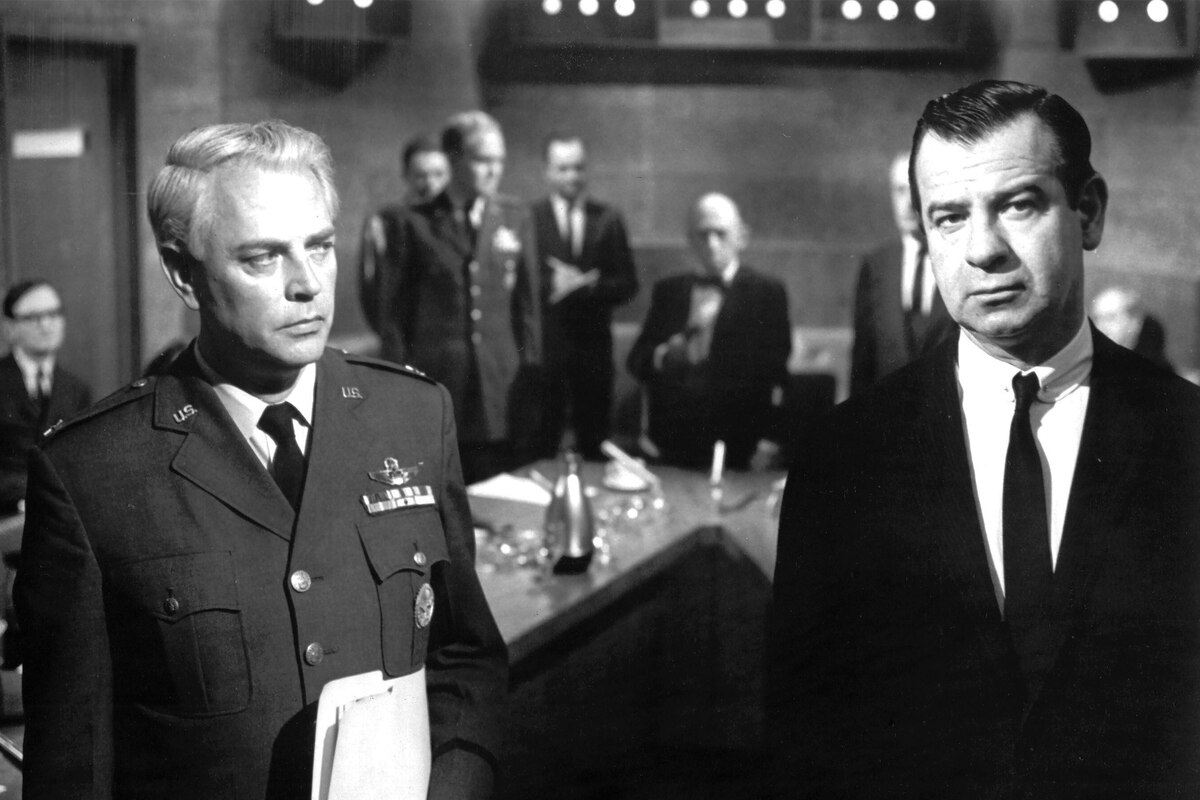
Lumet must also be credited for his choice of production team, and Fail-Safe, is aided immeasurably by their experience
and efforts. Albert Brenner's sets manage to at once enclose the action in almost claustrophobic spaces while giving a sense of
the world outside, unaware it's on the brink of destruction. Gerald Hirschfeld's stark black-and-white cinematography heightens
the sense of tension and doom, and the rhythm of the film is set at a crackling pace by the editing of Ralph Rosenblum, who
became a favorite of another New York-based director, Woody Allen. He edited all but two of Allen's first eight films, from
Take the Money and Run (1969) through Interiors (1978).
Images on the screen in the Omaha control room in Fail Safe were created using front projection. This required extra work by the crew to make sure no dust was in the air, as that would have made the projection less believable. For the War Room, the image was rear-projected to avoid those problems.
Interior shots of the bombers' flight crews were made inside a commercial airline simulator. As a result, the three-man crew is shown sitting together. In a real B-58, they would be separated by banks of machinery. The separation also allows each seat to be ejected separately in the event of an emergency.
by Frank Miller & Rob Nixon
Behind the Camera - Fail Safe
by Frank Miller & Rob Nixon | January 18, 2011
SIGN UP FOR OUR NEWSLETTERS

CONNECT WITH TCM