As an unidentified aircraft approaches the U.S., the Air Force sends fighter planes to intercept it and prepare for retaliatory action. Recall orders go out when the plane is identified, but one squadron mistakenly receives an attack order that can't be rescinded once they enter Soviet air space, where radio reception is jammed. With no way of bringing the planes back, politicians, military and scientists debate whether to launch a preemptive strike, try to take down our own planes or find some way to appease the Soviets should any of the nuclear warheads make it through.
Director: Sidney Lumet
Producer: Max E. Youngstein
Screenplay: Walter Bernstein
Based on the novel by Eugene Burdick and Harvey Wheeler
Cinematography: George Hirschfeld
Editing: Ralph Rosenblum
Art Direction: Albert Brenner
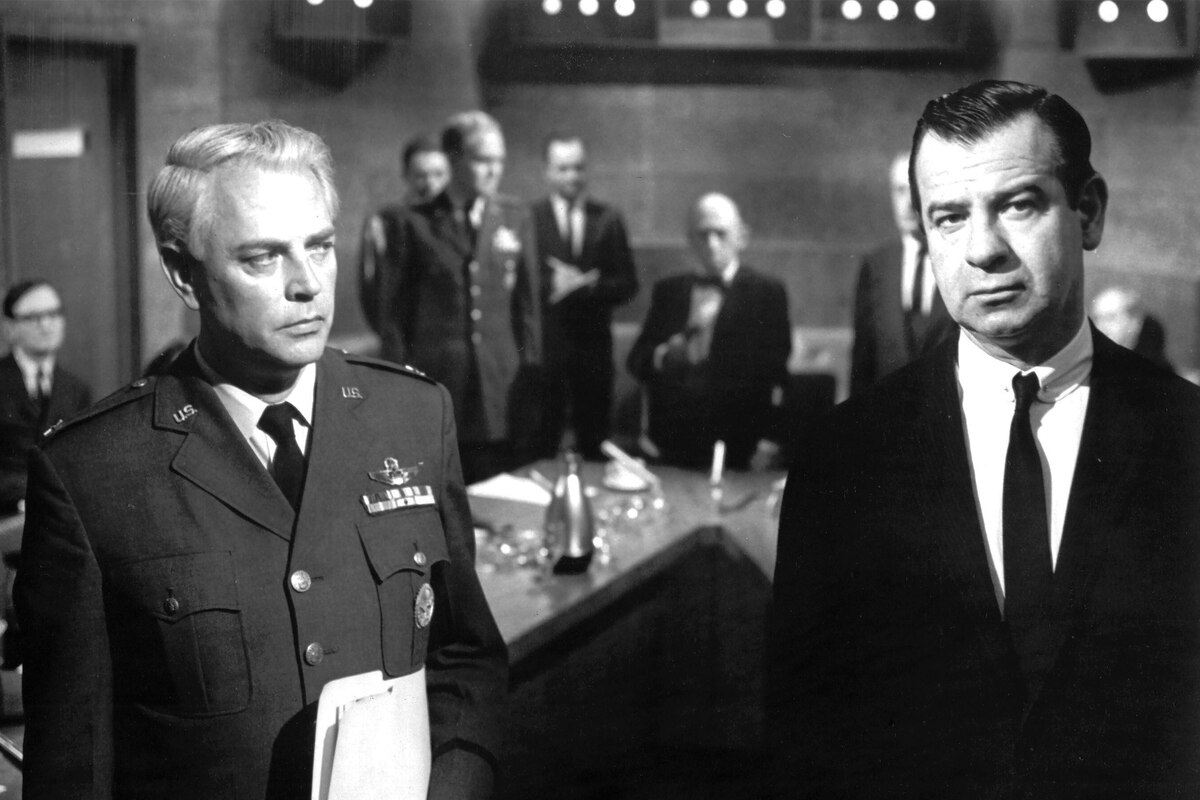
Cast: Dan O'Herlihy (Gen. Black), Walter Matthau (Groeteschele), Frank Overton (Gen. Bogan), Edward Binns (Col. Grady), Fritz Weaver (Col. Cascio), Henry Fonda (The President), Larry Hagman (Buck), Russell Hardie (Gen. Stark), Russell Collins (Knapp), Sorrell Booke (Cong. Raskob), Hildy Parks (Betty Black), Janet Ward (Mrs. Grady), Dom DeLuise (Sgt. Collins), Dana Elcar (Foster)
BW -111m.
Why FAIL SAFE is Essential
Fail Safe is a key work in a genre of films exploring the destructive potential of nuclear warfare and, with Dr. Strangelove or: How I Learned to Stop Worrying and Love the Bomb, one of two features that made 1964 the most important year for the genre. Starting with The Beginning or the End (1947), MGM's fictionalized depiction of the events leading to the dropping of the first atomic bomb on Japan, the genre has encompassed semi-documentaries, serious dramas and, in the case of Dr. Strangelove, outrageous comedy. For most of the '50s, it was dominated by low-budget science fiction films exploiting the action and horror elements of life after a nuclear holocaust, though Arch Oboler's Five (1951) and Stanley Kramer's On the Beach (1959) attempted more thoughtful treatments of post-nuclear landscapes. Although many such films captured the sense of humanity being destroyed by its own creations, Fail Safe is the only one to create a realistic, believable buildup to a nuclear exchange triggered by a series of equipment malfunctions. After the box office success of Dr. Strangelove and the failure of Fail Safe later the same year, the genre began to die out in 1965.
Made after his adaptation of Eugene O'Neill's Long Day's Journey Into Night (1962), the film marked director Sidney Lumet's transition from films adapted from plays, which corresponded closely to his early work in television, to films adapted from novels. As such, it bridges his more cinematic work on later films like The Pawnbroker (1964), Murder on the Orient Express (1974) and Network (1976) with his earlier work which, though using dynamic editing and camera techniques, was usually filmed on very limited sets. Like his theatrical adaptations -- including his debut film, 12 Angry Men (1957) -- Fail Safe uses a small number of sets, mostly interiors, brought to life by the director's ingenuity.
Fail Safe was the last of Lumet's films before the box office successes of The Pawnbroker and The Hill (1965) moved him into the ranks of Hollywood's top directors.
Lumet borrowed several camera techniques and effects previously used only in independent or foreign films for Fail Safe. Among them were zoom shots within scenes, freeze frames and negative images.
This was one of the last films in which Walter Matthau played a villain before rising to stardom with his comic supporting performance in The Fortune Cookie (1966), for which he won a Best Supporting Actor Oscar®. Prior to that, the New York-trained actor was mostly cast in parts that used his height (6'3") and craggy face as a source of menace. Among the leading players he threatened in his career as a supporting actor were Elvis Presley in King Creole (1958) and Audrey Hepburn and Cary Grant in Charade (1963).
Comic Dom DeLuise, later a mainstay of Burt Reynolds' films, and stage star Fritz Weaver made their film debuts in Fail Safe. It also contained one of Larry Hagman's first notable performances before he rose to television stardom with I Dream of Jeannie and Dallas.
by Frank Miller
The Essentials - Fail Safe
by Frank Miller | January 18, 2011
SIGN UP FOR OUR NEWSLETTERS

CONNECT WITH TCM