Pop Culture 101: EAST OF EDEN
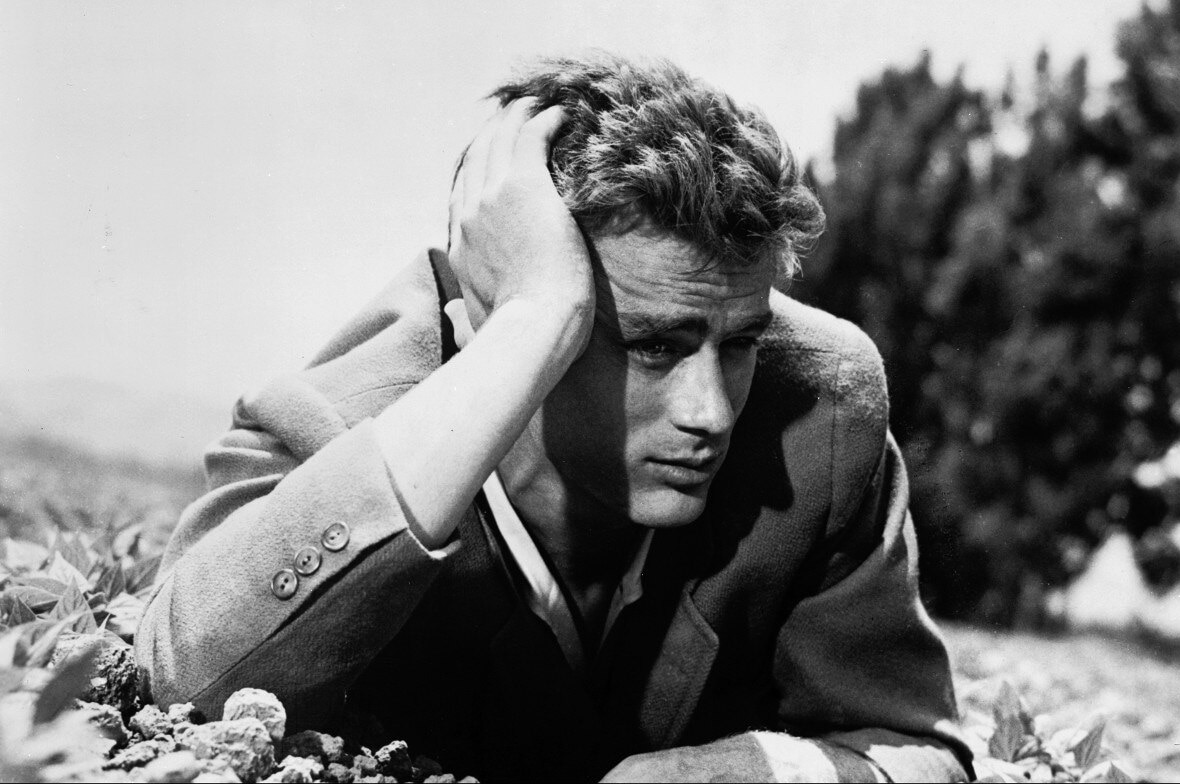
East of Eden has been credited with influencing the movie Hud (1963), which is also about the contentious relationship between a rebellious son and his stern father. Whatever the extent of that influence, it's certainly true that both films fit well within the style and themes of the "anti-hero" films of the 1950s and beyond, exemplified in the performances of James Dean, Marlon Brando, Paul Newman, and others. Undeniably the most important and durable pop culture influence of the film is simply the presence and image of James Dean, who is still an icon more than 50 years after his death. Dean's phenomenal popularity and the strong identification American youth had with him began immediately upon the release of the film and became a cult after his fatal accident in September 1955. Since then, his image has appeared on t-shirts, posters, stamps, and just about every product conceivable (helping his estate to earn about $5 million a year, according to Forbes magazine). His death guaranteed that his image as the young rebel would remain forever undisturbed.
James Dean has been the main subject of a number of songs and mentioned in countless others, including tunes by The Eagles, The Beach Boys, Chris Isaak, Lady GaGa, Madonna, R.E.M., Lou Reed, Rufus Wainwright, and others.
On the sitcom Happy Days, the character of Fonzie has a picture of Dean in his closet next to his mirror. A picture of Dean also appears on Rizzo's wall in the film Grease (1978).
Dean has been the subject of, or a character in, a number of movies (Come Back to the Five and Dime, Jimmy Dean, Jimmy Dean [1982], September 30, 1955 [1977]), and filmed biographies have included segments depicting his work on East of Eden. His life was recounted in a 2001 television biographical movie featuring Edward Herrmann as Raymond Massey, Enrico Colantoni as Elia Kazan, and Wendy Benson as Julie Harris. Dean was played by James Franco, one of many stars over the past few decades hailed as "the next James Dean." Some other actors compared to Dean include Martin Sheen, Heath Ledger, and Robert Pattinson. A new film portrait of the actor is set to be released in 2011, with James Preston as Dean.
A famous picture exists of Marlon Brando's visit to the set of East of Eden. Brando smiles broadly for the camera, Julie Harris looks up at him warmly, but Dean, who was a great fan of Brando's, appears tense and awkward. (Kazan later said Dean "was so adoring he seemed shrunken and twisted in misery.") Dean's identification with Brando was very strong, and reportedly after their meeting, he tried to call Brando frequently. In a letter he wrote to a friend during production of East of Eden, he signed off as "Jim (Brando Clift) Dean."
James Dean was reportedly idolized by Elvis Presley.
A Los Angeles newspaper reported in 1965 that plans were in the works for a television series based on the book but that never came to be.
According to an article in Daily Variety in 1967, United Artists was financing a Broadway musical based on the film and held an option to adapt the musical for the screen. The musical, Here's Where I Belong, was directed by record producer, recording artist, and television personality Mitch Miller. An article touting it appeared in Billboard magazine on March 2, 1968 claiming the show would open the following Sunday, but according to Miller's obituaries (August 2010), it closed after one performance. A planned cast album was never released. The part of Cal was played by 31-year-old Walter McGinn, who appeared in several plays, films, and television shows before his untimely death in 1977 at the age of 40. Aron was played by Ken Kercheval, who later gained fame as Cliff Barnes on the TV series Dallas, and Abra was played by Heather MacRae, daughter of stage and screen musical star Gordon MacRae. Song lyrics were written by playwright Alfred Uhry (Driving Miss Daisy), and the book was written by Terrence McNally (Love! Valour! Compassion!), who asked to have his name removed from the credits.
A 1981 eight-hour television miniseries covered the full novel, unlike the film. It was directed by Harvey Hart and starred Timothy Bottoms as Adam Trask, Jane Seymour as Cathy/Kate, Sam Bottoms as Cal, and Hart Bochner as Aron. This adaptation won an Emmy for art direction and Golden Globes for Best Mini-Series and Best Actress (Seymour).
A three-part, nine-hour stage adaptation by Alan Cook, using the full novel, was presented in 1992 as part of that year's National Steinbeck Festival. It has been revived at least twice since then, and a shortened two-part version of Cook's adaptation was presented at Actors Theatre of Louisville.
As of late 2010, a new film version was listed as "in development" for a 2011 release. English director Tom Hooper (TV's John Adams, Prime Suspect) has been mentioned as the director of this adaptation written by Christopher Hampton (Dangerous Liaisons), but none of this has been solidly confirmed.
When East of Eden was released in Germany and Austria, the scenes detailing the growing animosity the people of Salinas feel for German shoemaker Albrecht were heavily edited. In fact, it's not even clear in this version that Albrecht is German.
The references to the biblical story of Cain and Abel are obvious, not least in the title, which is taken from Genesis 4:16, and which says that after slaying his brother Abel, Cain went to live in "the land of Nod, east of Eden." Burl Ives, as the sheriff, quotes this passage after Cal has brought Aron to meet the mother he thought was dead and Aron, in a drunken furor, joins the army to go off to war. Like Cain, Cal's actions are precipitated by God's (not Adam's) rejection of his gift from the soil in favor of Abel's gift of one of his flock animals.
A photo of Richard Davalos (Aron), taken from a shot of him and James Dean on the set of East of Eden, appears on the cover of The Smith's album "Strangeways, Here We Come."
In the alternate history/sci-fi novel Homeward Bound by Harry Turtledove, James Dean does not die in the car crash and survives to make a number of movies, one of which is "Rescuing Private Rainfall," based on the same source material as the real-life Saving Private Ryan (1998).
by Rob Nixon
Pop Culture 101 - East of Eden
by Rob Nixon | January 18, 2011
SIGN UP FOR OUR NEWSLETTERS

CONNECT WITH TCM