SYNOPSIS
Cal and Aron Trask are brothers in their late teens who live with their father, the stern and moralistic farmer Adam, in northern California. Aron is well-behaved and respectful and has a pleasant and intelligent girlfriend named Abra, while Cal is a loner and wild boy, often in trouble and deeply tormented. Cal has found out that their mother, who he and Aron believed long dead, is actually a notorious madam in the coastal town of Monterey. Cal hops a train there and follows her around, hoping she'll speak to him. Cal believes he's bad because his mother is bad, and he feels that, like her, he's unloved by his father. In an attempt to win Adam over, Cal secretly goes into business growing beans, a crop whose prices rise at the outset of World War I. Cal wants to earn back the money his father lost on an ill-fated venture to ship lettuce long distances by refrigerated rail car. But just as he is about to give his father the cash as a birthday present, Aron trumps him by announcing his engagement to Abra, a fact even she was unaware of and finds distressing in light of her growing attraction to Cal. Adam is delighted, but his happiness turns bitter when he learns that Cal has made money off what Adam considers war profiteering. He rejects the gift, sending a desperately crushed Cal into an act of revenge that will have tragic consequences but ultimately bring about his redemption.
Director: Elia Kazan
Producer: Elia Kazan
Screenplay: Paul Osborn, based on the novel by John Steinbeck
Cinematography: Ted McCord
Editing: Owen Marks
Art Direction: James Basevi, Malcolm Bert
Cast: Julie Harris (Abra), James Dean (Cal Trask), Raymond Massey (Adam Trask), Burl Ives (Sam the Sheriff), Richard Davalos (Aron Trask), Jo Van Fleet (Kate), Albert Dekker (Will Hamilton).
C-115m.
Why EAST OF EDEN is Essential
One way to trace the importance of the film East of Eden might be through its source, a novel by one of America's most famous writers. John Steinbeck wrote nearly 30 books--novels, non-fiction, and short story collections, winning the Pulitzer Prize in 1939 for his most acclaimed work, The Grapes of Wrath; he established a reputation for authenticity, a strong sense of place (primarily the coastal towns and rural valleys of Northern California), and a compassionate view of the disenfranchised and struggling, all of which earned him a Nobel Prize near the end of his career in 1962. Yet East of Eden, although a best seller and recognized as his most ambitious and most personal work, was considered far from his best, and while some of his books (excluding Eden) remain on many required reading lists, his critical reputation, decidedly mixed during his life, has diminished considerably since his death. The 1955 film version, based on only the final 80 pages of the sprawling novel, is certainly compelling and powerful, but its melodramatic qualities and heavy-handed biblical parallels have not been looked on with great favor.
As a work by Elia Kazan, East of Eden surely merits attention. Again, Kazan's critical reputation has not held up in the long run, nor was it always the highest during his own life. Even so, there's no doubting his importance to American film and theater. By the time he made this movie, he had already earned a considerable name as an actor and director on the New York stage, a leading figure with the legendary Group Theatre and the highly influential Actors Studio. His award-winning direction of Gentleman's Agreement (1947), A Streetcar Named Desire (1951), and On the Waterfront (1954) assured his place as an exciting filmmaker with a great talent for getting the best performances from his actors. But with those three films and a number of justly famous stage works behind him, and many more to follow, can East of Eden truly be considered a crowning point of his career?
Neither of these aspects is to be dismissed, of course. Both contributed greatly to the picture's commercial success and its enduring appeal through the years, as did the evocative CinemaScope photography of Ted McCord, the insistent dramatic score of Leonard Rosenman (his first in a distinguished career of film composition), and the acting by a cast of film veterans and stage notables, especially Julie Harris and Jo Van Fleet, who won a Supporting Actress Oscar® for her work. But there's really one overarching reason why we still watch East of Eden with such fascination today, a single factor that qualifies it for "essential" status--the presence of James Dean.
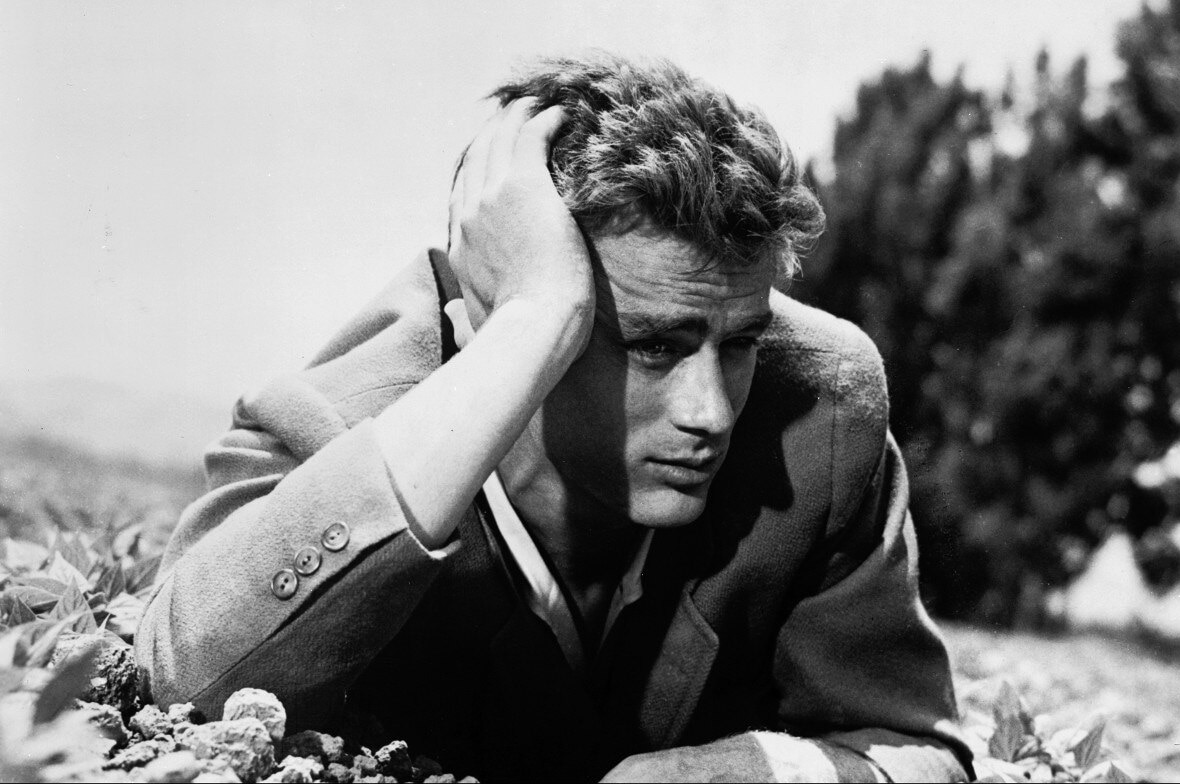
This is not, as many think, Dean's film debut. He had appeared in small roles in a half dozen previous pictures without any kind of impact, but this was his first starring role and the one that secured his iconography as the lost, desperate youth of the 1950s. Rebel Without a Cause (1955) fixed the image for us--the red jacket, jeans, contemporary "delinquent" attitude of both defiance and pain. But East of Eden, although set around World War I, established him in the eyes of American audiences as, in the words of biographer Donald Spoto, "the rebel as poetic antihero, as the misunderstood but vulnerable herald of a new generation--the boy in anguish as a disturbed animal, so needy of love that nothing else has any reality." In an age of apparent conformity and drive to achievement and status, Dean struck a chord with youth who perceived themselves as neglected, ignored, incapable of following the path expected of them. And those not suffering from any such disaffection were simply drawn to the sensitivity and magnetic sensuality they saw in him or projected upon him. Whatever it was--perhaps nothing more than a new spin on the "It" that Elinor Glyn had identified in stars three decades earlier--it was instantaneous. In fact, the idolatry began even before East of Eden was released, thanks to skillful publicity maneuvered by both Dean and the film's public relations flacks, and continues to this day.
It was an exciting and auspicious "debut" with hype and impact equal to that accompanying another Kazan "discovery," Marlon Brando. The awkward movements, rapid changes of mood, the halting difficulty of verbal expression all signaled for audiences of the time a new style, albeit one perhaps too modeled on Brando at first but with an even greater capacity for hurt and self-destruction. Yet even today, the jury is still out on Dean's acting ability. After his violent death in a car accident only a few months after the film's release, even Kazan questioned whether he would have been able to sustain popular interest or if he could have extended his range to grow with age and the changing times. Of course, we'll never know, and that's what adds a greater significance to East of Eden and the two remaining films released after his death, Rebel and Giant (1956, in which he did show signs of growth, even within the identity he had forged). Dean's death at 24 meant he would never have to prove himself further and could remain one of the most immortal icons of the screen.
The most compelling aspect of East of Eden and Dean's work in it, brilliantly tapped by Kazan, is the way it illustrates the magical way movies have of melding a role with the personality of the performer to create something bigger than each contained separately. It worked well for, say, Joan Crawford in her string of melodramas as the spunky poor girl struggling to make her way into the upper crust or John Wayne as the strong, willful man of action. But with Dean, the connection between life and art took on an even greater intensity, so much so that one of Dean's former teachers remarked how much the part he played on screen was so infused with the boy she knew in reality. Kazan immediately recognized in Dean's erratic and difficult behavior the qualities he saw in Cal Trask when the character was still on the page, and after seeing the young actor trying to interact with his own cold and disapproving father, Kazan knew that the story he was telling was alive in his new star. It was a risky decision to use only the last fourth of a highly popular novel as the basis for his story, but thanks to Kazan's exploitation of the deepest connections between Dean and Cal, he got maximum impact out of the novel's most compelling conflict, the desperate attempts of a troubled young man to win his father's love. Dean brought to his performance a level of emotion that would not have been possible through a purely technical approach. That made East of Eden a highly rewarding film then and one that continues to garner our rapt attention.
by Rob Nixon
The Essentials - East of Eden
by Rob Nixon | January 18, 2011
SIGN UP FOR OUR NEWSLETTERS

CONNECT WITH TCM