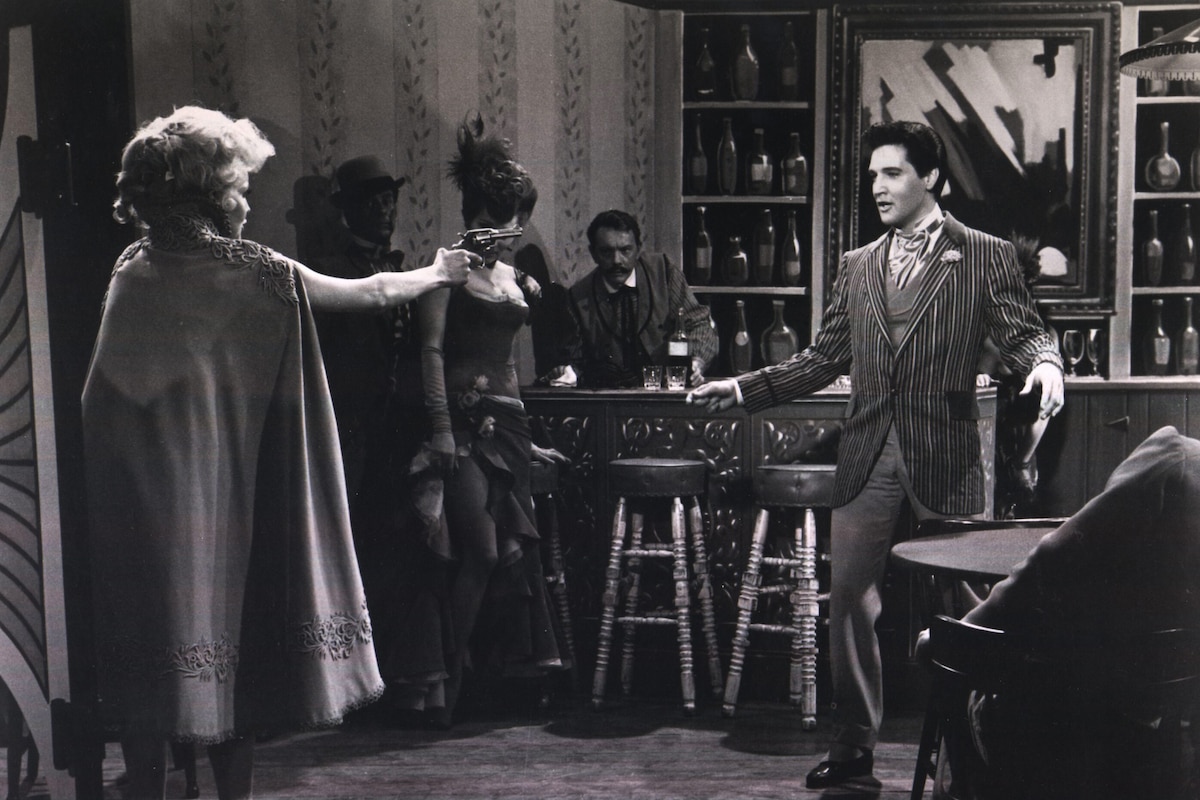
Falling between Paradise, Hawaiian Style and Spinout in the year 1966, Frankie and Johnny marked Elvis Presley's twenty-first motion picture and holds the unusual distinction of being inspired by a barroom ballad from the early 1900's. You know the song - torch singer falls for dashing gambler, is jilted by him for a female rival and empties her gun into the jerk. Somehow producer Edward Small and screenwriter Alex Gottlieb expanded this bare-bones storyline into a musical romance with a Mississippi riverboat setting and a happy ending - Johnny gets off lightly with a flesh wound.
First some background. The first published version of the "Frankie and Johnny" ballad - originally known as "He Done Me Wrong" - is generally attributed to Hughie Cannon in 1904. Since then, many others have recorded the song - Ted Lewis, Gene Autry, Mae West (in her 1933 film, She Done Him Wrong) Brook Benton, Sam Cooke, Johnny Cash and, of course, Elvis in 1965 - but, it was in 1936 when the first film version of Frankie and Johnny appeared. In it, Helen Morgan played a singer in a St. Louis casino named Frankie who forms a romantic triangle with gambler Johnny (Chester Morris) and rival Nellie Bly (Lilyan Tashman). In the 1966 remake, Elvis's Johnny is more than just an amorous cardsharp; he's got a singing act with Frankie and gets to perform such non-hit wonders as "Make Petunia's Tulips Mine, "What Every Woman Lives For," and "Please Don't Stop Lovin' Me." If you really want to know what killed Elvis, it wasn't the drugs or the overeating; it was movies like Frankie and Johnny.
The character of Nellie Bly, played by Nancy Kovack in this version, was actually based on a real person, a newspaper reporter for The Pittsburgh Dispatch who made front page headlines when she went around the world in seventy-two days, six hours, eleven minutes and fourteen seconds, beating Phileas Fogg's record in the Jules Verne adventure, Around the World in 80 Days.
Not one of Elvis's more popular films, Frankie and Johnny is probably more significant as a turning point in the singer's life than anything else. According to biographer Peter Guralnick (in Careless Love: The Unmaking of Elvis Presley), during the making of Frankie and Johnny, "Elvis was visibly overweight; and perhaps the most notable aspect of the filming was the spiritual connection that he made with his co-star Donna Douglas. Instead of dating her, according to Sonny West, he took a genuine intellectual interest in her. They exchanged books and ideas, spoke of Daya Mata and the Self-Realization Fellowship to which she, too, belonged, and meditated together. He showed her many of his books, Larry [Geller] noted proudly, "and they would go over his marked passages together." It certainly wasn't the image most people had of the off-screen Elvis or Douglas who was starring as Ellie Mae in the then-current TV sitcom, The Beverly Hillbillies.
Producer: Alex Gottlieb, Edward Small
Director: Frederick De Cordova
Screenplay: Nat Perrin (story), Alex Gottlieb
Cinematography: Jacques R. Marquette
Film Editing: Grant Whytock
Art Direction: Walter M. Simonds
Music: Fred Karger
Cast: Elvis Presley (Johnny), Donna Douglas (Frankie), Harry Morgan (Cully), Sue Ane Langdon (Mitzi), Nancy Kovack (Nellie Bly), Audrey Christie (Peg).
C-88m. Letterboxed.
by Jeff Stafford
Frankie and Johnny - Frankie and Johnnie
by Jeff Stafford | September 25, 2003
SIGN UP FOR OUR NEWSLETTERS

CONNECT WITH TCM