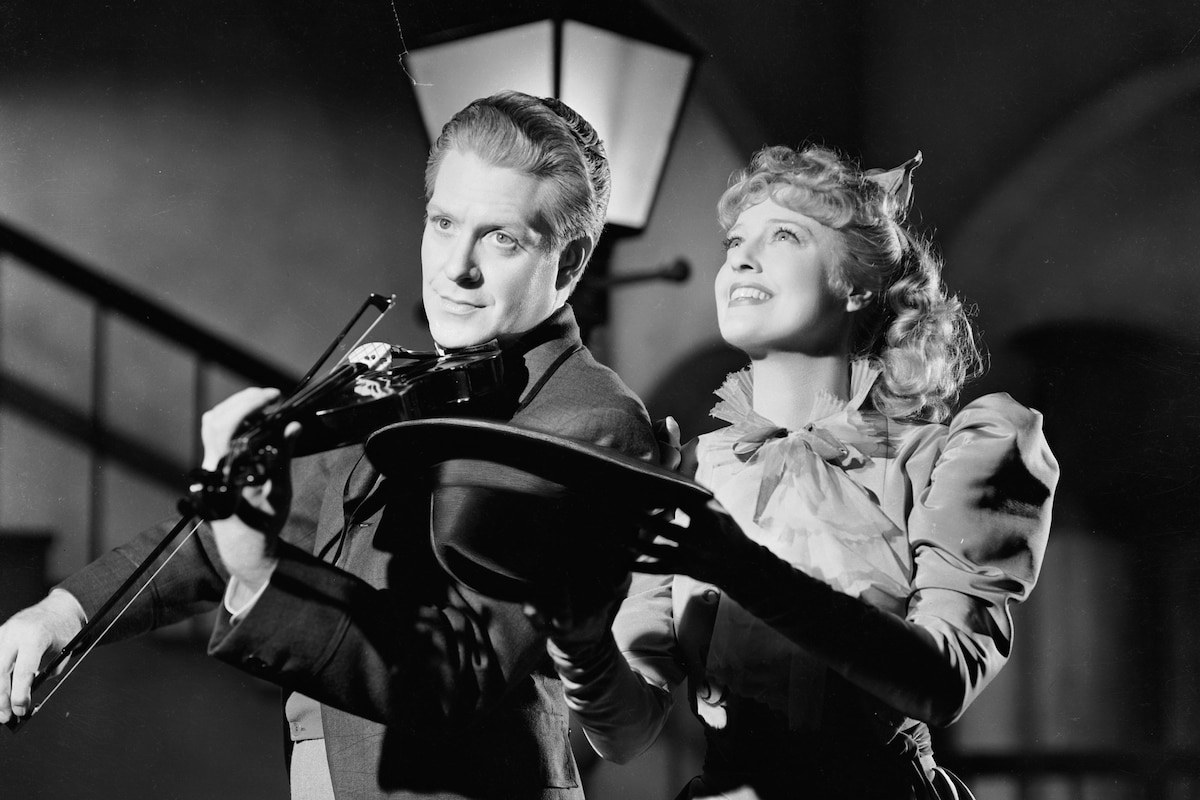
Bitter Sweet (1940) was the sixth feature film that America's singing sweethearts Nelson Eddy and Jeanette MacDonald made together. In the film, MacDonald plays an English society girl in the late 19th century who escapes an arranged marriage and elopes to Vienna with her penniless music teacher, played by Eddy. The blissful newlyweds need only love to live on as composer Eddy shops his operetta around town in hopes of having it produced. Fate intervenes in the form of Baron Von Tranisch (George Sanders), who hires MacDonald to sing in his cafe, but his motives are less than honorary. When he tries to force himself on her, Eddy challenges him to a duel.
Bitter Sweet was based on the operetta of the same name written by Noel Coward and performed first on the London and New York stages in 1929. It had been filmed once before in Hollywood in 1933 with Anna Neagle and Fernand Gravey in the roles of the young lovers. Jeanette MacDonald had also been considered for the lead in the 1933 film as well, but negotiations broke down resulting in Neagle getting the part instead.
The Nelson Eddy and Jeanette MacDonald Technicolor remake of Bitter Sweet was much anticipated as the operatic singing pair was at the height of its popularity. The buzz was that it might be another Maytime (1937), one of the team's greatest screen successes. For her role, MacDonald had to age convincingly from youth to old age. According to James Robert Parish in The Jeanette MacDonald Story (Mason/Charter), "this provided a challenge for makeup expert Jack Dawn. He prepared three life masks of Jeanette, and then by experimenting with a rubberlike substance he called "formula six" composed segmental latex alterations for her to apply as she "aged." Parish also wrote that during filming MacDonald once "arrived at the studio in a shade of vermilion called "sunburn." The burn was so severe that a Hungarian costume she was to wear had to be redesigned with a higher neck, and while modeling the outfit on camera, the star had to keep her smiling face in full view of the all-revealing lens."
A more serious problem was that the structure of Bitter Sweet too closely resembled Maytime. MGM therefore ordered Bitter Sweet's prologue and epilogue trimmed before it was released in an effort to cut down on the similarities between the two films.
Upon its release Bitter Sweet received a lukewarm reception from the public, and it turned out to be a rare financial disappointment for a Nelson Eddy-Jeanette MacDonald picture. Some critics found fault with the lavish production value, while others felt that Lesser Samuels' screenplay strayed too far from Noel Coward's original source material. Some even criticized the leads, both in their late 30s, for being too old to play young lovers. Most did agree, however, that the film's visual artistry was commendable with its beautiful costumes and sumptuous Technicolor art direction, which garnered an Academy Award nomination, as did the color cinematography. The grand number "Zigeuner" at the end of the film was given particular accolades for its unique staging and set design. The lovely Noel Coward songs featured include "Dear Little Cafe," "If You Could Only Come With Me" and "Tokay."
Producer: Victor Saville
Director: W.S. Van Dyke
Screenplay: Noel Coward (play), Lesser Samuels
Cinematography: Allen M. Davey, Oliver T. Marsh
Film Editing: Harold F. Kress
Art Direction: Cedric Gibbons
Music: Noel Coward
Cast: Jeanette MacDonald (Sarah Millick), Nelson Eddy (Carl Linden), George Sanders (Baron Von Tranisch), Ian Hunter (Lord Shayne), Felix Bressart (Max), Edward Ashley (Harry Daventry).
C-94m. Closed captioning.
by Andrea Passafiume
Bitter Sweet
by Andrea Passafiume | September 25, 2003
SIGN UP FOR OUR NEWSLETTERS

CONNECT WITH TCM