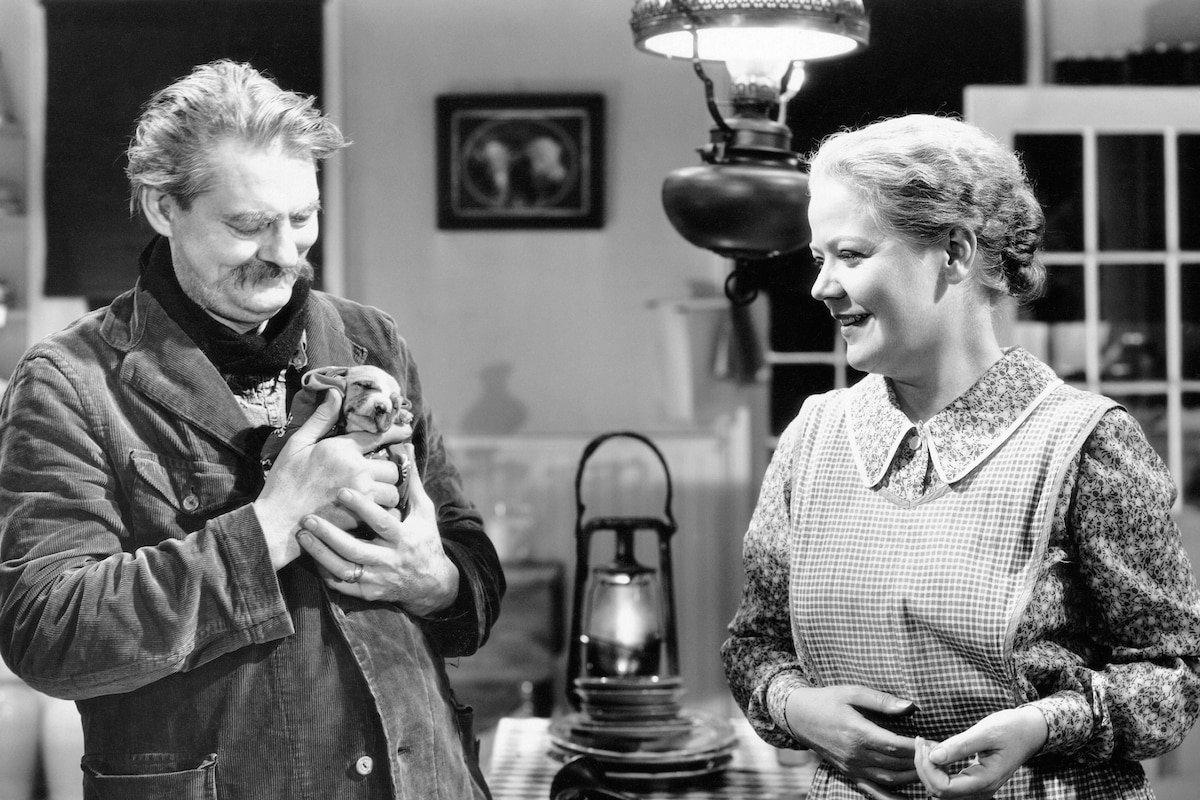
Ah, Wilderness! (1935), which had starred Lionel Barrymore, Wallace Beery, Spring Byington, Eric Linden and Charley Grapewin, had scored a hit for Metro-Goldwyn-Mayer in the depths of the Great Depression. Like all of the studios, they were hurting for revenue, and taking their cue from rival Universal's slogan "A Good Cast is Worth Repeating", MGM rushed The Voice of Bugle Ann (1936) into production. Adapted by Harvey Gates from the novel by MacKinlay Kantor, The Voice of Bugle Ann recycled the cast (minus Wallace Beery), added Maureen O'Sullivan, and changed the location from Eugene O'Neill's New England to Kantor's hills of Missouri.
Filming only lasted a month, going from November 25 to December 30, 1935, with the hunting scenes shot in the Ozark Mountains and the exteriors with the stars and supporting cast shot in Burbank and in the San Fernando Valley, California. Before World War II, the Valley (as it is known in Los Angeles) was mostly farm land. Barrymore himself owned a house with property in the Northridge section of the Valley. After the war, when the veterans returned to a housing shortage, the farmland was quickly carved into housing tracts. Today, it is almost entirely concrete and freeways.
Lionel Barrymore (along with his brother John) was a great lover of dogs but he could not get the dog playing Bugle Ann to bark when needed. He thought that if he brought the dog out to his home and spent some time with her, she would become more comfortable around him. The dog's trainer, Carl Spitz, who would later train Terry the terrier, who played Toto in The Wizard of Oz (1939), agreed. According to James Kotsilibas-Davis, "The hound became attached to the chauffeur, Harry Hinkley, who fed her. She ignored the star and refused to "bugle" on cue. 'Has she bugled yet?' Lionel asked. 'Yes sir, she shore has,' replied Harry, 'Once under the piano and twice on the rug.'"
"While attempting to get some proper baying from the hound, the star suffered minor wounds. He appeared on set with three patches of court plaster on the fingers of his right hand. 'That's where one of the dogs nicked him,' Charley Grapewin explained. 'He gets things addled,' Lionel said of his colleague. 'It was just the other way around. I nicked the dog.' Any animosity between man and dog disappeared on camera. The hound bugled on cue, and the hard-fisted man of the soil rose to silver-tongued eloquence in the famous courtroom paean for his pet. With scraggy moustache, battered hat, patched overalls, and voice and eyes surpassingly expressing pain and pleasure, the actor etches another memorable portrait."
Although the dog managed to "bugle" on cue once she returned to the set, the resulting sound wasn't quite what the sound director Douglas Shearer (brother of actress Norma Shearer) wanted. He finally managed to get the right tone by mixing the dog's bark with a French horn.
The Voice of Bugle Ann was released on February 15, 1936 and was warmly received by the critics. Frank Nugent, in his New York Times review of the film, wrote, "Metro has adapted [Kantor's] story into the tender, sentimental and richly human photoplay of the same title that opened yesterday at the Center Theatre. Far removed from the usual grist from the Hollywood mills, the picture shines with a clear and beautiful simplicity and rings--if so gentle a piece can ring--with conviction...Out of it, more importantly, has come a picture that should be excellent entertainment for every lover of dogs and still should be entirely satisfactory to those who can take them or leave them alone."
Lionel Barrymore would revise his role for the Lux Radio Theater version of the story with Anne Shirley and Porter Hall in July 1936. MacKinlay Kantor would likewise revisit his characters; writing a sequel, The Daughter of Bugle Ann (1953) in which Little Lady, Bugle Ann's daughter, helps to reunite the romantic couple of the first book.
Producer: John W. Considine, Jr.
Director: Richard Thorpe
Screenplay: Harvey Gates, Samuel Hoffenstein (writers); MacKinlay Kantor (novel)
Cinematography: Ernest Haller
Art Direction: Cedric Gibbons
Music: Rudolph Kopp; Milan Roder, Heinz Roemheld (uncredited)
Film Editing: George Boemler
Cast: Lionel Barrymore (Springfield 'Spring' Davis), Maureen O'Sullivan (Camden Terry), Eric Linden (Benjy Davis), Dudley Digges (Jacob Terry), Spring Byington (Ma Davis), Charley Grapewin (Cal Royster), Henry Wadsworth (Bake Royster), William Newell (Mr. Tanner), James Macklin (Delvin 'Del' Royster), Jonathan Hale (District Attorney).
BW-72m. Closed Captioning.
by Lorraine LoBianco
SOURCES:
Eyman, Scott Lion: The Life and Legend of Louis B. Mayer
Jacob, Merle, and Apple, Hope To Be Continued: An Annotated Guide to Sequels
The Internet Movie Database
Kotsilibas-Davis, James The Barrymores: The Royal Family of Hollywood
Nugent, Frank S., "Fox-Hunting Complications in Missouri, as Noted in 'The Voice of Bugle Ann,' at the Center", New York Times 27 Feb 36
The Voice of Bugle Ann
by Lorraine LoBianco | January 04, 2011
SIGN UP FOR OUR NEWSLETTERS

CONNECT WITH TCM