Marilyn Monroe was the most beautiful woman in the world. This is not an opinion, it is simply a fact. They say beauty is in the eye of the beholder: when the beholders number in the countless millions, across all cultures around the globe, then the question of beauty transcends personal taste and enters the realm of objective truth. Back in ancient Troy, this kind of beauty started wars. In the middle of the 20th century, it created celebrities.
Living in a spotlight that intense had its price: there was no way to step back out of the spotlight. She lost her privacy. Every move she took was photographed, celebrated, analyzed, consumed, even ridiculed. Case in point: she had enrolled in Lee Strasburg's fabled Actor's Studio to study "The Method." The movie press collectively laughed -- look at the dumb blonde who thinks she can act! "Will acting spoil Marilyn Monroe?" the headlines crowed.
It's not like she hadn't been a dramatic actress before. She had already played it straight in Fritz Lang's Clash by Night (1952), but that had been a supporting role predating her massive pop cultural breakthrough. For those who knew her only as the cartoon sex bomb of The Seven Year Itch (1955), such credits meant little. She had a headlining dramatic part in the low-budget noir thriller Don't Bother to Knock (1952), but that had been belittled by critics of the time (and only recently rehabilitated in hindsight as a fine performance in a clever film). To break the stereotypes, Marilyn Monroe needed to escape the small-mindedness of studio bosses.
Monroe took steps to prove that she meant it. She legally changed her name to Marilyn Monroe, as if to prove she was no poseur. She was Marilyn Monroe. Then she renegotiated her contract with 20th Century Fox to assert control over her films. From now on, she would choose the scripts, the directors, the technicians. She formed Marilyn Monroe Productions, with herself as President, to administer these new responsibilities.
The first film to be made under this new arrangement was Bus Stop (1956). On Broadway, William Inge's play had been a huge and long-running hit, even nominated for a Tony. Inge was a prestigious playwright -- not unlike Arthur Miller, who at the time was holed up in Nevada, trying to establish residency so he could divorce his wife and be free to wed Marilyn.
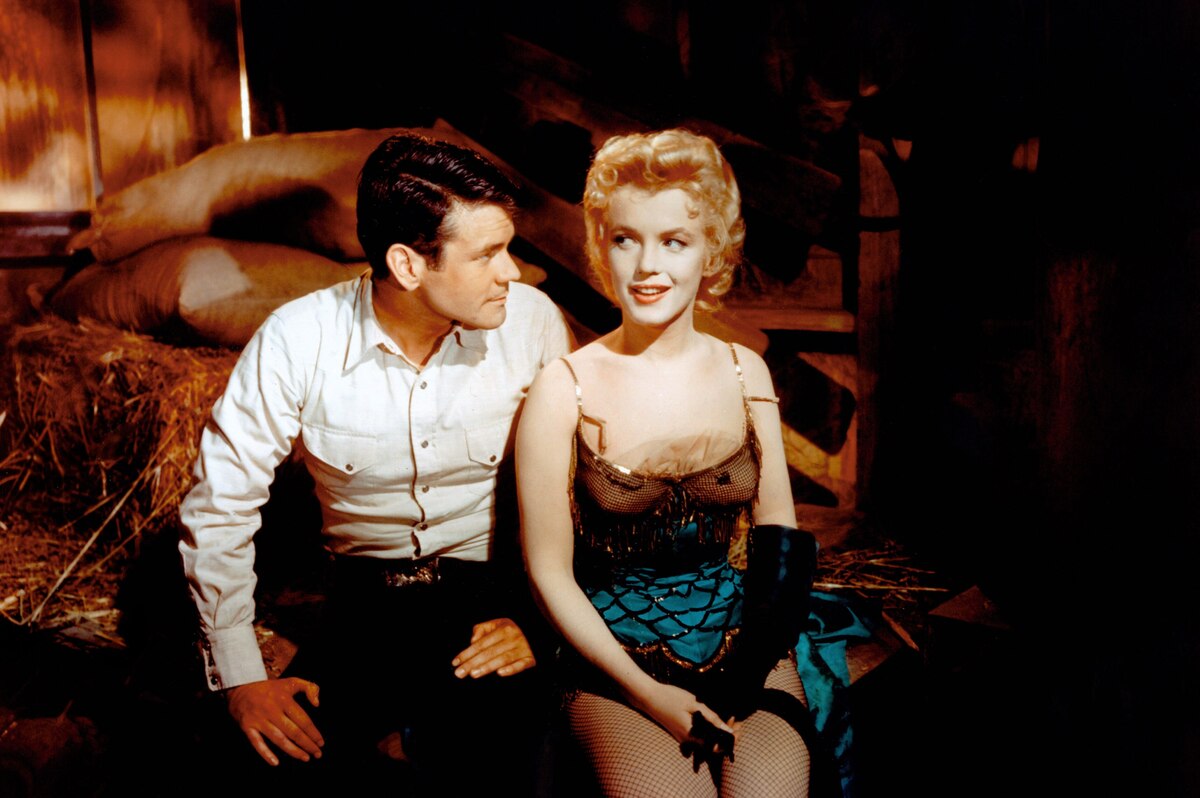
Bus Stop had a lot to offer Marilyn in her bid to bridge the gap between Movie Star and Serious Actress. The female lead, Cherie, is an aspiring actress and a terrible singer. "I'm a chanteuse," she says, with her Southern twang making "chanteuse" sound faintly obscene. Cherie has slept her way to the very bottom, but still holds impossible hopes that her dead-end job at a Phoenix saloon is just a way station on the way to stardom in Hollywood. One day. She is, in short, a shopworn sexpot, who does not even realize her best days are already behind her. And therein lies the irony--Marilyn Monroe, playing someone who wants to be like Marilyn Monroe but isn't. How better for Marilyn to demonstrate she could play someone other than herself?
She handpicked as her director Joshua Logan, a man better known for his work on such stage hits as South Pacific and Picnic. He had, in fact, directed the film adaptation of Picnic, which had opened in theaters just as the stage version of Bus Stop opened in New York, with Actor's Studio alum Kim Stanley in the role Monroe would play onscreen. Logan, though, was wary of the New Marilyn. The "old" Marilyn was a notorious flake--always late, unable to remember her lines. Was Marilyn 2.0 a worthwhile upgrade, or did it burden an already buggy system with unnecessary new features? Strasburg confided in Logan that of the hundreds of actors who had studied with him, there were only two he thought really stood out from the pack. Marlon Brando and Marilyn Monroe. This was high praise indeed.
Together they developed Cherie as a cruel parody of Marilyn's screen image. Her skin is as chalky as a vampire's, to show how the poor girl's nocturnal life denies her sunlight. Her wardrobe is tawdry and threadbare, her hair tousled and unkempt. She moves like a gangly puppet, her voice is grating. Fox executives watched nervously, as she studiously undermined everything audiences came to expect from her.
It did not come easily. Logan tried to accommodate her chronic unreliability, but she leaned heavily on that patience and strained it to the breaking point. And then, she strained it past the breaking point. With hundreds of thousands of dollars at stake if she didn't get on set now, Logan dragged her forcibly in a humiliating moment she could not forgive. Meanwhile, newcomer Don Murray, playing opposite Monroe, found himself on the receiving end of her tantrums. It made for a tense set, dominated by mutual hostility and unrelieved antagonism.
Had Bus Stop been a different movie, such on-set stress could have helped establish the on-screen mood. That is, had Bus Stop played its drama as a horror movie. The stuff of a horror movie is all there: Don Murray plays a naïve but physically intimidating young man, named Bo Decker, whose sheltered life on his cattle ranch has left him with no understanding of other people, certainly not of girls. He's used to asserting his will on other creatures, and simply cannot comprehend that there is anything else to life. When his friend Virgil (Arthur O'Connell) tries to explain that maybe Cherie resents being hogtied like a farm animal and hauled against her will onto a bus for a life of forced servitude, Bo is bewildered: "How else was I gonna get her on the bus?" He is huge and strong, heedless of social graces and unconcerned what anyone else thinks of him. He is a sort of monster, and his relentless pursuit of Cherie has similarities to various film noir tales of kidnappers and hostages--Ida Lupino's The Hitch-Hiker (1953) for example. Those connotations are there, undeveloped. At no point does Logan attempt to explore the thriller aspects of the story he has in front of him.
This is partly because Murray plays the role for laughs. He yells every line, and swaggers through each scene as if the Beverly Hillbillies' Jethro had been jacked up on coke and let loose. Cherie admits to finding this human freakshow physically attractive; Bo is insulted that she isn't equally attracted to his mind. To demonstrate his intellectual side, he blusters into her bedroom, wakes her up, pins her naked body under his, and screams the Gettysburg Address into her ear. The scene's absurdity masks its terror--Bo is just this side of raping her, but instead of sexual violence, he's hollering a piece of grade-school recital. The audience laughs nervously, because there's nothing to laugh at.
Instead, the story of Bus Stop is not about Cherie's attempt to escape this brute, but her complete inability to escape him. Bo is the sort of fella who won't take "no" for an answer, so the fact that Cherie can only muster up a half-hearted and ambivalent "no" doesn't deter him at all. At every juncture, she continues to beckon him on. She doesn't really want to be tied up, kidnapped, forcibly married, and abducted to an almost uninhabited wilderness...but neither is she entirely against the idea. Because of all the things she wants, being loved -- truly loved -- is the one she wants most, and say what you will about this big lug, he really wants her.
Despite these touches, Bus Stop isn't a thriller. Although Murray plays his role with a broadness that veers into slapstick farce, it isn't a comedy. There are a couple of songs, but it's not a musical. It builds to a mythical fight between cowboys staged at a remote Western outpost, but it isn't a Western. It's hard to say exactly what it is--other than a self-consciously serious vehicle for a self-consciously serious actress.
Marilyn Monroe's career gamble paid off as critics embraced Marilyn 2.0. Setting aside the fractiousness of the shoot, Logan praised her as being "as near genius as any actress I ever knew." Bosley Crowther, the influential and hard-to-please critic for the New York Times opened his review: "Marilyn Monroe has proved herself as an actress." Her performance in Bus Stop was widely praised, but it was costar Murray who got the Academy Award nomination (for Best Supporting Actor), which must have burned a little. Prone to seeing betrayal and intrigue all around her, Monroe was already seething that her best work on Bus Stop had been obscured from the public. The scene in question took place on board the bus, as Cherie confided in a fellow passenger (played by Hope Lange) about her deepest hopes. It was a set-up all but calculated to push Monroe's anxieties to the limit. For one thing, she feared that the deliberately anti-glamorous look she had concocted for Cherie was ruining her sex appeal, and had taken to flirting with Murray in an effort to convince herself she still "had it." But Murray had fallen for Lange -- they were soon married--and so any interaction with Lange chafed Monroe's rawest nerves.
There was another problem. The scene called for Monroe to deliver a long monologue, which needed to be filmed in a single take without cutaways. Never before had the actress successfully delivered so long of a speech at one time. It went as you would expect: Logan started the camera, called "action," Marilyn started talking -- and then would fumble. A misspoken word, a misplaced inflection, a misdirected gesture, something. Logan would call "cut!" and the cycle began anew. Nerves frayed, the day trickled away, and gradually Logan noticed something. Marilyn was more likely to screw it up at the top of the scene, and got better as it went. That first instant, as the camera starts up, was piquant with expectation -- and that was a psychological flashpoint for the fragile actress. Once past that initial burst of expectation, she settled down. So Logan figured whatever he wasted in excess filmstock would be paid for by saved time, and just stopped calling "cut." Instead, he let the camera roll, and allowed Marilyn to restart again and again on her own, until she nailed it. At the pace they'd been going, she might have taken days to get it right; Logan had gotten it from her in hours.
And then Fox executives snipped it from the film. Bus Stop was overlong, they said, and the scene dragged things to a crawl during an otherwise taut sequence. Monroe fumed that Logan would allow her triumph, so hard won and dear, to be discarded like that. Privately, Arthur Miller was growing worried that Marilyn's mood swings and self-destructive tendencies were manifesting as a genuine suicidal risk. History, tragically, would prove him right. But that was still in the future -- first, she was going to save him.
1956 was the pitch of the Red Scare, you see, and the sage lawmakers of the most powerful nation on Earth decided that they urgently needed to interview this playwright about his political beliefs. Others had faced HUAC's paranoid wrath before, and learned that there were but two painful options. Either you 1) refused to answer questions, and appeared to be a traitorous Commie or 2) you ratted out your friends as traitorous Commies. Miller was an honorable man and he thought he'd figured out a third way: be honest about his own past involvement with leftist causes, but refuse to name others. His lawyers urged him to reconsider. They saw his strategy as simply a more foolish version of Choice #1. In the end, Miller lucked into a genuine third way, entirely by accident: he mentioned he was engaged to Marilyn Monroe. HUAC let him go, and instead of an angry press tarring him as un-American, he rode a wave of happy PR. Commies are Commies, but dammit, man, this is Marilyn we're talking about! Yeah, she was All That, and Bus Stop proved she had surprises yet in store.
Producer: Buddy Adler
Director: Joshua Logan
Screenplay: George Axelrod (screenplay); William Inge (play)
Cinematography: Milton Krasner
Art Direction: Mark-Lee Kirk, Lyle R. Wheeler
Music: Cyril J. Mockridge, Alfred Newman
Film Editing: William Reynolds
Cast: Marilyn Monroe (Cherie), Don Murray (Beauregard 'Bo' Decker), Arthur O'Connell (Virgil Blessing), Betty Field (Grace), Eileen Heckart (Vera), Robert Bray (Carl), Hope Lange (Elma Duckworth), Hans Conried (Life Magazine Photographer), Casey Adams (Life Magazine Reporter).
BW-96m. Letterboxed.
by David Kalat
Sources:
Sam Kashner and Jennifer Macnair, The Bad and the Beautiful: Hollywood in the Fifties.
Barbara Leaming, Marilyn Monroe.
Carl Edmund Rollyson, Marilyn Monroe: A Life of the Actress.
J. Randy Taraborelli, The Secret Life of Marilyn Monroe.
Bus Stop
by David Kalat | December 01, 2010
SIGN UP FOR OUR NEWSLETTERS

CONNECT WITH TCM