If America is about self-reinvention and finding yourself amid the wide-open spaces on either side of a beckoning road, Thelma & Louise (1991) is a quintessentially American movie - twice over. Its dynamite protagonists - Geena Davis's Thelma, trapped in a marriage too small for her, and Susan Sarandon's Louise, spinning her wheels waiting tables in a coffee shop while waiting for a commitment-phobic boyfriend to marry her - breathe new life into two classic American movie genres: the existential road movie and the outlaw buddy movie. It stands both genres on their heads not only by reversing the sexes, but by bringing to the rejiggering a more mature, more emotionally generous outlook than these movies usually get when guys propel them.
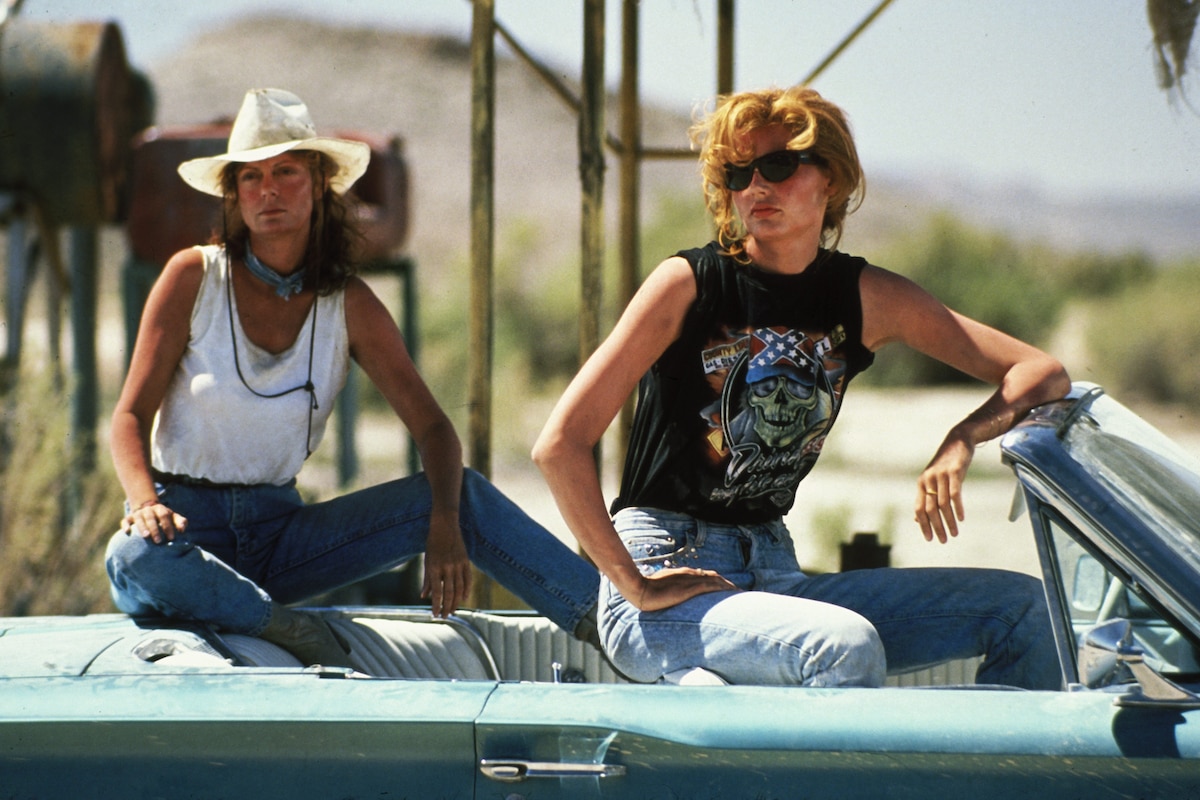
And do they ever propel! There's no sign of a soapbox here. It's all gearbox as you're swept up in the exhilaration of their flight from small-town Arkansas drudgery in Louise's sea-green vintage T-Bird. They floor it after thumbing their noses at Thelma's stifling fathead salesman and Louise's country'n'western Peter Pan. Even when initial larkiness gives way to something darker and more desperate after an ugly attempted rape and an act of violence that follows it, the film still sweeps you along. Like the best road movies, Thelma & Louise is drunk on recklessness, intent on seeing the open road as an escape hatch, even though it may end up being just another noose.
As they run the gamut of American male loserdom en route - from the vicious would-be rapist to a caricatured clown of a chauvinist truck driver, with several easier-to-take if hardly more admirable types in between, including a slick hustler played by Brad Pitt on the verge of his career breakout -- the film never simply sets up their adversaries to be offed, as most male excursions in this genre do. The women react humanly and in some cases humanely, as in Sarandon's touching scene when she kisses off Michael Madsen's nice guy lightweight. Or in a scene when, cornered and armed, they display a change of heart and decide not to shoot a state trooper pursuing them when he tells them he has a wife and children. "You be sweet to them," says Thelma in the film's most quoted line. "My husband wasn't sweet to me, and look how I turned out!"
By then, they're in deep trouble. Thelma & Louise abounds in ironies. The big one is that as both women's spirits expand, their range of possibilities cruelly shrinks. Another is that they have liberation thrust upon them by a would-be rapist who attacks Thelma in a parking lot. After he's gunned down, the film takes the plunge into no-looking-back territory. No less than Faye Dunaway's Bonnie in Bonnie and Clyde (1967) or Glenn Close's uncontrollable career women in Fatal Attraction (1987), it's a seizure of power by a strong woman who isn't afraid to pull the trigger. In doing so, these two women also boldly grab what had pretty much been a hitherto exclusively male prerogative - the right to hit the road and get in touch with themselves. And, secondarily, subvert male monopoly.
Just when Sarandon's Louise, the earth mother of the two, finds her spirits flagging after Pitt's slickster robs them, Davis's hitherto dependent Thelma acquires newfound nerve. Suddenly you feel rangy Thelma testing her wings, and delighted to find they work. Later, when the possibility of surrender is raised, you believe her when she says she can't go back, that somewhere she crossed a line. And you note the proud tilt Sarandon brings to Louise's chin to realize that Louise won't clip their wings, either. You feel that both have crashed through a male-dominated society's roadblocks - literal and figurative - in an ending that amounts to a moral victory if not quite a triumph.
It was shrewd of screenwriter Callie Khouri to make Harvey Keitel's pursuing cop the nicest guy in Thelma & Louise, seen chasing them, occasionally speaking to them by phone, and leading the army of men closing in on them. The women, who embark on desperate remedies in the aftermath of a rape attempt because they're convinced nobody will believe they've been attacked (not hailing from a milieu that would have immediately realized a reasonably competent defense attorney could have got them off), can, inevitably, run only so far. But not before they become whole in a landscape that - temporarily at least - gives them some spiritual elbow room. The film's big, bold panoramic images mythify with enduring potency the themes it taps.
Thelma & Louise is Hollywood doing what it does best - vividly connecting with simmering issues waiting to erupt as works of pop culture, giving them shape and form, then shoving them into a national arena starved for vigorous - as opposed to merely strident - discourse. More than reinventing and repopulating Easy Rider (1969), Butch Cassidy and the Sundance Kid (1969), or The Sugarland Express (1974), the big pop myth that isThelma & Louise does more than just reverse a lot of the power plays in which male-dominated Hollywood has been trafficking for years. It's a depth charge, exploding at some subterranean level, providing an exit point for huge masses of disequilibrium needing redress. And its visuals reinforce its theme of expanding spirits through sheer scale and spaciousness.
Thelma & Louise giddily inhales the open spaces of the American West as perhaps only an outsider can - director Ridley Scott is British. Not since the wonderstruck cameras of Wim Wenders and Percy Adlon wandered America's Southwestern desert in Paris, Texas (1984) and Bagdad Café (1987), respectively, has the West (well, Bakersfield, California, where most of the filming took place) been served up in the last decades of the 20th century in so visually supercharged a manner. Although Khouri won the film's only Oscar® (for Best Original Screenplay), Scott earned his directing nomination, while Sarandon and Davis presumably canceled one another out when both were nominated as Best Actress. (Also nominated: Adrian Biddle, for Best Cinematography.)
The movie isn't perfect. There are times, you note with irritation, when Scott hasn't entirely got away from his advertising background. Davis's sex scene is merely slick (although Pitt contributes wit), and Scott has a way of backlighting his heroines in the manner of a shampoo ad. But who had any idea that Scott - whose reputation rests mainly on his visuals, and who has since retreated to a string of boldly-contoured but thematically safe action movies - could get this far with a character-based film in a classical American mold? Even though the stacking of the odds against the women is pretty blatantly manipulative, and the men are pretty simplistically drawn, you'd have to be dead inside not to respond to the friendship forged by these two women. They surprise us as much as they convince us they surprise each other as the ante keeps getting raised. You don't have to be a woman to love Thelma & Louise.
Producer: Mimi Polk, Ridley Scott
Director: Ridley Scott
Screenplay: Callie Khouri
Cinematography: Adrian Biddle
Art Direction: Lisa Dean
Music: Hans Zimmer
Film Editing: Thom Noble
Cast: Susan Sarandon (Louise Sawyer), Geena Davis (Thelma), Harvey Keitel (Hal), Michael Madsen (Jimmy), Christopher McDonald (Darryl), Stephen Tobolowsky (Max), Brad Pitt (J.D.), Timothy Carhart (Harlan), Lucinda Jenney (Lena, the Waitress), Jason Beghe (State Trooper)
C-130m. Letterboxed. Closed Captioning. Descriptive Video.
by Jay Carr
Thelma & Louise
by Jay Carr | December 01, 2010
SIGN UP FOR OUR NEWSLETTERS

CONNECT WITH TCM