British actor Richard Todd was in the right place at the right time one night in late 1948. The 29-year-old actor was standing at the bar at an Elstree Studios cocktail party, about an hour outside of London, when American director Vincent Sherman noticed him from across the room. Sherman liked Todd's look and thought he might be perfect for the part of Lachie in a new film he was casting: The Hasty Heart (1949). Todd had limited screen experience -- just two credited roles and a few uncredited bits -- and he did not possess two skills necessary to play Lachie, namely a Scottish accent and an ability to play the bagpipes. But Sherman's hunch panned out. After having Todd work with a Scottish voice coach for a few days, Sherman shot a screen test and sent it back to Warner Brothers studios in Burbank. Jack L. Warner approved. Todd went on to learn the bagpipes well enough for the role, played Lachie beautifully, and ended up with an Academy Award nomination for Best Actor. He lost to Broderick Crawford in All the King's Men (1949), but for such a newcomer, surely the nomination itself was ample reward.
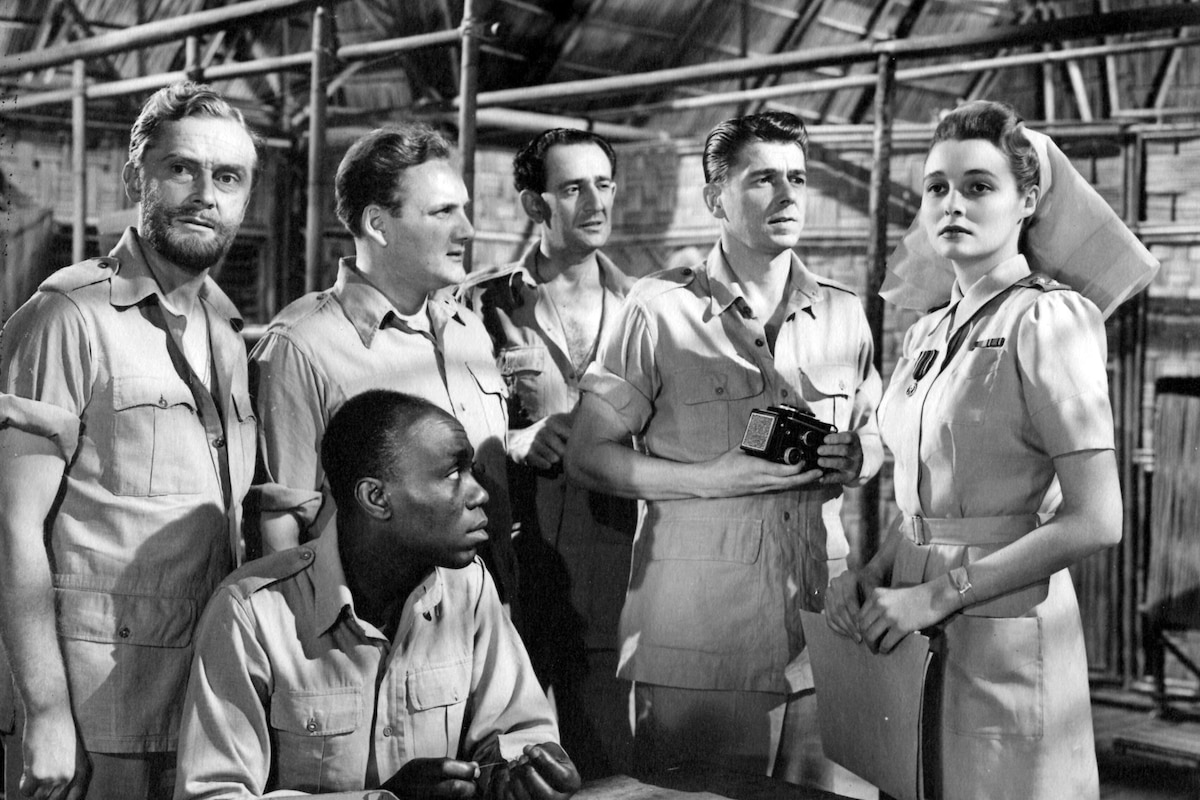
Playwright John Patrick, whose hit 1945 play was the basis for the movie, was also thrilled with the result, telling The New York Times, "Richard Todd is wonderful. I am writing to tell him so." Patrick's story about a Scottish soldier's last days in a British military field hospital in WWII Burma was based on several real-life Scot soldiers he had met during the war. The character of Lachie is a gruff, proud Scot who doesn't know that he has only days to live because of a kidney ailment. His fellow patients are an American (Ronald Reagan), an Australian, a New Zealander, an Englishman, and a Basuto African who speaks no English. The nurse (Patricia Neal) is a Canadian. The hospital's commanding officer asks the patients to befriend Lachie and make him feel comfortable before he is told of his terminal illness. The soldiers agree, but find that Lachie rebuffs them, naturally suspicious of anyone trying to get too close...
Vincent Sherman's passion for the play was the single most driving reason the film got made at all. He learned that Warners owned the rights to the play and asked Jack Warner if he could direct it. Warner said no and told him instead he wanted Sherman to direct a mystery ultimately entitled Backfire (1950). This held no interest for Sherman, but he said he'd do it if he could then do The Hasty Heart; Warner agreed. The day after production ended on Backfire, Warner called Sherman into his office and told him he'd be shooting The Hasty Heart in England, as Warner wanted to take advantage of a recent British law requiring foreign companies to reinvest their banked British money in England. Warner gave Sherman a budget of $1.2 million and basically sent him off to handle everything else, including casting -- with the exception of the two main stars. Reagan was set as the American, and Eleanor Parker was originally meant to play the nurse. But her pregnancy caused her to withdraw, and she was replaced by Patricia Neal, who had just worked with Reagan in John Loves Mary (1949).
The film was a point of considerable pride for the British cast and crew, as it was the first to be shot at the newly-rebuilt Elstree studio. (During the war, Elstree had been converted into a camouflaged military headquarters.) Still, filming at Elstree was difficult. The winter of 1948-49 was England's coldest in twenty years, making things tough on the cast who were performing in shorts since the film's location was sultry Burma. Sherman later wrote that the actors wore heavy bathrobes during rehearsals and in between takes. Perspiration was sprayed on immediately before the cameras rolled. "Often, when we had a long take," Sherman recalled, "I could see the goosebumps slowly rise on their arms."
To create a tropical look in the British winter, hundreds of tropical plants, shrubs and trees were brought in for the sets and had to be carefully watered. According to studio production notes, "a man had to go around polishing each and every leaf after each day's shooting."
Patricia Neal later wrote that she and Reagan were quite good friends dating back to their previous film together, and that they spent much time together when not needed on the set. (The studio liked this as it "made good copy.") With rationing laws still in effect in England, Reagan had steaks flown in regularly from the New York restaurant "21," and he would invite Neal to join him to "share his precious treasure." Decades later, President Ronald Reagan invited her to a 1981 dinner at the White House, for a dinner of smoked filet of trout. "I couldn't help wishing it had been steak," Neal wrote.
Sherman found Reagan to be a pleasant enough fellow, but the director does recount in his memoir that Reagan had some trouble taking critical direction after one major dialogue scene. "I felt it was a memorized speech and lacked the inner truth necessary," wrote Sherman. Reagan had felt it was perfect, and was miffed that Sherman had him redo it. From then on, Sherman sensed a change in Reagan's feelings toward him. Years later, in his own memoir, Reagan wrote at length about The Hasty Heart, mentioning all those involved -- except for Vincent Sherman.
Sherman related that he had the primary set constructed with Lachie's bed in the foreground, away from the others, so as to allow Sherman to hold all the characters in the same shot yet still stress their distance -- a way of visually representing the emotional distance and conflict between Lachie and the others. "The more I kept them apart, yet in the same frame," Sherman wrote, "the greater the tension, and more effective the film became."
For one memorable scene in which Reagan must recite all the books of the Bible, Sherman said he "staged it precisely so that an audience would know that it was not a cheat, the camera never leaving him, and he did it perfectly on the first take."
The Hasty Heart was a big hit in London, and Sherman received acclaim as director and producer. But for the American release, Warner removed Sherman's producing credit, wanting to give the impression that Warner himself had done the producing legwork. Sherman professed not to mind too much, but still, this was all quite ironic considering that Sherman had to talk Warner into even making the film to begin with.
Variety declared, "Every once in a while a motion picture gets down into the very guts of human emotions. Such a picture is The Hasty Heart." The trade paper also called the film "one of [Reagan's] best jobs to date," an opinion still shared by many.
According to studio production notes, the Nigerian actor Orlando Martins, who plays the Basuto African character named "Blossom," who in the film speaks no English, was in fact the most talkative person on the set. Richard Todd actually did serve in the military over the entire course of WWII, first as a captain in the British Commandos and later with a parachute battalion, bailing out over France on D-Day.
Producer: Robert Clark (uncredited)
Director: Vincent Sherman
Screenplay: Ranald MacDougall (screenplay); John Patrick (play)
Cinematography: Wilkie Cooper
Art Direction: Terence Verity
Music: Jack Beaver
Film Editing: E.B. Jarvis
Cast: Ronald Reagan (Yank), Patricia Neal (Sister Margaret Parker), Richard Todd (Cpl. Lachlan 'Lachie' MacLachlan), Anthony Nicholls (Lieutenant Colonel Dunn), Howard Crawford (Tommy), Ralph Michael (Kiwi), John Sherman (Digger), Alfred Bass (Orderly), Orlando Martins (Blossom).
BW-102m. Closed Captioning.
by Jeremy Arnold
Sources:
Patricia Neal, As I Am
Stephen Michael Shearer, Patricia Neal: An Unquiet Life
Vincent Sherman, Studio Affairs
The Hasty Heart
by Jeremy Arnold | December 01, 2010
SIGN UP FOR OUR NEWSLETTERS

CONNECT WITH TCM