Z (1969) begins with an unusual version of the standard disclaimer about
resemblances between the movie and actual events or persons, living or dead - instead
of being coincidental, a title card tells us, in this picture they're entirely on
purpose. That doesn't mean the allegorical meanings of Z will be immediately
clear to everyone who sees it; even in 1969, most moviegoers had to brush up on recent
European politics if they wanted to grasp the film's full range of references. But no
homework is necessary to appreciate the fast-paced suspense that made Costa-Gavras's
political thriller an international box-office success. It was also an Academy Award
nominee for best picture, director, and adapted screenplay - no non-English-speaking
film had received a best-picture nod since Jean Renoir's masterpiece Grand
Illusion (1937) three decades earlier - and it won Oscars® for best
foreign-language movie and best film editing.
Based on a novel of the same title by Greek author Vasilis Vasilikos, itself based on
recent upheavals in Greece's repressive political landscape, Z tells the
slightly disguised story of events connected with the 1963 assassination of Grigoris
Lambrakis, an antiwar activist and liberal member of the Greek legislature. He was a
physician and renowned athlete as well as a politician, and like his surrogate in the
film, played by the politically minded actor Yves Montand, he was murdered by a pair
of extremists who fractured his skull with a club. He died of brain injuries a few
days later, and half a million people came to his funeral, which became a spontaneous
rally against the right-wing government then in power, bringing about the prime
minister's resignation and the rise of a progressive youth movement that influenced
Greek politics for years to come.
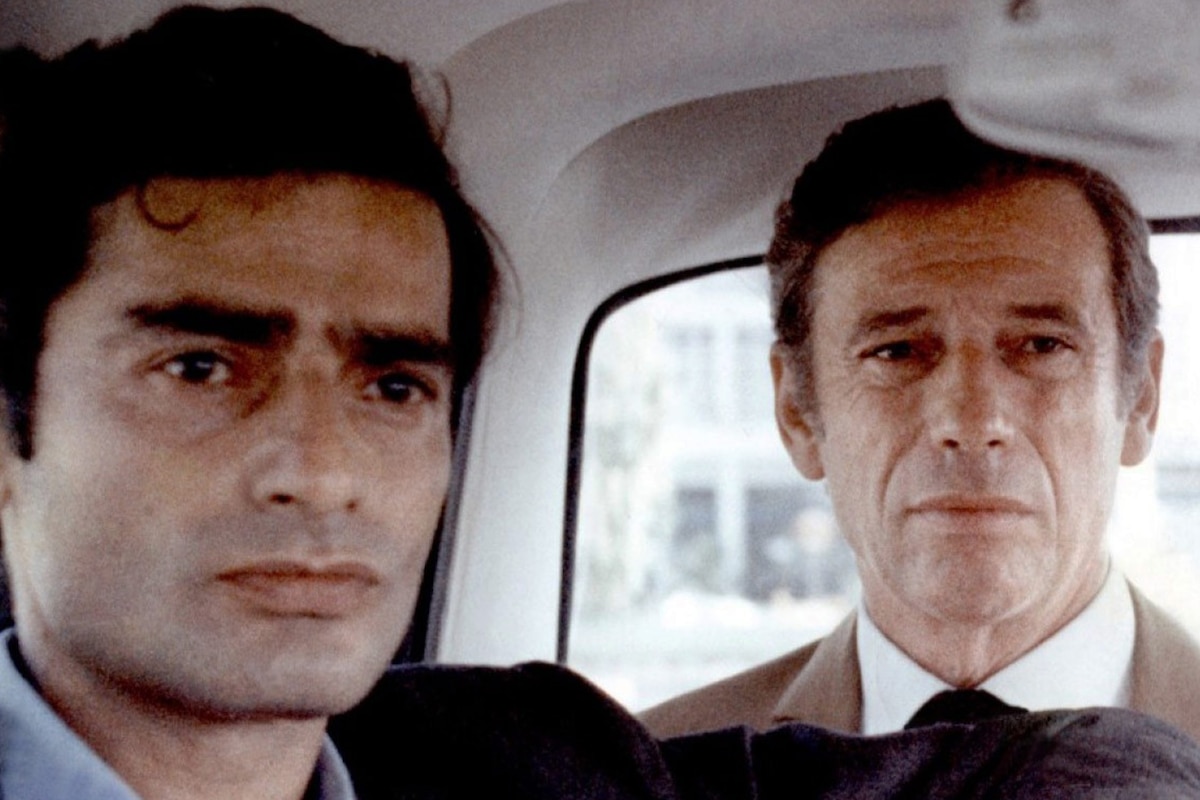
A key figure after the assassination was a scrupulous legal examiner whose counterpart
in Z is a Magistrate played by Jean-Louis Trintignant, winner of the Cannes
best-actor prize. His investigation revealed links between far-right ideologues and
elements of the military and police - discoveries so incendiary that he was later
fired by the government (along with the nation's attorney general) and put in prison.
All these events arose from the deep left-right split that had divided Greece since
the end of World War II, leading to a 1967 coup by a military junta that remained in
place until free elections returned in 1974. Made not long after the junta took power,
Z was promptly banned by the regime.
As a politically concerned Greek who had lived and worked in France since the 1950s,
Costa-Gavras closely followed developments in his native country. His first
directorial efforts were genre pictures - Shock Troops, a 1967 war movie, and
The Sleeping Car Murders (1965), a mystery - but his political imagination was
aroused by Vasilikos's novel, and he turned Jorge Semprún's well-crafted screenplay
into a movie that's accessible and entertaining as well as righteously indignant about
the arrogance of power. Although he shot it mainly in Algeria, the story appears to
take place in France, since the dialogue, newspapers, shop signs, and so on are in
French; yet some details are clearly Greek, and the precise setting is never
explicitly stated. This makes the politics seem less specifically Greek, lending a
universal quality to the film's all-important moral and ethical themes.
Costa-Gavras immediately sets the tone of rapid-fire intrigue. Leftists organizing a
political rally learn that their permit for an auditorium has been abruptly canceled,
so they decide to move the event outdoors. Then they're told that their featured
speaker, known as the Deputy, is the object of a death threat. Arriving on the scene,
the Deputy refuses to be intimidated and walks fearlessly into the crowd; moments
later he is clubbed into unconsciousness and whisked to a hospital, where surgery
fails to save his life. While he's in the operating room the movie follows the
aftermath of the attack, showing the weak police response and the continuing
aggression of the right-wing thugs, who cause chaos everywhere they go.
The police coerce witnesses and distort evidence to support the official claim that
the Deputy was struck and killed by a drunk driver. But a young photojournalist with a
high-speed camera manages to identify the killers and connect them with top brass in
the military and police. Using this information, an upright Magistrate pursues his
investigation until the instigators and perpetrators are hauled into court; but the
film's reverse-twist conclusion shows power defeating justice in the end. A brief
epilogue gives a long list of culturally incorrect things that were banned by the
military junta when it seized power - ranging from strikes to existentialism, from
Sophocles to Samuel Beckett, from the Beatles to miniskirts. And yes, the letter Z,
used by graffiti-spraying protesters as shorthand for "He is alive," referring to the
martyred Deputy.
Z was only Costa-Gavras's third feature, but he was already a good action
director with a flair for chases and fights, as when a left-wing organizer and an
ultra-right killer have a harrowing struggle in the back of a speeding truck. The film
also has a pitch-dark sense of humor that arrives in the very first scene, when a
government ideologue hijacks a lecture on agricultural hygiene to attack progressive
"mildew" that threatens the nation's entrenched interests. The most menacing thug, a
grinning bully named Vago, is almost a slapstick character at times, and Costa-Gavras
throws amusing red herrings into the plot, as when a flashback near the beginning
suggests that the Deputy's marital fidelity might be more important to the story than
his social and political views.
Much of the credit for Z goes to the brilliant team who worked alongside
Costa-Gavras, including film editor Françoise Bonnot, composer Mikis Theodorakis, and
master cinematographer Raoul Coutard, whose French New Wave trademarks - artfully
plain lighting and edgy, restless camerawork - determine the picture's moods and
emotions more than any other aspect of its design. The acting is meritorious as well,
done by top-flight performers whose contributions blend into a seamless, organic
ensemble: Montand as the Deputy, Irène Pappas as his wife, Trintignant as the
Magistrate, Jacques Perrin as the photojournalist, Marcel Bozzufi and Renato Salvatori
as the thuggish Vago and Yago, and others. Costa-Gavras has made other political
films, such as the excellent 1982 drama Missing, with Jack Lemmon as a
businessman searching for his son after Chile's military coup of 1973. But none has
made a stronger impact than Z, which arrived at a propitious moment - in the
late 1960s both the United States and Europe were ideologically torn in many ways -
and remains a compelling drama with a cautionary message well worth heeding.
Director: Costa-Gavras
Producers: Jacques Perrin, Ahmed Rachedi
Screenplay: Jorge Semprún; based on the novel by Vassili Vassilikos
Cinematographer: Raoul Coutard
Film Editing: Françoise Bonnot
Production Design: Jacques D'Ovidio
Music: Mikis Theodorakis
With: Yves Montand (the Deputy), Irène Pappas (Hélène), Jean-Louis Trintignant (the
Magistrate), François Perier (the District Attorney), Jacques Perrin (the
photojournalist), Charles Denner (Manuel), Pierre Dux (the police general), Georges
Géret (Nick), Bernard Fresson (Matt), Marcel Bozzufi (Vago), Julien Guiomar (the
police colonel), Magali Noël (Nick's sister), Renato Salvatori (Yago), Habib Reda,
Clotilde Joanno (Shoula), Maurice Baquet (the heroic mason), Sid Ahmed Agoumi, Allel
El Mouhib, Hassan Hassani (the general's chauffeur), Gérard Darrieu (Barone), Jean
Bouise (Georges Pirou).
C-127m. Letterboxed.
by David Sterritt
Z (1969) - Z
by David Sterritt | December 01, 2010
SIGN UP FOR OUR NEWSLETTERS

CONNECT WITH TCM