German novelist Erich Maria Remarque had fought on the Western front during World War I and been wounded five times. He based All Quiet on the Western Front on his experiences there. The novel first appeared in Germany in 1928 in the newspaper Vossissche Zeitung, with the book coming out there in 1929. An English translation appeared in 1930. Within 18 months of its January 1929 publication, it had sold 2.5 million copies in 25 languages.
In 1929, Carl Laemmle had given the job of production head at Universal Studios, the film company he had founded in 1912, to his son, Carl Laemmle, Jr. as a 21st birthday present. Rather than just fill the executive office, however, Junior Laemmle announced that he was changing the studio's focus from low-budget family fare to prestige pictures. For his first big project, he optioned Remarque's novel.
Laemmle offered the film to director Herbert Brenon, best known for such silent classics as Peter Pan (1924) and Beau Geste (1926). When Brenon asked for $125,000, a tenth of the projected budget, agent Myron Selznick suggested instead one of his clients, Lewis Milestone, who had won the only Oscar® ever given for Best Comedy Director for Two Arabian Knights (1927), a wartime comedy. All Quiet on the Western Front would be his second sound film. Milestone had asked Selznick to go after the film for him, and agreed to work for $5,000 a week on a ten-week guarantee. If the film went over schedule, he would continue at the same rate. With production delays, he would end up making $135,000 for directing the film.
Completing the screenplay to Milestone's satisfaction went over the ten-week guarantee in the director's contract. Laemmle had originally assigned the adaptation to Broadway playwright Maxwell Anderson, who had co-written the original What Price Glory?. Milestone felt his script strayed too far from the original, so he set to work with Del Andrews, a friend from whom he had learned how to edit film before he had started directing. They turned out a treatment, then had Anderson write the dialogue. Stage director George Abbott was then brought in to do a final polish.
Selznick suggested another of his clients, future director George Cukor, for a position on the film. Cukor was then under contract at Paramount as an apprentice director, assigned to coach actors. Laemmle borrowed him from Paramount to work as dialogue director on All Quiet on the Western Front and to film screen-tests.
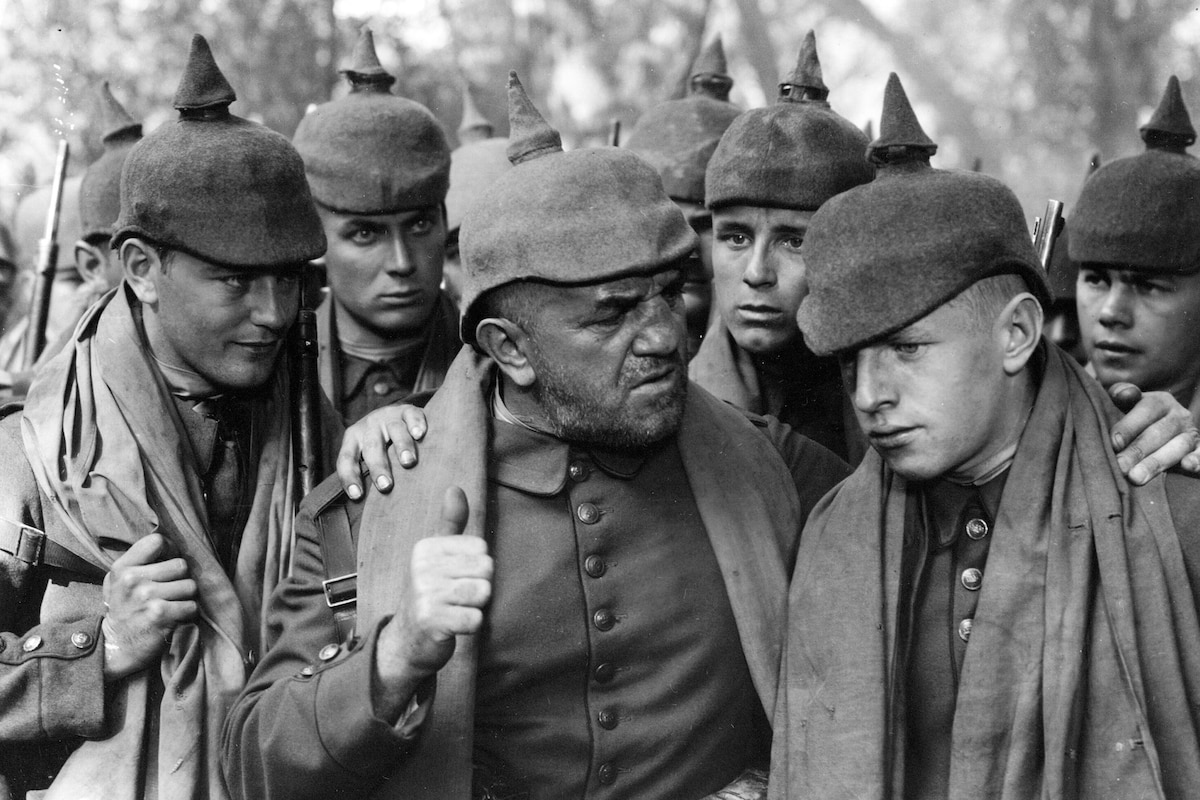
Laemmle wanted to cast James Murray, the star of King Vidor's The Crowd (1928), as Katczinsky, the tough veteran who mentors the young soldiers on the battlefield. Milestone, however, insisted on casting his friend Louis Wolheim, who had starred for him in Two Arabian Knights and The Racket (1928).
John Wray was originally slated to play Paul Baumer, but Milestone wanted Douglas Fairbanks, Jr., whose home studio, United Artists, was dragging its heels about arranging a loan-out. Twenty-year-old Lew Ayres -- who was just starting his career at MGM and had worked opposite Greta Garbo in her last silent film, The Kiss (1929) -- had read the novel and was desperate for a role in the film. MGM producer Paul Bern tried to get Milestone to test him, but the director was too busy with the script to respond. Since Cukor had begun testing actors for the film's many roles, Ayres just showed up at an open call. He did the test but didn't think Cukor was that impressed. Timing worked out in his favor, however. Just a few days before filming started, Milestone finally learned that Fairbanks would not be available for the leading role. He screened Cukor's tests, starting with the most recent, which included Ayres' test. As soon as the actor showed up on screen, Milestone said, "I think this is our man." Wray was moved into a supporting role as the man who trains Ayres and his fellow enlistees.
by Frank Miller
SOURCES:
George Cukor: A Double Life by Patrick McGilligan
The Big Idea - All Quiet On the Western Front
by Frank Miller | November 10, 2010
SIGN UP FOR OUR NEWSLETTERS

CONNECT WITH TCM