SYNOPSIS
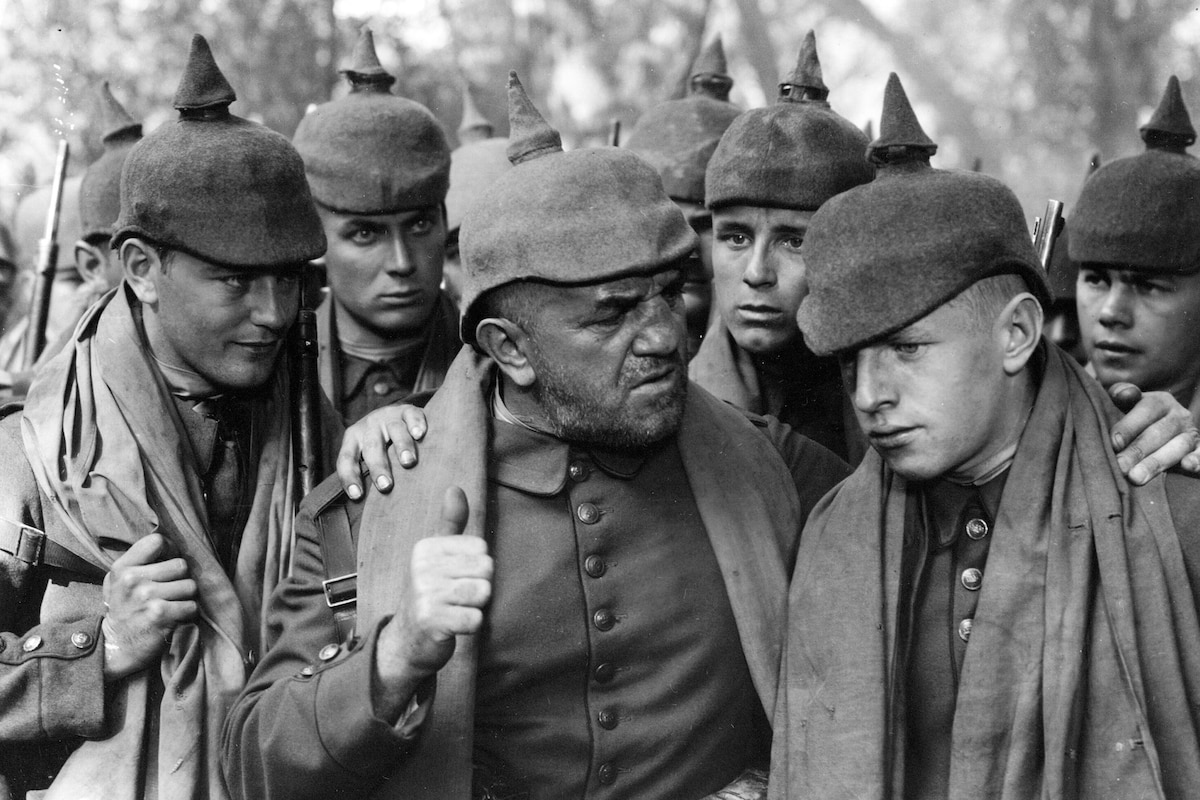
Paul Baumer and three of his classmates are in the German Army during World War I after being inspired by a patriotic teacher who fills their heads with dreams of glory. When they arrive for training, those fantasies are quickly dashed, first by a former postmaster from their village who is now their corporal and uses his status to get back at them for past slights. On the battlefield, they quickly discover the true horrors of modern war, only finding shelter with a protective veteran, Katczinsky and a few French girls who trade a night of love for some bread and meat. After losing most of his friends in battle, Baumer goes home on leave, but when he visits his school and confronts his former teacher about his lies, he's branded a traitor. Tiring of the false impression of war at home, he returns to the front to instruct his new comrades in warfare but has become a hardened, disillusioned man in the process.
Director: Lewis Milestone
Producer: Carl Laemmle, Jr.
Screenplay: Del Andrews, Maxwell Anderson, George Abbott
Based on the novel by Erich Maria Remarque Cinematography: Arthur Edeson
Editing: Edgar Adams, Milton Carruth
Art Direction: Charles D. Hall, William R. Schmidt
Music: Frank H. Booth
Cast: Louis Wolheim (Katczinsky), Lew Ayres (Paul Baumer), John Wray (Himmelstoss), Slim Summerville (Tjaden), Russell Gleason (Muller), William Bakewell (Albert), Ben Alexander (Kemmerich), Arnold Lucy (Prof. Kantorek), Heinie Conklin (Hammacher), Beryl Mercer (Mrs. Baumer), Fred Zinnemann (Man), Raymond Griffith (Dying Soldier), Robert Parrish (Schoolboy)
BW-133m.
Why ALL QUIET ON THE WESTERN FRONT is Essential
With its focus on the German Army during the final days of World War I, All Quiet on the Western Front is widely considered to be one of the greatest anti-war films ever made. Its depiction of the horrors of war is so harrowing that for decades it was routinely banned outside the U.S. in nations gearing up for war, particularly Nazi Germany.
The film set the pattern for many of the plot elements that would recur in anti-war movies for decades to come, capturing the plight of men caught in the midst of a senseless battle with little access to the military leadership and no way to get supplies short of scrounging them from the dead. Images from the film, particularly the harsh cross-cutting between soldiers advancing in a senseless campaign and the weapons poised to cut them down, would turn up in such later films as Stanley Kubrick's Paths of Glory (1957) and Peter Weir's Gallipoli (1981). Steven Spielberg would credit director Lewis Milestone's work on this and his other war films as an influence on his own Saving Private Ryan (1998).
All Quiet on the Western Front is generally considered Milestone's best movie. It is also the first of five pictures in which he examined the lives of men at war, followed by The Purple Heart (1944), A Walk in the Sun (1945), Halls of Montezuma (1950) and Pork Chop Hill (1959). Sadly, this early peak was something he would never be able to match. Only the newspaper comedy The Front Page (1931), A Walk in the Sun and the film noir The Strange Love of Martha Ivers (1946) have approached All Quiet on the Western Front in critical regard.
The film featured several innovations in sound technology, most notably the first use of a giant mobile crane in a talking picture. It also is one of the first sound films to use a mobile camera in an era when the camera was usually confined to a soundproof box so that the motor noise would not be heard on the soundtrack. At the time, Milestone achieved this by simply shooting his crane shots silent. Battle sounds were added in postproduction, with some of the best synching yet seen in a sound film.
All Quiet on the Western Front was the first of a string of critical and box office successes that established the talent of producer Carl Laemmle, Jr., son of Universal Studios founder Carl Laemmle. Despite jokes about nepotism ("Mr. Carl Laemmle has a very large 'fem-ly'."), Laemmle, Jr. produced some of the studio's most noteworthy films of the '30s, including Waterloo Bridge (1931), Bride of Frankenstein (1935) and Show Boat (1936).
This was one of George Cukor's first film credits and his influence is seen in the performances. As dialogue director, he rehearsed the actors and worked to eliminate regional accents so they would all sound as if they came from the same country.
by Frank Miller
The Essentials - All Quiet On the Western Front
by Frank Miller | November 10, 2010
SIGN UP FOR OUR NEWSLETTERS

CONNECT WITH TCM