Critical reaction to A PLACE IN THE SUN
"...This second screen edition of Theodore Dreiser's monumental novel, 'An American Tragedy' ...is a work of beauty, tenderness, power and insight. ...There may be some belief that Montgomery Clift, as the tortured George Eastman, is not nearly the designing and grasping youth conceived by Dreiser. But his portrayal, often terse and hesitating, is full, rich, restrained and, above all, generally credible and poignant. He is, in effect, a believable mama's boy gone wrong. Equally poignant is Shelley Winters' characterization of the ill-fated Alice. Miss Winters, in our opinion, has never been seen to better advantage than as the colorless factory hand, beset by burgeoning anxieties but clinging to a love she hopes can be rekindled. Elizabeth Taylor's delineation of the rich and beauteous Angela also is the top effort of her career. ...Despite the fact that this version of Dreiser's tragedy may be criticized -- academically, we think -- for its length or deviations from the author's patterns, A Place in the Sun is a distinguished work, a tribute, above all, to its producer-director and an effort now placed among the ranks of the finest films to have come from Hollywood in many years." - Bosley Crowther, the New York Times, August 29, 1951.
"A Place in the Sun, judging by the competition so far, is the picture to beat for 1951's Academy Awards. It is at once a faithful adaptation of the novel, an artful job of moviemaking and an engrossing piece of popular entertainment. ...Moviemaker Stevens, working with an intelligent script by Michael Wilson and Harry Brown, captures the power of the novel without its heaviness, the insight without the inventories. The story still flows inexorably from the springs of character and environment. And though Stevens concentrates on its poignant love affairs, he neither overlooks Dreiser's implied social comment nor oversimplifies it with trite labels. ...In the pivotal role, actor Clift's sensitive, natural performance gives the film a solid core of conviction. Actress Taylor plays with a tenderness and intensity that may surprise even her warmest fans. In a film of less uniform excellence, Shelley Winters' mousy factory girl would completely steal the show. Shy, petulant, or shrilly nagging by turns, she makes the most of her unconventional role and of the movie's boldest scene, when she gropes, on a choked-up brink of tears, for a tactful way to ask a doctor for an abortion. ...Stevens makes imaginative use of his soundtrack: the cry of a loon, the distant whine of sirens, the barking of dogs become recurring motifs bound up with the action. His camera is effectively restrained; it peeks through doorways or stands patiently in the corner like a hidden witness; and when it moves suddenly into close-ups, the effect of intimacy is breathtaking." - Time, September 10, 1951.
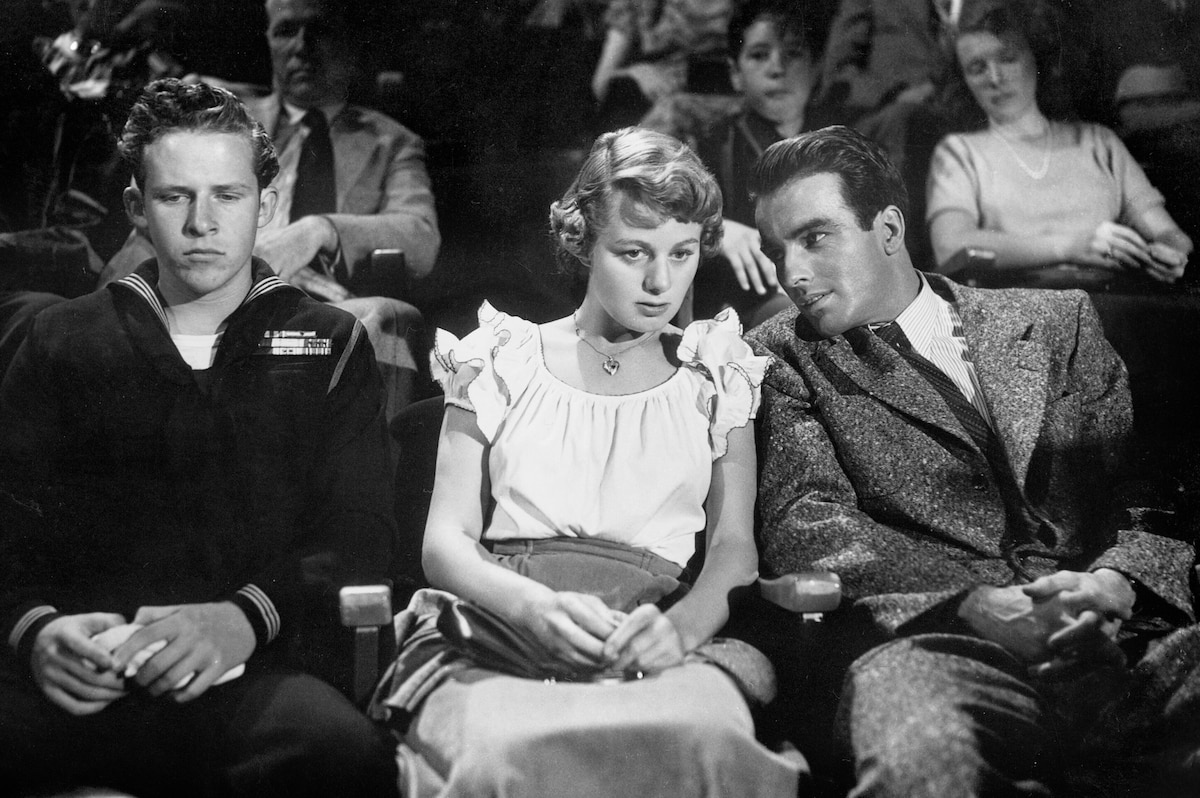
"Like the 1931 screen version of An American Tragedy, this new adaptation is not the social indictment that Theodore Dreiser had in mind when he wrote his famous novel in 1925. His hero, Clyde Griffiths (here called George Eastman), is presented to the audience in full manhood... As a result, both the film and the character lose significance. Unlike Griffiths, Eastman is tentative, even weak, and more to be mothered than censured. But the Michael Wilson-Harry Brown screenplay makes amends to Dreiser for the omissions. And producer-director George Stevens has fashioned it into an intelligent, absorbing movie that is easily one of the most brilliant films to come out of Hollywood in years. ...Aside from having unerringly chosen the right people for his three leading roles, Stevens time and time again injects masterful directional touches -- when George and Alice walk from the movies to her furnished room, their lovestruck faces searched by street lamps and porch lights; when George eagerly follows Angela into her shiny life of Cadillacs and motorboats; when the disintegration of love turns Alice into an ugly woman. ...Considering the fact that George is negative and may be a diffident, even dull, version of the Horatio Alger hero gone wrong -- certainly not what Dreiser had in mind -- Montgomery Clift turns in a thoughtful and intelligent performance." - Newsweek, September 10, 1951.
"In the main, the success of A Place in the Sun is probably attributable to George Stevens, who produced and directed it with workmanlike, powerful restraint and without tricks or sociological harangue. He has drawn excellent performances from Montgomery Clift, who is thoroughly believable as the young man; Elizabeth Taylor, who is remarkably well cast as the daughter of a wealthy social clan; and Shelley Winters, who is particularly moving in the role of the unwanted sweetheart." - G.A., New York Herald Tribune.
"The Stevens film ...makes Dreiser's clear-cut class demarcations less rigid, and puts as much emphasis upon psychological factors as upon societal. ...Allowing for the elimination of the long section dealing with George Eastman's boyhood, the pattern of the story has been kept relatively close to the book with an ending that is very similar to Dreiser's. A final irony is preserved. The issue is left undecided in the moral sense, even though truth, in the legal sense, would have shown George not guilty and unpunishable. Clift, of course, had George Stevens to discuss and probe with him the nature of the character, and this ability of the director to make his actors see what he wanted paid off astonishingly with the female roles. Elizabeth Taylor is a joy to watch as the charmingly spoiled Angela (one had somehow never conceived of the glamorized creature as an actress)... Shelley Winters (the sexiness hidden, the legs undisplayed) achieves almost a tour de force of naturalness. ...There are scenes that nakedly reveal all that is going on in her mind. ...Scene after scene distills the meaning of events that Dreiser took long pages to unfold. The novel gained it effects largely by its massive accumulation of detail (the writing is for the most part irritating and clumsy); the technique of the movie is vastly different. Here each scene must accomplish its objective with vividness and economy; dialogue is often scrapped in favor of the visual symbol. From moment to moment, in fact, the two distinct kinds of telling, interwoven as they are, can be discerned, as the symbolic image accompanies the realistic level of the happenings. ...Now and then a line of dialogue does get out of key, very occasionally the symbol grows obtrusive, but in each case never enough to seriously disturb. One has, at the end, the feeling of a screen that has been illuminated in a new way by a hand altogether accomplished." - Saturday Review of Literature, September 1, 1951.
"Perhaps because Stevens' methods here are studied, slow, and accumulative, the work was acclaimed as 'realistic,' though it's full of murky psychological overtones, darkening landscapes, the eerie sounds of a loon, and overlapping dissolves designed to affect you emotionally without your conscious awareness. Stevens and his scriptwriters (Michael Wilson and Harry Brown) pre-interpret everything, turning the basically simple story into something portentous and 'deep.' The film is mannered enough for a gothic murder mystery, while its sleek capitalists and oppressed workers seem to come out of a Depression cartoon; the industrial town is an arrangement of symbols of wealth, glamour, and power versus symbols of poor, drab helplessness. ...But whatever one's reservations about this famous film, it is impressive, and in the love scene between Taylor and Clift, physical desire seems palpable." - Pauline Kael, 5001 Nights at the Movies.
"Typically slow and stately in the later Stevens manner, this is a shameless travesty of Theodore Dreiser's monumental (if ponderous) An American Tragedy. Most of the book's acid social comment is elided, turning Dreiser's hero's attempt to better himself by latching onto a snobbish society girl into something like a starry-eyed romance; what is left is rendered meaningless by being ripped out of period context into a contemporary setting. Although all three leads are excellent, only the scenes with Winters ...really work." - Tom Milne, Time Out Film Guide.
"Overblown, overlong and over-praised melodrama from a monumental novel of social guilt; sometimes visually striking, this version alters the stresses of the plot and leaves no time for sociological detail. A film so clearly intended as a masterpiece could hardly fail to be boring." - Halliwell's Film & Video Guide (HarperPerennial).
"This version, brought completely up to date in time and settings, is distinguished beyond its predecessor in every way. Montgomery Clift, Shelley Winters and Elizabeth Taylor give wonderfully shaded and poignant performances." - Variety Movie Guide (Prentice Hall).
"Though hailed by many at the time of its release as one of the best American films, it now seems overblown and pretentious and curious in its romanticized portrait of Angela and her circle." - Georges Sadoul, Dictionary of Films (University of California Press).
"For Stevens, the story of the young man crushed by capitalism became one of the most lush romantic films of the 1950s. If Stevens violates the soul-killing drabness of Dreiser's novel by transforming George and Angela into star-crossed lovers, the glamour of the film is consistent with the director's new reading of the text. The hero's dilemma is conveyed in a nearly expressionistic play of cinematic light and dimension....By the end of A Place in the Sun both the audience and George have been made to submit to the voluptuous raptures of Alice's murder and Angela's kiss." - Charles Affron, The International Dictionary of Films and Filmmakers (Perigee).
Awards and Honors
A Place in the Sun won Oscars in several major categories:
Best Director: George Stevens
Best Writing, Screenplay: Michael Wilson, Harry Brown
Best Film Editing: William Hornbeck
Best Cinematography, Black-and-White: William C. Mellor
Best Costume Design, Black-and-White: Edith Head
Best Music, Scoring of a Drama or Comedy: Franz Waxman
In addition, A Place in the Sun was nominated for Oscars in these categories:
Best Picture
Best Actress in a Leading Role: Shelley Winters
Best Actor in a Leading Role: Montgomery Clift
A Place in the Sun won the Golden Globe for Best Motion Picture - Drama.
A Place in the Sun was named Best Picture in 1951 by the National Board of Review.
A Place in the Sun was placed on the National Film Registry in 1991.
Compiled by John M. Miller & Jeff Stafford
Critics' Corner - A Place in the Sun
by John M. Miller & Jeff Stafford | November 09, 2010
SIGN UP FOR OUR NEWSLETTERS

CONNECT WITH TCM