Following his acclaimed 1948 family drama I Remember Mama, producer/ director George Stevens began production on an adaptation of Theodore Dreiser's 1925 novel, An American Tragedy. Stevens had long wished to tackle the project; he first began shaping a script while still a part of Liberty Films, the independent production group he formed in 1945 with fellow filmmakers Frank Capra, William Wyler, and Samuel J. Briskin. Liberty Films was later absorbed by Paramount Pictures, the company that owned the rights to the Dreiser book, so Stevens gladly signed a production deal with the studio. Stevens himself said of the book, "The greatness of An American Tragedy lies in the fact that it is all things to all people...In the main this might have been the love story of any Johnny or Mary in America -- Dreiser was factual; a man of great compassion, a tremendous realist...He made his central character, Clyde Griffith, one of the most fascinating and controversial figures in literature. You can spend weeks debating Clyde?s guilt or innocence, his legal immorality over his spiritual immorality."
Paramount Pictures was reluctant at first to produce another version of An American Tragedy. The first version they released in 1931 was a box-office failure, fared poorly with critics, and was despised by author Dreiser. Studio brass was also concerned that the story would be perceived as anti-American; by 1949-1950 the country was in an intense reaction to actual or perceived threats of Communism, and Dreiser's story, which could be seen by some as an attack on Capitalism, must have seemed rife with danger. Paramount retitled the picture, eliminating the word "American" and Stevens pointed out that his picture would bear little relation to the 1931 version; he intended to adhere closer to the book, and update the setting to modern day. In addition, Stevens changed the name of the lead character, "Clyde Griffiths," to "George Eastman" -- he arrived at this by combining his own first name with the first part of the corporate-sounding Eastman-Kodak Company. Michael Wilson and Harry Brown are credited with the script for A Place in the Sun, although there were additional contributions from Stevens and from his trusted associate producer, Ivan Moffat.
For the pivotal role of protagonist George Eastman, Stevens cast 27-year-old Montgomery Clift. At the time of the casting, Clift had only two movies in release, Fred Zinnemann's The Search (1948) and Howard Hawks? Red River (1948), but he was already a major star. Years in the theater helped shape his skills, and his smoldering, moody nature and boyish good looks ensured that he would be a major force in films. Indeed, he became one of the only men ever nominated for a Best Actor Oscar® for his first movie role.
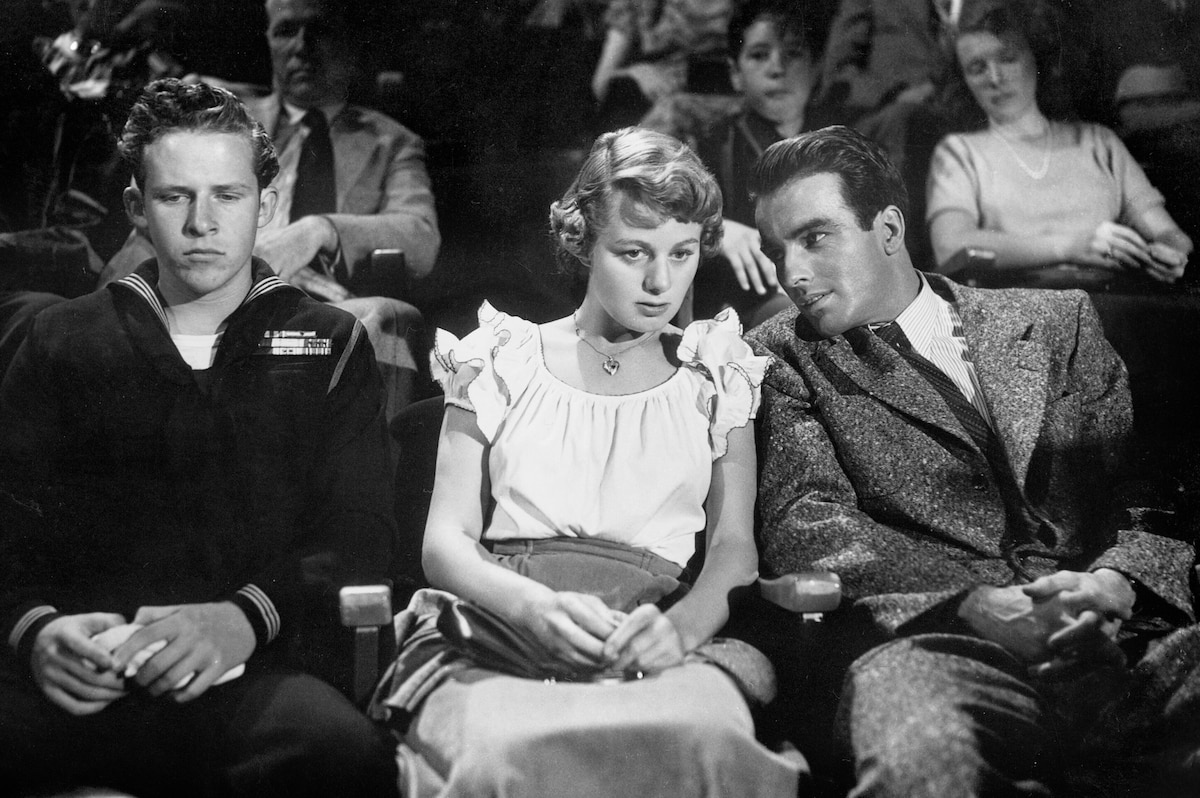
Shelley Winters actively campaigned for the role of Alice Tripp. Initially, her agents could not get Paramount or director Stevens to even agree to meet the actress, known at that time almost exclusively for her "blonde bombshell" parts. Winters later wrote extensively in her autobiography about this episode of her life. She said that it was writer Norman Mailer who first alerted her to the role, and then coached her in the intricacies of Dreiser's novel, and "...the inner workings of that girl's soul and mind and what Dreiser wanted the reader to feel about the whole American syndrome of success at any price. Norman knew so much about Dreiser that I got the feeling he had been his protégé, figuratively and perhaps literally."
Winters was determined to audition for the part of Alice Tripp and not take "No" for an answer. She contacted Stevens's lawyer, and found out that though Stevens didn't want her to come and audition at the studio, he would agree to meet her in the lobby of the Hollywood Athletic Club. Winters embarked on some research. "I rushed out to the Firestone Tire factory and looked at all the girls on the assembly line. ...I rushed back to my apartment, dyed my hair brown, took the polish off my nails, combed my hair flat with sad little curls on the end below my ears, with two bobby pins on the side, and washed my face clean of makeup. Then I made myself a sandwich and put it in a brown paper bag." Winters also borrowed plain clothes from her sister Blanche, and so disguised, sat in the lobby of the Club -- lost amongst the ordinary people going to and fro. Stevens arrived and did not recognize her. Winters caught his attention as he was about to leave. "Slowly he walked over to me, touched the little bobby pins on the side of my head and said the words that changed my life: "Shelley, if I test you for this role and you get it, will you let me photograph you like this??" Not only did Winters allow the director to photograph her however he wanted, she also wore her sister's clothes for most of the film.
Elizabeth Taylor was loaned out from Metro-Goldwyn-Mayer for the film; her salary at MGM was $1,000 a week and they charged Paramount $35,000 for her ten weeks of work, netting $25,000 in profit. Shelley Winters was borrowed from her home studio, Universal-International.
by John M. Miller
The Big Idea - A Place in the Sun
by John M. Miller | November 09, 2010
SIGN UP FOR OUR NEWSLETTERS

CONNECT WITH TCM