John Klempner's story "One of Our Hearts," about a group of suburban wives who learns that one of their husbands has run off with another woman, first appeared in the August 1945 issue of Cosmopolitan magazine. He expanded it into novel form as A Letter to Five Wives. 20th Century-Fox picked up the film rights in March 1946.
The first screen treatment was written by Melville Baker and Dorothy Bennett. Although most of their work was not used, it was Bennett who first suggested the film be narrated by Addie Ross, the woman who has run off with one of the husbands, and that she never be seen. They also reduced the number of couples from five to four.
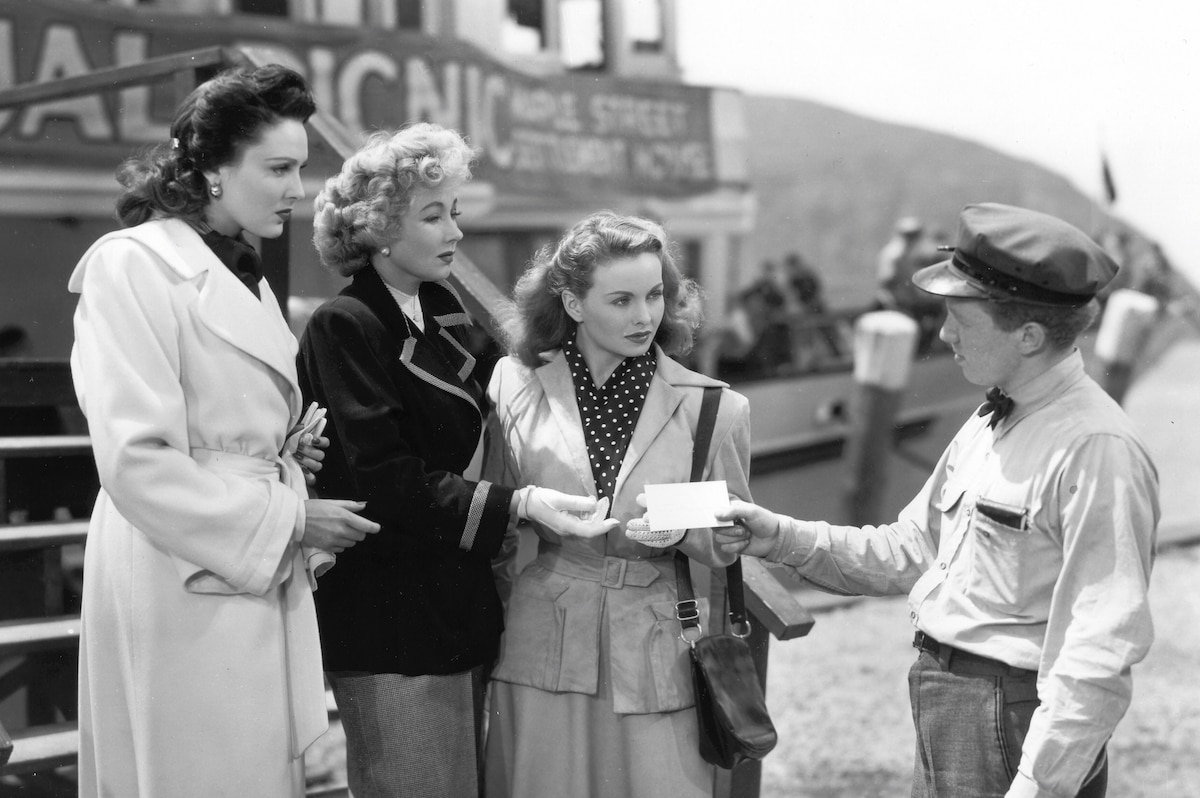
Joseph L. Mankiewicz then took over the screenplay. He wrote three drafts, then gave up, at which point it went to producer Sol Siegel, who assigned Vera Caspary to do her own treatment. In the novel, the five wives had received Addie's letter at a club meeting, but Siegel thought that wasn't logical, as there was no reason any of them couldn't have simply phoned her husband on the spot. With Caspary, he developed the idea that the wives would get Addie's letter just before leaving to take a group of orphans on a boat trip up the Hudson River, effectively cutting them off from outside communications.
Studio head Darryl F. Zanuck wanted Ernst Lubitsch, then at the end of his career, to direct. Siegel, however, insisted that the film be directed by Mankiewicz, even though that meant holding up production while the director finished the other films on his schedule. Zanuck's main concern was the writer-director's ego. "I can't get along with him now after four flops," he protested. "If he gets a hit with this, he'll be unlivable!" When Mankiewicz came up with a hit, Zanuck held a grudge against him for years.
After Mankiewicz returned to the script of A Letter to Four Wives, Zanuck made one major change to the story. He insisted on cutting another couple to tighten the film (and give it the standard three act structure). The original couple dealt with money problems, servant problems and a past in which his family had been better off.
Actors up for leading roles included Dorothy McGuire, Alice Faye, Maureen O'Hara, Anne Baxter, Gene Tierney and Tyrone Power. Baxter was tentatively cast as the fourth wife, only to have her role eliminated from the script. Both Joan Crawford and Ida Lupino were considered for Addie's off-screen voice before Celeste Holm was cast. When Mankiewicz offered Holm a role that would never be seen in the film, she quipped, "Oh my, that's wonderful. My wooden leg won't have to show." (Holm, quoted in Geist). She consented when he told her Crawford was after the role. As a publicity stunt, however, her involvement was kept out of the press until after A Letter to Three Wives was released and the studio had held "Who is Addie?" contests around the nation.
by Frank Miller
SOURCES:
Pictures Will Talk: The Life and Movies of Joseph L. Mankiewicz by Kenneth L. Geist
The Big Idea - A Letter to Three Wives
by Frank Miller | November 08, 2010
SIGN UP FOR OUR NEWSLETTERS

CONNECT WITH TCM