Everyone knows a woman is fragile and helpless.
Everyone's wrong. Remember My Name...or else.
Tag line from Remember My Name
The poster art with the above caption for Remember My Name (1978) shows a profile mug shot of a woman in dark sunglasses smoking a
cigarette.
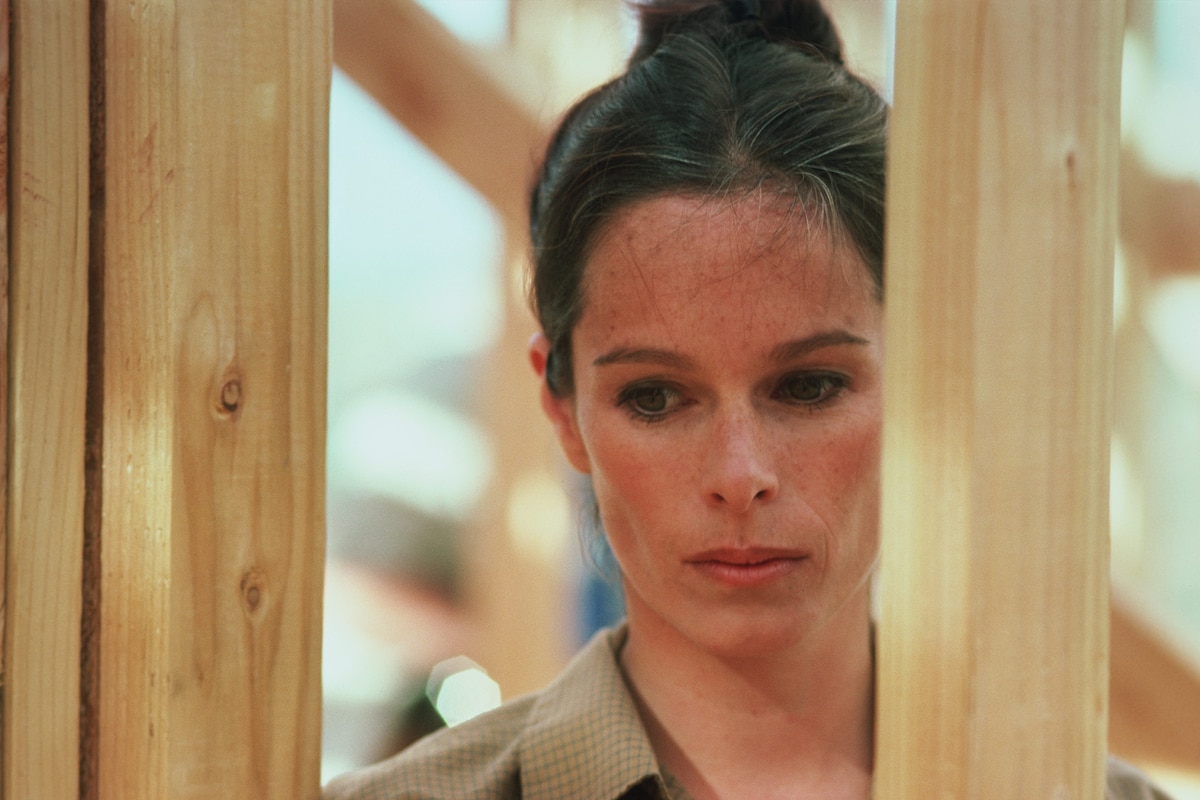
Despite the fact that she's played by the petite, delicate looking actress Geraldine Chaplin, Emily, the protagonist of Alan Rudolph's
second directorial effort after Welcome to L.A. (1976), is tough, single minded, cunning and manipulative in the style of such film
noir heroines as Joan Crawford (The Damned Don't Cry, 1950), Rita Hayworth (Gilda, 1946) and Ann Sheridan (Nora
Prentiss, 1947). And that association is completely intentional as Rudolph once stated that Remember My Name was "an update on
the themes of the classic woman's melodramas of the Bette Davis, Barbara Stanwyck, Joan Crawford era."
A brief description of the bare bones plot also suggests a vintage Warner Bros. melodrama on the surface: Emily, a recent parolee from
prison after a 12-year sentence, arrives in a small town and takes a room in a local boarding house. She wrangles a job at the local
Thrifty Mart and initiates an affair with her landlord (Moses Gunn) in order to receive additional amenities. But her real focus is Neil
(Anthony Perkins), a married construction worker, who shares a secret past with Emily and may have been the reason for her imprisonment.
She stalks Neil and his wife Barbara (Berry Berenson), breaks into their home, commits petty, malicious acts like destroying a flower bed
or making prank calls, upsets the balance of their shaky relationship and generally instills fear and panic before ending her visit.
Yet, in tone and execution, Remember My Name is abstract and free-form, a mood piece that is more interested in penetrating Emily's
psyche than following a conventional narrative. And Geraldine Chaplin is mesmerizing in what might be the finest performance of her
career. Veering from looking lost and wounded to exploding in violent outbursts, she may very well be psychotic and dangerous...or maybe
it's all an act. Rudolph keeps you guessing as he underscores Emily's transitory emotional state with the songs of blues singer Alberta
Hunter. Such tunes as "You Reap Just What You Sow," "My Castle's Rockin'" and "I've Got a Mind to Ramble" not only comment on Emily's
state of mind but also propel the quirky narrative along toward a final resolution of sorts between Emily and Neil.
Rudolph, who began his film career as an assistant director and worked for Robert Altman on several films, moved into writing and
directing in 1972 with his low-budget debut feature, Premonition. It wasn't until 1976, however, that he began to develop his own
distinctive style and themes with Welcome to L.A., a film that put him on the radar of most major film critics, despite the mixed
reviews. According to Rudolph, the idea for Remember My Name popped into his head while he was driving in Los Angeles; he was on
his way to meet with Altman to discuss a project and he passed a theatre marquee in Los Angeles promoting a series of "femme fatale"
films. Altman agreed to serve as the producer on Remember My Name and both filmmakers felt Geraldine Chaplin was the ideal actress
for Emily, having worked with her previously on Nashville (1975), Buffalo Bill and the Indians, or Sitting Bull's History
Lesson (1976) and Welcome to L.A. (in which Altman also served as producer).
Anthony Perkins was cast on the basis of his brilliant performance in the stage production of Equus which Rudolph's wife had
recently seen and suggested him for the part. Perkins also had a suggestion of his own; he recommended his own wife, Berry Berenson, for
the part of Barbara, his screen wife. Rudolph stated that "if Tony was comfortable with her, there was something that might come out of it
that I wouldn't have to guide." (from Split Image: The Life of Anthony Perkins by Charles Winecoff). Ironically, Berenson was
natural and confident for her first film role but Perkins felt completely insecure about his performance. Altman recalls that the actor
was nervous about the film: "He was doing double duty, worrying about himself and his wife. And I think the blue-collar aspect of it
worried him. I told him, 'You don't have to be born with a hammer in your hand to take on that situation. This guy's got a strange
past.'"
When Perkins was encouraged to watch the day's rushes, something he normally avoided, he became convinced he was completely wrong for the
part and wanted to quit. When Rudolph threatened to quit too if Perkins did, the actor was genuinely moved and decided to stay. "From that
moment on," the director said, "he became our number one cheerleader...Everyone loved him. Geraldine just adored him. He went from being
insecure to being the most stabilizing factor in our film."
For the scene in Remember My Name when Neil and Emily get drunk in a bar before going to bed together, Perkins requested real
alcohol. Rudolph recalled, "He was drinking for real, and we did it just in two takes...It wasn't acting, it was meta-acting. There
was nothing unprofessional about it; they were both amazing. The exit from the bar was the last thing we did before lunch, and Tony was
getting pale. Finally he said, 'Did you get what you need? Do you want us to do it again?' I said no. So he got up from the table, grabbed
a trash can, barely made it outside, and vomited. He spent lunch lying down somewhere, then he was fine. He continually added that
something extra."
Remember My Name is worth seeing alone for the inspired performances of Perkins and Chaplin and the rich blues score by the
83-year-old Alberta Hunter who wrote new compositions for the movie. But it yields the additional pleasures of seeing a cast of
up-and-coming actors in distinctive supporting roles - Jeff Goldblum as a harried store manager and Alfre Woodard as a suspicious
co-worker of Emily. Also, in small bit parts you can spot Dennis Franz (in his feature film debut) as Neil's hardass boss and Tim
Thomerson as a construction worker. There is also the curiosity of seeing Berry Berenson in her only major part (she also had cameos in
Winter Kills [1979] and Cat People [1982]); she died on Sept. 11, 2001 as one of the passengers aboard the hijacked American
Airlines Flight 11, which crashed into the World Trade Center.
When Remember My Name was released, it suffered the same fate as Rudolph's previous feature, Welcome to L.A. - mixed reviews
and a poor box office reception. The Variety reviewer wrote, "Whatever the generic goal, the end product is an incomprehensible
melange of striking imagery, obscure dialog, a powerful score, and a script that doesn't known how to go from A to B...If done on a
traditional, linear level, Remember My Name might have induced some interest as a moderate chiller with emotional undertones."
There were advocates of the film as well such as Tom Milne of Sight and Sound who called it a "brilliantly realized
exercise...whose emotional truth becomes devastatingly real." But clearly Remember My Name was a film ahead of its time and not
understood or fully appreciated at the time.
Rudolph once said he saw the movie as "a metaphor for whatever impact the women's movement as a public forum had on me." Still, feminists
criticized the film, and the director noted, "They said Emily...was too much like a man in her vengeance. I pointed out that if she were
like a man, she would have killed her ex-husband, and shame on them for not understanding that." Possibly the best endorsement and defense
of Remember My Name came from film critic Jonathan Rosenbaum who wrote, "It strikes me as the most exciting Hollywood fantasy to
come along in quite some time...Remember My Name deliberately suspends narrative clarity for the better part of its running time,
and never entirely eliminates the ambiguities that keep it alive and unpredictable - even though its themes, thanks to Alberta Hunter's
offscreen blues songs, are never really in question. It will only confound spectators and critics who perceive movies chiefly through
their plots...Settling on a tight yet relaxed framework where the anger and passion of a wounded outsider can define its own awesome
limits....the results are spellbinding."
Producer: Robert Altman
Director: Alan Rudolph
Screenplay: Alan Rudolph
Cinematography: Tak Fujimoto
Music: Alberta Hunter
Film Editing: William A. Sawyer, Thomas Walls
Cast: Geraldine Chaplin (Emily), Anthony Perkins (Neil Curry), Moses Gunn (Pike), Berry Berenson (Barbara Curry), Jeff Goldblum (Mr.
Nudd), Timothy Thomerson (Jeff), Alfre Woodard (Rita), Marilyn Coleman (Teresa), Jeffrey S. Perry (Harry), Carlos Brown (Rusty).
C-93m.
by Jeff Stafford
SOURCES:
Split Image: The Life of Anthony Perkins by Charles Winecoff (A. Dutton Book)
Alan Rudolph: Romance and a Crazed World by Richard Ness (Twayne Publishers)
JonathanRosenbaum.com
IMDB
Remember My Name
by Jeff Stafford | October 27, 2010
SIGN UP FOR OUR NEWSLETTERS

CONNECT WITH TCM