Josef von Sternberg is one of those auteurs we thought we had pegged - as Dietrich's Svengali, as a petulant arch-expressionist wrestling with the studio system, as the artist who turned his ambiguous ardor for Marlene into absurd, campy sand castles of light and fetishized iconicity, and then wandered in the desert without her, creating dark fantasias out of lurid genre films (The Shanghai Gesture [1941],Macao [1952]) that remain fascinating because of their wild wrongness. And we did peg him, as far as it goes. But should it ever be done right, the picture will change - as if, perhaps the Dietrich movies, which are slow and arch and extremely, knowingly silly, were merely one way for this fascinating artist to attack the medium. (Honestly, the gritty realism of The Blue Angel [1930] is light years away from, say, The Scarlett Empress's [1934] arch, silvery fakeness, and only a few years separate them.) For one thing, you can look at the new Criterion Collection DVD box of long-unavailable silents (Underworld [1927],The Docks of New York [1928],The Last Command [1928]) made on the cusp of the sound era, you can't help but think that maybe von Sternberg had his most eloquent years before talkies burdened the production process.
Certainly, his version of Dostoevsky's Crime and Punishment, released in 1935, belies all expectations. It doesn't feel like a von Sternberg film as we've come to know them - it is spare, no-frills, unadorned. Von Sternberg was a famous and shady prevaricator, and what little we know of his biography are often outright lies. (His dryly riotous memoir, Fun in a Chinese Laundry, is more of a cranky editorial rant on the man's career than a recollection of it.) But it must be significant that Crime and Punishment, executed by von Sternberg as a contractual obligation, came immediately after his last film with Dietrich. Whatever kind of obsessive romance Dietrich and von Sternberg had had during their six years of feverish image-making together - no one knows if they were lovers, or created their intimacy through the camera - their falling out in 1935 must've been heartbreaking, for one or both. We'll never know for sure, but here comes this small-boned, low-budget studio riff on Dostoevsky's essentially unfilmable novel, trailing after one of the most rhapsodic relationships between director and star in the history of movies (see Shanghai Express if that statement seems hyperbolic to you, and then it won't), and you can see bitterness leak out of every frame.
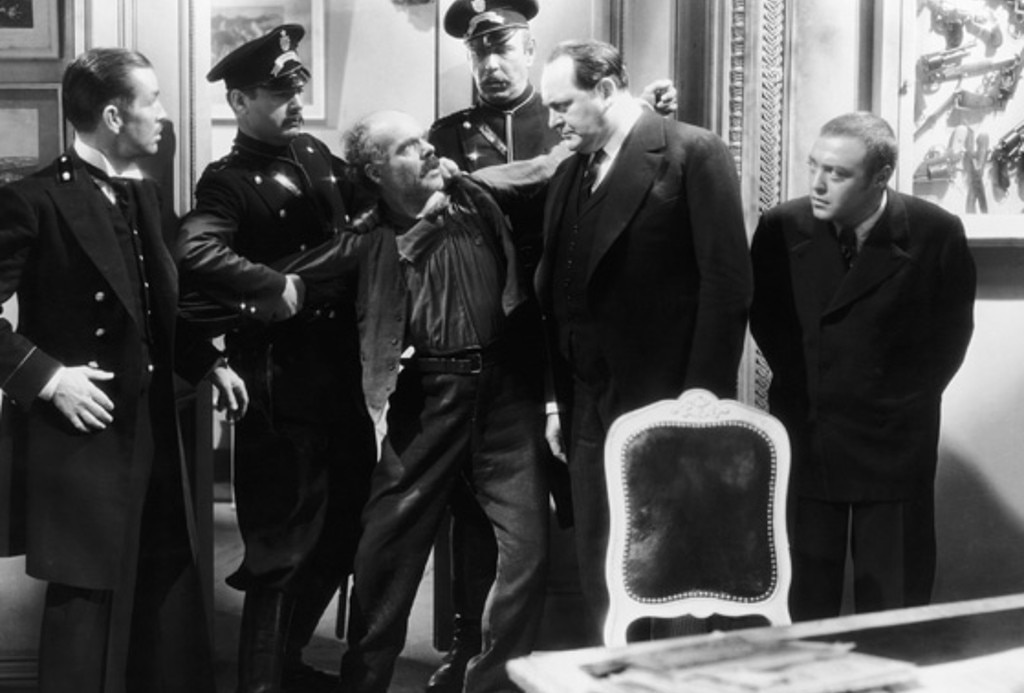
If anything, this almost rudimentary tour through the novel's agonized psychology and ethical struggle plays something like a pre-noir - and it shares a lot of visual and thematic elements with another ultra-cheap tour of hell, Edgar G. Ulmer's Detour (1945). Shot on barely decorated studio sets and shot with confrontational simplicity, von Sternberg's film attends briskly to the book's story: Raskolnikov (still-chubby recent émigré Peter Lorre) graduates from university a brilliant and cynical scholar, but is soon reduced to poverty, as is his family. As his sister contrives to wed a rich fool, Raskolnikov, thinking his intelligence places him on a distinct moral plane, decides to kill an usurious pawnbroker. Afterwards, his guilt and dread eat away at him, as a sporting police chief toys with the culprit, waiting for him to implicate himself or confess.
Of course, in Dostoevsky the action is mostly interior and philosophical, and attending to von Sternberg's film as an adaptation, or anything but a student's introduction to the novel, is a mistake. (Von Sternberg dismissed the movie himself, as he did most of his assignments, saying it was "no more related to the true text of the novel than the corner of Sunset Boulevard and Gower is related to the Russian environment.") In any case, no adaptation of any Dostoevsky novel is an unqualified success; some authors are immune to cinema. (Hollywood takes on classical European fiction are not famous for fidelity at any rate.) Instead, it's a grim, bell-jar dissertation on criminology and personal responsibility, resembling more an experimental play than a typical studio film of the '30s, with its Nietzchean "ubermensch" talk not only beating Chaplin's postwar postures in Monsieur Verdoux (1947), to the punch ("If you wipe out thousands, no one condemns you!" Raskolnikov barks at the individual-vs.-the-state hypocrisy), but echoing the mindset of the Leopold and Loeb murderers a decade earlier.
As is typical of the era, the cast's heavy dose of personality makes the movie compulsive watching. Lorre, so quickly a Warner Bros. character-actor joke that he was often caricaturized for Bugs Bunny cartoons, is surely one of the Golden Era's most distinctive personages, a sweaty homunculus with eyes the size of 8-balls and a desperate whine of a voice that here, under von Sternberg's sotte voce guidance, rarely rises above a self-involved mutter, and then it does rise, to a raspy bellow. (Dietrich also learned how to understate her readings under von Sternberg, speaking so drolly from her diaphragm you barely see her lips move.) Edward Arnold, who gets top billing, plums it up as the affable policeman, but more interesting are Douglass Dumbrille, who brings his typical stalwart sensitivity to the role of a squelched suitor to Raskolnikov's sister, and the all-but-forgotten Tala Birell, who in the thankless sister role is altogether regal, acidic and fascinating. Still, arguably, it's the unseen man behind the camera that dominates the mood, casting about angry and desperate on these cheap sets, looking for the raison d'etre he'd just recently lost for good.
Producer: B.P. Schulberg
Director: Josef von Sternberg
Screenplay: Joseph Anthony, S.K. Lauren (writers); Fyodor Dostoevsky (novel)
Cinematography: Lucien Ballard
Film Editing: Richard Cahoon
Cast: Peter Lorre (Roderick Raskolnikov), Edward Arnold (Insp. Porfiry), Marian Marsh (Sonya), Tala Birell (Antonya Raskolnikov), Elisabeth Risdon (Mrs. Raskolnikov), Robert Allen (Dmitri), Douglass Dumbrille (Grilov), Gene Lockhart (Lushin), Charles Waldron (University president), Thurston Hall (Editor).
BW-88m.
by Michael Atkinson
Crime and Punishment (1935)
by Michael Atkinson | October 21, 2010
SIGN UP FOR OUR NEWSLETTERS

CONNECT WITH TCM