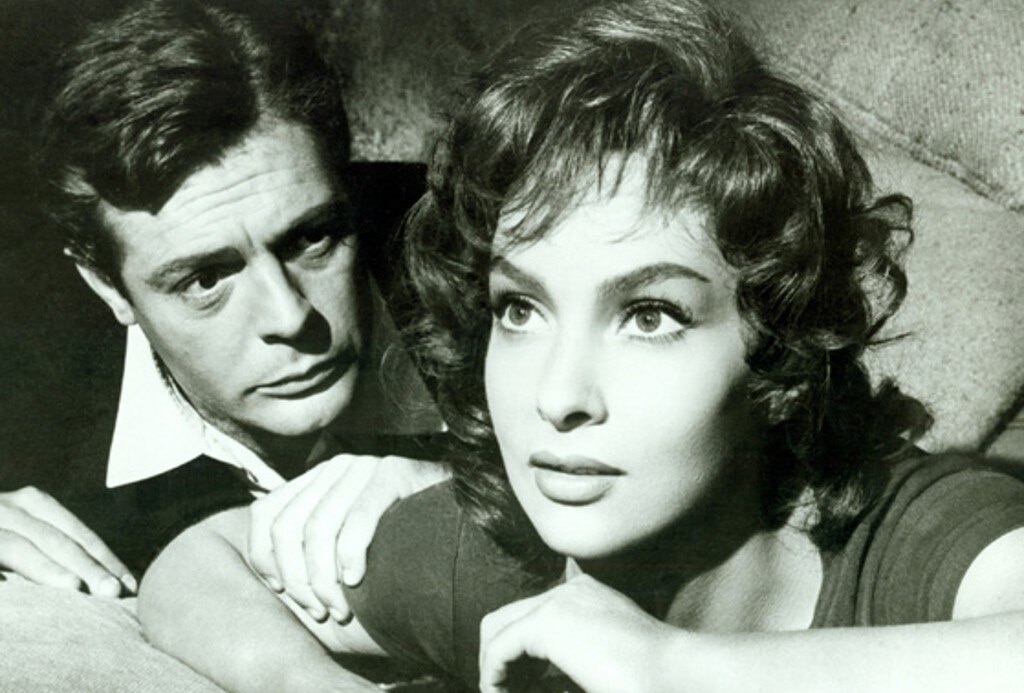
Expatriate American filmmaker Jules Dassin was at the end of his first decade of self-imposed, post-HUAC exile when he made The Law (1959), his fifteenth film and his fourth abroad. This Italian (La Legge) and French ( La Loi) coproduction followed Dassin's well-regarded (and hugely influential ) French caper film Rififi (1955) and marked his first collaboration with Greek actress Melina Mercouri, whom he would marry in 1966 after the international success of their 1960 sex farce Never on Sunday). Based on the award-winning 1957 novel by Roger Vailland, The Law is a quasi-Shakespearean comedy of manners and mores set in the tiny coastal village of Porto Monacore. The story begins in fish-out-of-water mode, with the arrival of big city agronomist Enrico Tosso (Marcello Mastroianni). Charged by the government with the task of draining the region's swamps to reduce the incidence of malaria, Tosso butts heads with local capo Don Cesare (Pierre Brasseur, with a Falstaffian set of whiskers), who uses the marshes as a hunting ground and understands that modernization of any sort will mean the end of his sovereignty. Plot complications arise when Don Cesare's beautiful servant, Marietta (Gina Lollobrigida), sees in Tosso a prospective husband and her ticket out of Porto Monacore. Marietta's affection for the handsome stranger angers racketeer Matteo Brigante (Yves Montand), whose own desire for the girl has been twisted into the compulsion to turn her into a prostitute.
Tales of strangers entering closed communities in which internecine tensions boil beneath a seemingly placid surface translate well to any genre; countless westerns have been made from this logline and the variables can run from the benign and comedic (Bill Forsyth's Local Hero, 1983) to the sinister and shocking (Robin Hardy's The Wicker Man, 1973). Dassin keeps The Law largely on the pastoral side, paying Michael Powell-like attention to the mystical aspects of the local fishing industry and enjoying the intersections and collisions of his dramatis personae of lovers and liars, players and pawns; The restless wife (Mercouri) of the local judge (Dassin regular Teddy Bilis) conspires to run away with Brigante's son (Raf Mattioli, who died tragically the following year), the chief of police (Vittorio Caprioli) betrays his wife (Anna Arena) with her best friend (Lidia Alfonsi, who popped up in "The Telephone" vignette of Mario Bava's Black Sabbath a few years later in 1963), and Marietta swipes 500,000 lire from a Swiss tourist (Herbert Knippenberg) as a dowry towards her dream marriage to Tosso but plants the empty wallet on Brigante after he attempts to rape her. Discovering the plant at the bar of the local cantina, Brigante is too minor a thug to consider returning the wallet and is seen pocketing it by Tonio (Paolo Stoppa), Don Cesare's alcoholic aid-de-camp, who had been humiliated by Brigante the night before in a cruel drinking game called "The Law."
Dassin's attention to textures and detail is the only link to his earlier, documentary-style work on Universal's The Naked City (1948) or Night and the City (1950), which the director shot in England before pressing further into the Continent. The buoyancy of Dassin's subsequent comedies (Never on Sunday and the spritely Topkapi, 1964) is in evidence here, leavened with a soupcon of tragedy (a third act suicide inspired by night table readings of Tolstoy's Anna Karenina).
Dassin had wanted a younger actress for the role of Marietta (and had briefly considered Baby Doll's [1956] Carroll Baker); when the 32 year-old Lollobrigida's participation became a stipulation of the Italian money, Dassin was forced to rewrite his script to suit her. While Lollobrigida was approaching the apex of her international fame, Marcello Mastroianni was between his breakout role in Mario Monicelli's Big Deal on Madonna Street (1958) and his career-defining work with Federico Fellini, beginning with La Dolce Vita the following year. In his cosmetic scars and snap-brim hat, Yves Montand makes for one of cinema's great small town shitheels, whose only weakness is his Adonis-like son Raf Mattioli (who died tragically in 1960, a week shy of his twenty-fourth birthday.) Montand graduated from this supporting role to Marilyn Monroe's leading man in George Cukor's troubled Let's Make Love (1960), during which the onscreen lovers carried on a poorly-concealed love affair.
The Law went unreleased in the United States until after the success of the Academy Award-winning Never on Sunday, after which it was pared down by distributor Joseph E. Levine from its 125 minute run time, dubbed into English and slapped onto a double bill with Phil Karlson's Key Witness (1960) under the lurid title of Where the Hot Wind Blows. Critics and moviegoers were largely indifferent although The New York Times praised the production as "vibrant... consistently arresting... solidly provocative." A complete cut of the film, with subtitles, was released three years later under the original title with no uptake in critical or commercial interest. Derided for its transparent Communist inflections (the film ends with the outcry "No more bosses!"), The Law has never been considered top-flight Jules Dassin and was left out of a 2009 retrospective (commemorating the filmmaker's death in 2008) at New York's Film Forum. Rescued from obscurity for Lincoln Center's 2010 "Rendez-Vous with French Cinema" festival, The Law made its DVD debut later that year, opening up the possibility of a fresh assessment of this flawed but criminally neglected bagatelle.
Producer: Jacques Bar, Maleno Malenotti
Director: Jules Dassin
Screenplay: Jules Dassin (writer); Françoise Giroud (dialogue); Diego Fabbri (uncredited); Roger Vailland (novel "La Loi")
Cinematography: Otello Martelli
Art Direction: Robert Giordani
Music: Roman Vlad
Film Editing: Roger Dwyre, Mario Serandrei
Cast: Gina Lollobrigida (Marietta), Pierre Brasseur (Don Cesare), Marcello Mastroianni (Enrico Tosso, the Engineer), Melina Mercouri (Donna Lucrezia), Yves Montand (Matteo Brigante), Raf Mattioli (Francesco Brigante), Vittorio Caprioli (Attilio, the Inspector), Lidia Alfonsi (Giuseppina), Gianrico Tedeschi (First Loafer), Nino Vingelli (Pizzaccio).
BW- 126m.
by Richard Harland Smith
The Law aka Where the Hot Wind Blows
by Richard Harland Smith | October 20, 2010
SIGN UP FOR OUR NEWSLETTERS

CONNECT WITH TCM