Producer Charles H. Schneer (1920-2009) enjoyed a fruitful partnership with stop-motion animation wizard Ray Harryhausen; their pairing spanned twenty-five years, and resulted in a dozen features (almost all of them for Columbia Pictures). While Harryhausen was occupied with his time consuming post-production animation, Schneer and his company, Morningside Productions, were able to produce other films that didn't require Harryhausen effects. One of the most elaborate and acclaimed of the Schneer-Harryhausen films was the fantasy Jason and the Argonauts (1963). During the lengthy post-production work on that movie, Schneer produced the low-budget adventure Siege of the Saxons (1963) and was able to turn out an economical programmer which served as a co-feature for Jason and the Argonauts, satisfying those exhibitors who required a double-feature program from Columbia.
Schneer and the studio created their cost-effective "epic" by reusing footage from an earlier Columbia adventure film, The Black Knight (1954), which had been filmed in England by director Tay Garnett and starred Alan Ladd alongside a largely British cast. Schneer, who had moved his operation base to London in 1960, filmed Siege of the Saxons at Bray Studios (the home base of Hammer Films), and at Oakley Court castle in Berkshire. Not only was most of the battle footage borrowed from The Black Knight, but various costumes, props, and some plot elements were also transferred to the new production.
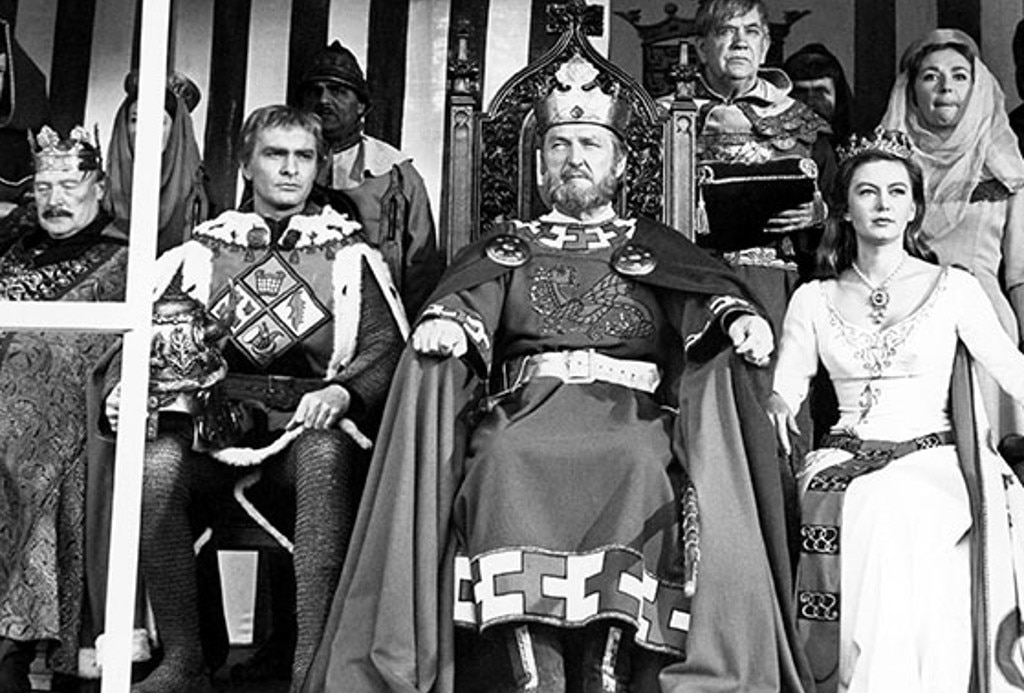
Synopsis: Following a joust in which Edmund of Cornwall (Ronald Howard) wins the prize, King Arthur (Mark Dignam) suffers a seizure. Requiring rest, Arthur and his daughter Katherine (Janette Scott) embark on a journey to a countryside castle. They are waylaid in the forest by Robert Marshall (Ronald Lewis), who intends to rob the party; instead the thief is hired by Arthur as a guide and hunter. Traveling ahead of the party, Marshall is clubbed by The Limping Man (Jerome Willis), a thug in the service of Edmund. Marshall is framed for an attempt on Arthur's life, but he discovers Edmund's plans to attack the castle with men disguised as Saxons, murder Arthur and marry his daughter. Marshall escapes with Katherine; they endeavor to find Merlin (John Laurie) and claim the throne and Excalibur for Arthur's rightful heir.
Siege of the Saxons is often haphazard with folklore and plays loose with factual time periods. Though set in the mythic Romano-British time of Arthur, there are elements of medieval England on view, such as an anachronistic coat of arms that includes the French fleur-de-lys. The film is also one of the several examples of filmed versions of the Arthurian legend that incorporate elements of the Robin Hood mythos. As Kevin J. Harty wrote (in his overview for the book Cinema Arthuriana: Twenty Essays), "The film... has an oblique connection to the legend of a later medieval hero, Robin Hood. While Robert Marshall does not steal from the rich to give to the poor, his status as an outlaw nonetheless loyal to the true king echoes the legendary loyalty of Robin Hood to the absent Richard I, often chronicled on film and television." Siege of the Saxons is also one of several films that eliminates the traditional villain of Arthurian legend - Mordred - in favor of betrayal from one of Arthur's trusted knights.
Director Nathan Juran keeps Siege of the Saxons moving at a steady clip, judiciously spacing action sequences to relieve possible tedium from scenes of exposition. Schneer handed the directorial reins to Juran many times during his long stint for Columbia. The former art director helmed the Harryhausen pictures 20 Million Miles to Earth (1957), The 7th Voyage of Sinbad (1958), and First Men in the Moon (1964) for Schneer as well as such non-genre projects as Hellcats of the Navy (1957), the only film to pair Ronald Reagan with his future wife Nancy Davis. Juran directed several other features apart from Schneer's Morningside Productions, but the two most well-remembered may be a pair of ultra-low budget science fiction films for which Juran used the pseudonym "Nathan Hertz" - The Brain from Planet Arous (1957) and Attack of the 50 Foot Woman (1958).
Top-billed Janette Scott is fondly remembered by science fiction fans for two leading roles of the 1960s, The Day of the Triffids (1962) and Crack in the World (1965). Of the other players, Ronald Lewis proves to be a colorless hero, while Ronald Howard (son of British matinee idol Leslie Howard) and Jerome Willis turn in villainous performances suitable for eliciting boos and hisses at matinee screenings. Columbia promised an epic with its advertising, picturing thundering hordes and a flaming castle on the poster art, along with the tagline, "Saxon legions storm the flaming walls of King Arthur's Camelot!"
Schneer and Juran turned out another low-budget epic for Columbia the following year called East of Sudan (1964). This film also reused footage from an earlier, larger-budgeted adventure movie, in this case the classic Korda brothers production of The Four Feathers (1939). It went out as the second feature to the Schneer-Harryhausen production First Men in the Moon.
Producer: Jud Kinberg (producer); Charles H. Schneer (producer, uncredited)
Director: Nathan Juran
Screenplay: John Kohn, Jud Kinberg (writers)
Cinematography: Wilkie Cooper, Jack Mills
Art Direction: Constable
Music: Laurie Johnson
Film Editing: Maurice Rootes
Cast: Janette Scott (Katherine), Ronald Lewis (Robert Marshall), Ronald Howard (Edmund of Cornwall), John Laurie (Merlin), Mark Dignam (King Arthur), Jerome Willis (The Limping Man), Francis De Wolff (The Blacksmith), Charles Lloyd Pack (The Doctor), Peter Mason (Young Monk)
C-85m.
by John M. Miller
Siege of the Saxons
by John M. Miller | October 20, 2010
SIGN UP FOR OUR NEWSLETTERS

CONNECT WITH TCM