Hollywood has always shown a nostalgic bent and has never been averse to feeding upon itself. Since the American film industry's
inception in New York, old scenarios have been routinely respun, retooled and rebooted. Films both popular and obscure have been
remade or simply re-released when the rights holders deemed it potentially profitable. In the late 1950s, Hollywood studios
opened up their film vaults to provide broadcast material for television, and in so doing reintroduced their back catalogues to
new and receptive audiences. As creaky horror movies of the Thirties and Forties were revived under the auspices of the
syndicated Shock Theatre and dusty cowboy pictures rerun on the small screen due to the popularity of such weekly westerns
as The Lone Ranger (ABC, 1949-1957), Gunsmoke (CBS, 1955-1975) and Wagon Train (NBC 1957-1962), so silent
films were championed afresh a full generation after the advent of talking pictures. References and homages to silent films began
creeping into popular American entertainment throughout the 1950s, in such films as Billy Wilder's Sunset Blvd. (1950), in
William Castle's The Tingler (1959) and in Abbott and Costello Meet the Keystone Kops (1955), which boasted a cameo
by slapstick pioneer Mack Sennett.
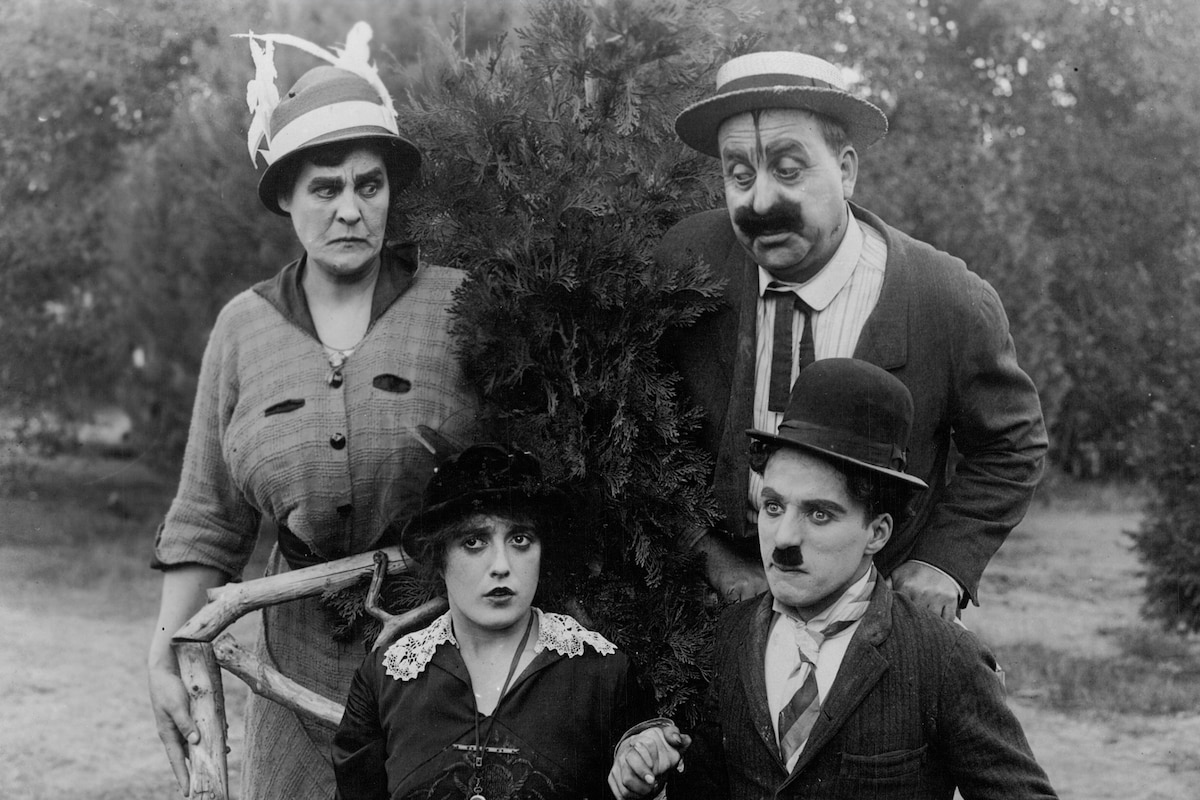
Robert Youngson's When Comedy Was King (1960) is an affectionate and reverential anthology of manic scenes from classic
silent film comedies, featuring such iconic performers as Charlie Chaplin, Laurel & Hardy and Buster Keaton, alongside the
forgotten likes of Harry Langdon, Edgar Kennedy, Mabel Normand and Roscoe "Fatty" Arbuckle. The film was Youngson's second
theatrical compilation of existing material related to the silent film era. The Golden Age of Comedy (1957) had rekindled
public interest in the cinematic partnership of Stan Laurel and Oliver Hardy. (Hardy had died in 1957 and a quietly retired
Laurel would follow in 1965.)
In retrospect, the documentary proved invaluable for its inclusion of the classic pie fight scene (in condensed form) from Laurel
and Hardy's lost short The Battle of the Century (1927); shortly after Youngson duped the sequence for use in his own film,
the negative for The Battle of the Century decomposed entirely. The success of The Golden Age of Comedy ensured a
follow-up and When Comedy Was King hit movie screens scarcely two years later.
Born in Brooklyn, New York, in 1917, Robert Youngson received a master's degree in business administration from Harvard University
after undergraduate studies at New York University. While attending Harvard, his 16mm short subject Smoke Dreams (1940),
which depicted a young woman's hallucinatory reaction to smoking marijuana, received the Harvard Film Society Award and a cash
price of fifty dollars. Youngson went to work editing newsreels for Pathé News in 1941 and returned to it after his military
service in World War II. When Pathé was sold by RKO to Warner Brothers in 1947, Youngson was retained as a writer-producer of
short subjects, notably the Sports News Review and Vitaphone Novelties one-reelers. Nominated for five Academy
Awards for "Best Short Subject" between 1951 and 1957, Youngson won twice, for World of Kids (1951) and This Mechanical
Age (1954), the latter a look back at some of the less successful pioneers of early aviation. Largely forgotten now, Youngson
had sufficient industry clout in the spring of 1960 to receive name-above-the-title status on theatrical one sheets for When
Comedy Was King, which also trumpeted his early Oscar® wins.
The demand for contemporary retrospectives highlighting the silent epoch kept Robert Youngson busy throughout the decade, during
which he was responsible for no less than six additional feature length compilations, among them Days of Thrills and
Laughter (1961), MGM's Big Parade of Comedy (1964) and his final, Four Clowns (1970). It seems sadly ironic that
a filmmaker so devoted to preserving a neglected art form that he would make it the focus of his own career would be forgotten so
swiftly after his death but such was the case of Robert Youngson. The filmmaker's untimely demise in New York in April of 1974
went largely unnoticed, apart from a special, posthumous citation from the National Board of Review for "his 25 year work with
tasteful and intelligent compilation of films."
Clearly, obsession was something that ran wildly in the Youngson family. The anthologist's Oxford and Sorbonne-educated widow,
Jeanne Keyes, founded and served as president of The Count Dracula Club (now The Vampire Empire Club) and The Bram Stoker Memorial
Association, opened a Count Dracula Museum in New York City (located now in Austria) and in 1986 founded The International Society
for the Study of Ghosts and Apparitions.
Producer: Robert Youngson
Director: Robert Youngson
Screenplay: Robert Youngson
Music: Ted Royal
Cast: Roscoe 'Fatty' Arbuckle, Wallace Beery, Charles Chaplin, Buster Keaton, Harry Langdon, Edgar Kennedy, Mabel Normand, and
other silent stars.
BW-82m.
by Richard Harland Smith
Sources:
The Harvard Crimson, May 29, 1940
The Film Encyclopedia by Ephraim Katz
When Comedy Was King
by Richard Harland Smith | October 07, 2010
SIGN UP FOR OUR NEWSLETTERS

CONNECT WITH TCM